
Stieg Larsson Was a Bad, Bad Writer
I was on vacation last week, and since it involved spending one day flying across the country and another day flying back, I decided to bring along the galleys of The Girl with the Dragon Tattoo, The Girl Who Played with Fire, and The Girl Who Kicked the Hornet’s Nest that had been taking up space in my bookshelves since the first one arrived two years ago—reading and shedding, that was the plan! I was ready to see for myself what all the fuss was about… except, as I quickly discovered just a few pages into the first volume, the Millennium trilogy is the worst batch of fiction to reach #1 on the bestseller lists since—well, I don’t know how long it’s been. If you’ve known me for a long time, you know that I don’t think much of Dan Brown as a prose stylist, so when I say that Stieg Larsson isn’t even remotely as good a writer as Dan Brown, you have some sense of exactly how bad I think he is.
But let’s make it plainer: I don’t know how the editors at Alfred A. Knopf expect me to view a novel in which the narrator uses the construction “irrespective of whether [A] or [B]” as resembling anything like a display of literary prowess, and frankly if it weren’t for having read Carl Hiaasen’s excellently satirical Star Island just before going on vacation, I would have to seriously consider the possibility that the publication of Stieg Larsson was evidence of a lack of literary discernment on Knopf’s part.
(I am emphatically not blaming “Reg Keeland,” the translator of the three Larsson novels, for the atrocious prose, because Steven T. Murray has been quite vocal about how the British editors tampered with his first pass at the material, and enough British English remains in the Knopf editions that I doubt they spent much time or energy on making things better.)
20 August 2010 | uncategorized |
Read This: Scott Pilgrim’s Finest Hour

All the subtle clues Bryan Lee O’Malley has sprinkled throughout the previous five volumes of the series come to a head in Scott Pilgrim’s Finest Hour, as he finally confronts the fact that he’s not such a peppy video-game hero—what has often seemed, throughout the story, as spontaneous, upbeat and wacky is finally revealed as a deliberate refusal to acknowledge his mistakes and grow through them—an undertaking so comprehensive that he’s actually written over his own memories, from the high school battle with Simon Lee to the unraveling of his relationship with Envy. (This calls the gaming aspects of the Pilgrim universe into question momentarily, but not so much that the final showdown with Gideon won’t turn into a sprawling epic.)
What started out as a cutesy metaphor in Scott Pilgrim’s Precious Little Life has gradually shifted into a serious meditation on emotional maturity, arrested development, and adult relationships. (And, if I’m not mistaken, the field of cultural references has expanded: Are those Brazil and Crouching Tiger, Hidden Dragon allusions I see in the artwork?) The last three volumes of the graphic novel diverges significantly from the movie—which is in large part due to O’Malley’s spreading the story out over several months, while Edgar Wright compresses the action into a few days—and that winds up giving the books far more opportunity to explore Scott’s emotional development. Although Michael Cera does a great job of revealing what a self-absorbed jerk Scott can be, the character’s self-discovery is almost completely elided over, more of a loose-end tie-up than an actual resolution. As much as I enjoyed the movie, I highly encourage you to track down the books, and dedicate at least one weekend to engrossing yourself in them.
19 August 2010 | read this |
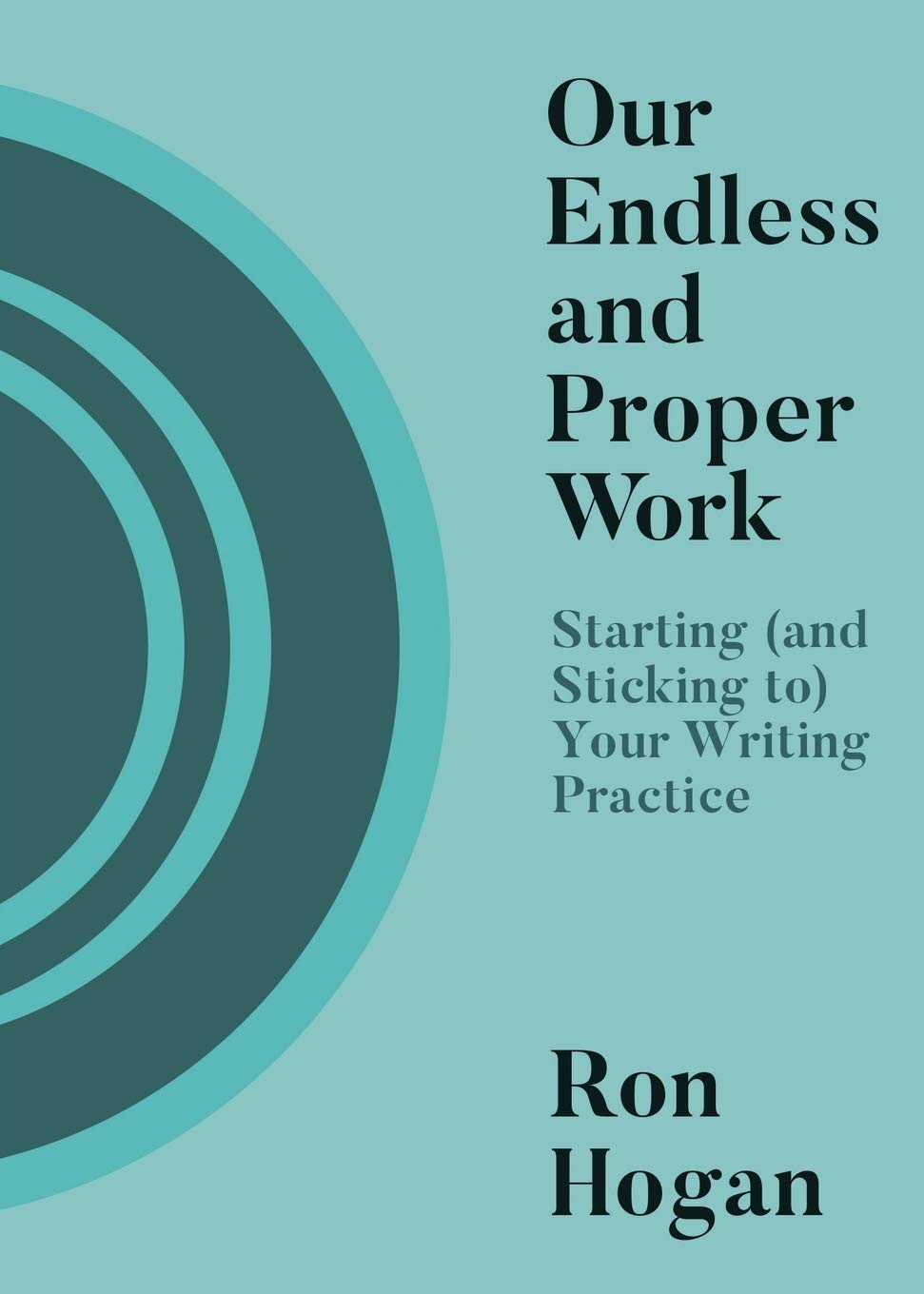 Our Endless and Proper Work is my new book with Belt Publishing about starting (and sticking to) a productive writing practice.