
Read This: Scott Pilgrim Vs. the Universe

When I talked about Scott Pilgrim Gets It Together, I discussed how Bryan Lee O’Malley was moving the focus of the story away from the pyrotechnic battles into more serious emotional terrain. As the fifth volume, Scott Pilgrim Vs. the Universe, gets underway, the battles with the evil exes have become so incidental that O’Malley literally treats Scott’s fight as a background element.
Things don’t stay that way—but when the main fight takes place, about halfway through the volume, O’Malley sets it up as a deliberate echo of a flashback scene from Scott Pilgrim Vs. the World, as Scott is forced to rescue his best friend, Kim, from the Katayanagi twins in a scenario staged much like his high school rescue of Kim from the evil Simon—and he’s only able to win that battle because Kim sets up a fantasy about his relationship with Ramona… but the fighting isn’t enough to keep Ramona around, as the truth about Scott’s muddled transition from dating Knives to dating Ramona finally comes to light. (Here the graphic novels linger on the narrative beats much longer than the film: Although Ramona does bail on Scott in both cases, he spends a lot more time moping here, and in the process almost completely eradicating the fantasy elements of the story—now, when he tries to fight his way through his problems, it just looks ridiculous.)
Yes, we can be reasonably certain Scott’s going to pull himself together for the final showdown, but it’s unclear at the end of this volume what that’s actually going to mean, and how Ramona’s going to fit back into the story…
18 August 2010 | read this |
Read This: Scott Pilgrim Gets It Together
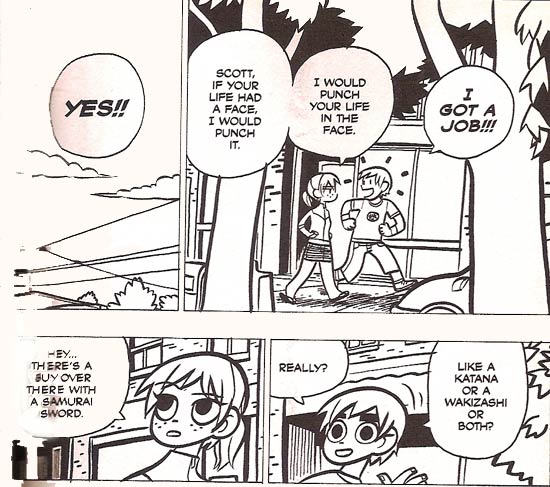
NOTE: Very little of Scott Pilgrim Gets It Together makes it into the movie, and what does turn up does so in a highly altered/condensed form.
Which is a bit of a shame, really, because this installment of the story puts Scott Pilgrim’s love for Ramona to a test more real and more serious than the battles with the seven evil exes—the return of his best friend from high school, the girl he never dated but maybe could’ve/maybe should’ve. Also, he’s working on proving to Ramona that he’s not a slacker by getting a job… which turns out to be way too easy, something we could say about a lot of Scott’s life. The other aspect of this book that is most unfortunately lost from the movie is the nuance of Scott’s friendship with Kim (seen above)—that also goes back to high school (as we saw back in Scott Pilgrim vs. the World). Events in this book make it clear that the urban fantasy elements framing Scott and Ramona’s relationship are “real” enough that Kim can experience them, too—so this isn’t all just in Scott’s head.
It started building up in Scott Pilgrim and the Infinite Sadness, but this is the point where it becomes so clear Bryan Lee O’Malley is using shonen manga and video game metaphors to tell a very serious story about emotional maturity. One of my favorite bloggers, Chris Sims, wrote a fascinating essay last week about why making the Archie gang grownups doesn’t work: “If you make him the typical aimless twentysomething, his relatable problems suddenly aren’t that funny.” And that may be true of the Archie characters because of the decades of accumulated cultural relevance they’ve acquired, but Scott Pilgrim and his friends don’t have that restraint; we’re getting to know them for the first time, so while it may be disconcerting to have the comic veer from “Big Battle as metaphor for relationship issues” to “serious conversations about relationship issues,” it’s a narrative bait-and-switch that totally works.
17 August 2010 | read this |
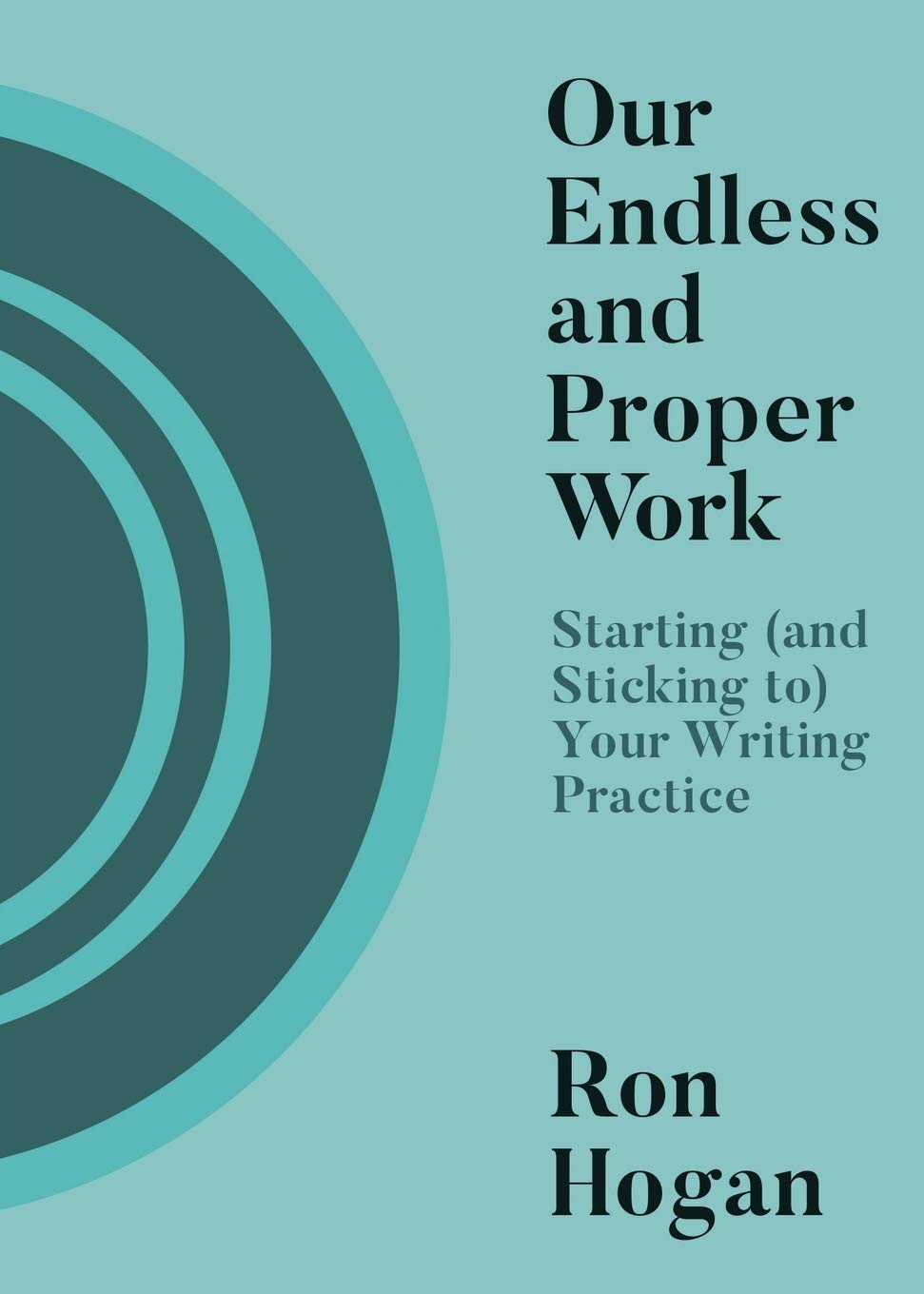 Our Endless and Proper Work is my new book with Belt Publishing about starting (and sticking to) a productive writing practice.