Stephen O’Connor & the Constant Flux of “The Country Doctor”
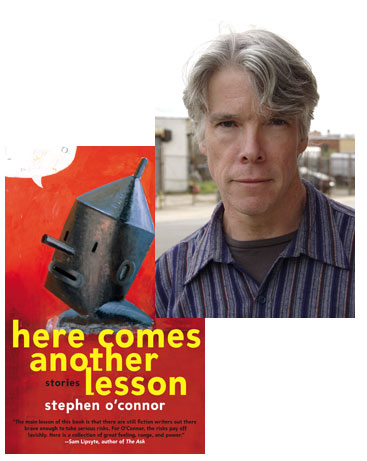
One of the things I love about the stories in Stephen O’Connor’s new collection, Here Comes Another Lesson, is the way the scenes play out in staccato bursts—check out “Ziggurat,” in which a Minotaur wandering through a postmodern Labyrinth happens upon a teenage girl who isn’t nearly as terrified of him as perhaps she ought to be, and you’ll see what I mean. (The story right after it in the collection, “White Fire,” deploys much the same tactic in a more psychologically realistic fashion, as a soldier coming home from Iraq struggles to get his life back the way it was; it’s so effective that you might miss the sheer brutality of his failure the first time you read through, only to have it hit you at the story’s end. And then there’s the sequence of stories sprinkled throughout the book featuring Charles, “the professor of atheism,” who fumbles through a variety of scenarios that sorely test his lack of belief in the divine. Whether he’s writing in a surrealist or a realist mode, there’s a dream-like quality to O’Connor’s prose that will remind many readers of Kafka—no accident, as O’Connor reveals in this essay about the inspiration he found in a particulary vivid Kafka short story.
The first time I read Franz Kafka’s “A Country Doctor”—at around age twelve—I had the distinct impression that I was discovering myself, that in his language and images, and in particular in his always surprising juxtapositions and narrative turns, I was experiencing something essential about the way I was and wanted to be in this world.
The story opens with a long, breathless sentence:
“I was in a great perplexity; I had to start on an urgent journey; a seriously ill patient was waiting for me in a village ten miles off; a thick blizzard of snow filled all the wide spaces between him and me; I had a gig, a light gig with big wheels, exactly right for our country roads; muffled in furs, my bag of instruments in my hand, I was in the courtyard all ready for the journey; but there was no horse to be had, no horse.”
By the time I reached the end of this sentence, I already had a sense of the terrific understatement that its first six words would soon turn out to be. I could feel the narrator’s barely suppressed hysteria through his repetitions (“a gig, a light gig;” “no horse to be had, no horse”), through the intensity of his adjectives and adverbs (“great,” “urgent,” “seriously”), and in the way six short sentences had been jumbled into one outburst. What is more, I had a sense that neither the narrator nor the world in which he existed was quite normal. Why had he bothered, for example, to emphasize what we would have expected: that his gig was suitable for the local terrain? And why was he waiting in his frigid courtyard when, not merely was his gig still unhitched, there was no horse for it? And then there was the simple oddness of a doctor, a man of science, alone, “muffled in furs,” passively waiting for fate to change, and the peculiar implication that, since the blizzard only “filled all the wide spaces between” one place and another, it had somehow stayed outside the boundaries of each.
This was a world in which things could go very wrong (people became seriously ill, horses vanished) and in which one was deprived even of the consoling expectation that people and things would behave in a normal, predicable and rational way—a world in which one could accept that the doctor’s “perplexity” was “great” indeed, and expect that it would only become greater.
23 August 2010 | selling shorts |
What’s New with Getting Right with Tao
 It’s been a few months since Channel V Books and I got together to publish Getting Right with Tao, a print edition of my modern adaptation of the Tao Te Ching, and it’s been exciting to see how the book continues to strike a chord with readers—like a post earlier this month at the American Taoist blog, which looked at three chapters in my version to consider the neutrality of Tao. I’m particularly excited by a new project that’s taking shape at The Rambling Taoist: a line-by-line analysis of the Tao Te Ching that juxtaposes my version with more established translations by James Legge, Derek Lin, and Gia-fu Feng and Jane English—this last likely being one of the most well-known apart from the Stephen Mitchell.
I read through a lot of different translations of the Tao Te Ching as I was writing my adaptation, but that was a long time ago… and, in any event, it’s very illuminating for me to see what somebody else who’s spent much more time than I have thinking about Taoism thinks of my effort, and how the message I was trying to impart holds up against Lao Tzu’s original wisdom. This line-by-line approach is clearly going to take a while; it’s nearly two weeks in, and we’re still on the second chapter. But I’m looking forward to what I might learn from the Rambling Taoist as his exegesis unfolds.
22 August 2010 | uncategorized |
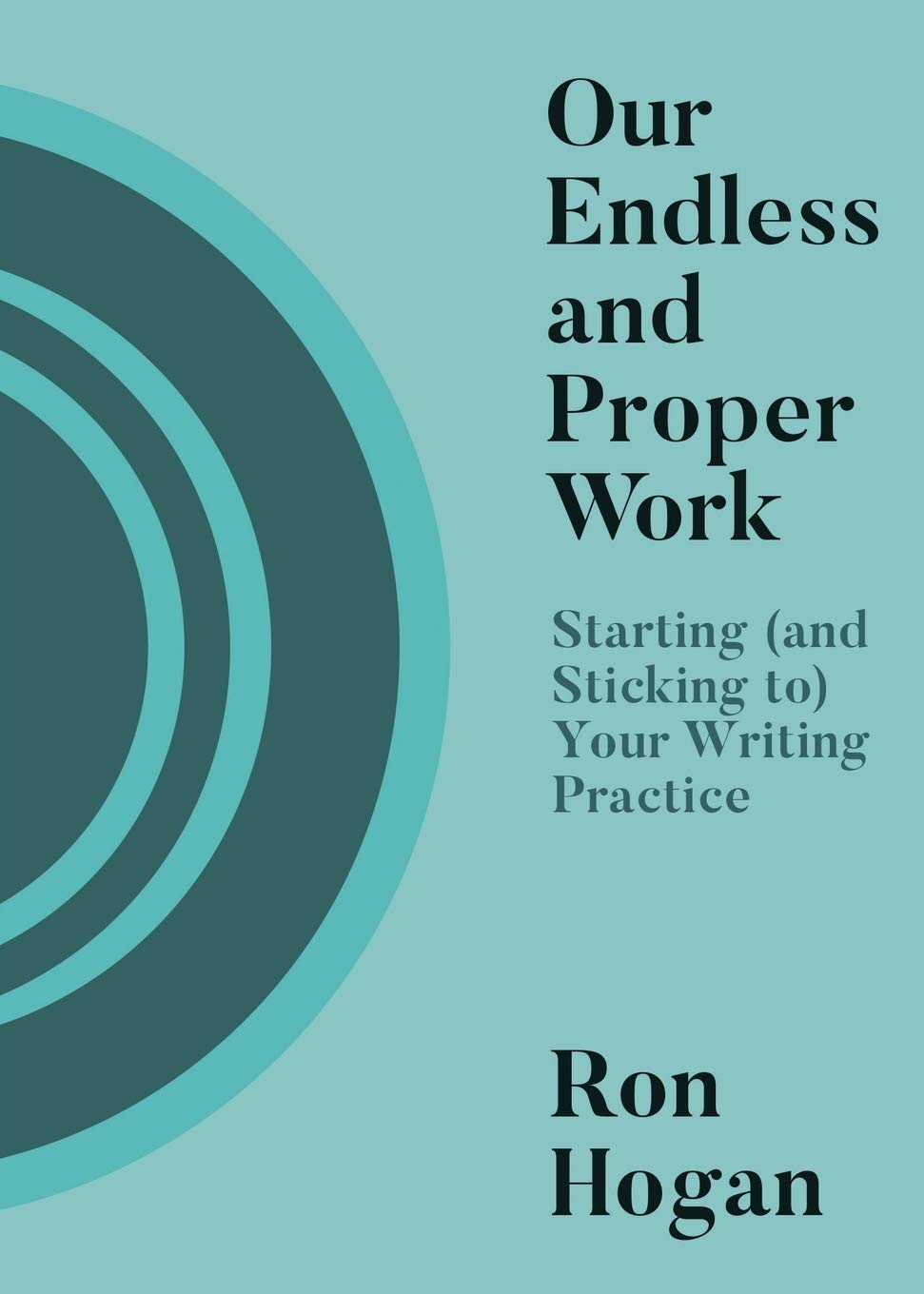 Our Endless and Proper Work is my new book with Belt Publishing about starting (and sticking to) a productive writing practice.