
Elizabeth Alexander, “The Texas Prophet”
I am the Texas Prophet who is now in Baltimore.
God blesses those that see me and I’m coming to your town.
I guarantee you without fail a straight and one-way blessing.
I come to bring you luck and by your popular demand.I’m bringing Mojo hands for those of you can’t win for losing.
All manner of disease is healed. Cash money falls like rain.
If I were you I would come early. He can’t stay all night.
Those who know me know I am no money-hungry Prophet.I am the Texas Prophet who is now in Baltimore.
I’m bringing good luck talismans and guarantee my work.
Keep looking up keep looking up His help is on the way.
Yours in spirit and in love The Prophet John C. Bates.
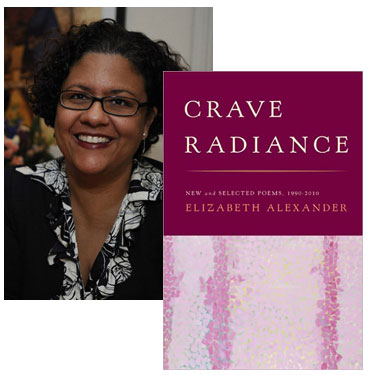
Crave Radiance collects twenty years’ worth of poems from Elizabeth Alexander, including “Praise Song for the Day,” which she read at the inauguration of President Barack Obama. Up until then, she was perhaps best known as the author of “The Venus Hottentot,” about which Ta-Nehisi Coates has written, “I’m embarrassed to say that I hated this poem when I first read it. But I was young and foolish. I knew better after I read it ten more times… This is, to my mind, one of the best meditation I’ve ever read on black women and the loss–and I guess reclamation–of control of their physical selves.”
The Academy of American Poets presents some other poems included in this collection: “Blues,” “Haircut,” and “Ladders.” Alexander’s own website also features poems from throughout her career.
1 October 2010 | poetry |
The Liberal Backlash Against Freedom
 I’ve recommended Freedom, the new Jonathan Franzen, but I’m not one of those people who thinks it’s an “instant masterpiece.” As a novel, it has some hefty flaws, but the fact remains that Franzen knows how to tell a compelling story, even when he’s cramming Big Issues into the narrative in what comes across as an effort to connect his domestic dramas to the larger world and thus imbue his fiction with larger significance. So when I come across something like B.R. Myers’s condescending pan of Freedom in The Atlantic, about the only thing I can do is shake my head and wonder how somebody can get things so wrong.
Which isn’t to say Myers isn’t right sometimes—such as the Big Issues problem cited above:
“Instead of portraying an interesting individual or two, and trusting in realism to embed their story naturally in contemporary life, the Social Writer thinks of all the relevant issues he has to stuff in, then conceives a family ‘typical’ enough to hold everything together. The more aspects of our society he can fit between the book’s covers, the more ambitious he is considered to be.
I for one would be very happy if the word “ambitious” were to vanish from the collective consciousness of America’s book reviewers, that’s for sure. Mind you, I don’t think Myers would agree with me that it’s this trust in realism (with some dramatic flourishes) that makes novels like Jennifer Weiner’s Fly Away Home interesting and worth talking about in the same breath (or at least the same newspaper sections) as anointed works of genius like Freedom—but that’s because of the broader strokes in his snobbish approach to both literature and culture, starting with Franzen’s use of the word “fucking,” continuing through his utter contempt for the novel’s female lead—who may be seriously troubled, and who may also be unconvincingly delineated by her author, but who is hardly “too stupid to merit reading about”—leading up to the notion that “too much of Freedom takes place in high school, college, or suburbia,” expanses of American culture that are not, in Myers’ estimation, worth writing about as they “change the least.” Uh huh.
30 September 2010 | theory |
 Our Endless and Proper Work is my new book with Belt Publishing about starting (and sticking to) a productive writing practice.




