
Read This: The Poetry Home Repair Manual
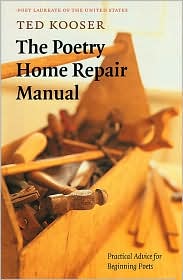
“A poem is the invited guest of its reader. As readers we open the door of the book or magazine, look into the face of the poem, and decide whether or not to invite it into our lives. No poem has ever entered a reader’s life without an invitation; no poem has the power to force the door open. No one is going to read your poem just because it’s there.”
It may seem unusual to start a set of National Novel Writing Month reading recommendations with a book of “practical advice for beginning poets,” but Ted Kooser’s The Poetry Home Repair Manual has a great deal of useful advice for fiction writers as well. I’m thinking chiefly of Kooser’s principle of poetry as communication, that “[its] purpose is to reach other people and touch their hearts.” For Kooser, that leads you to think of the chosen reader—the imaginary audience you believe will be most receptive to your poems. Who are those readers? What are they looking for? And how can you best deliver your message to them? That’s something that fiction writers would do well to consider as well… and that doesn’t mean, he emphasizes, that you need to pander or reduce your writing to the lowest common denominator. If your imagined reader isn’t afraid of a little difficulty, a little ambiguity, work with that!
(And, on a technical level, too, Kooser’s advice to throw out all the “spare parts” and focus on what matters, to discover inner feelings by writing about what’s observable, or to rein in the reader’s imagination with a well-chosen adjective are as applicable to prose as they are to verse.)
The quote I’ve chosen to share may seem a bit harsh, but it’s also something that’s very important for anybody who’s taking part in NaNoWriMo to remember. I’m not saying you can’t write just for yourself this month; in fact, one valuable function of NaNoWriMo may very well be the opportunity to prove to yourself that you can write a novel, even if that particular novel isn’t one that you’d ever publish. If you are hoping to share the results of the next thirty days (and, most likely, much subsequent revision) with other readers, though, keep in mind that the novel needs to make sense to someone else besides you. I’ve sometimes given the advice (hardly original to me) that you should imagine the type of fiction you’d most to read but aren’t finding from other authors, then write that. To that, with this in mind, I would add that such fiction shouldn’t be a private gift, for your eyes only. As Kooser observes, “The more narrowly you define the reader, the more difficult it will be to put your poem someplace where that reader might come upon it…. the more difficult it becomes for your poem to contact him or her.”
1 November 2010 | books for creatives, read this |
W.S. Merwin: Poetry & What Can’t Be Expressed
 Last Friday night, Mrs. Beatrice and I had the pleasure of attending a New York Public Library event featuring W.S. Merwin, just a few days before his official appointment as the new U.S. Poet Laureate began. In a conversation with NYPL public programming director Paul Holdengräber, Merwin went all the way back to the beginning to discuss his love for language, starting with how he had learned to read when he was three (or maybe four?) from a book that had drawings of Native Americans living in the forests (which, back on the NYPL stage, soon got him to thinking about the lost lyric poetry of Native America). He got to thinking about poetry as “language about what cannot be said,” citing the notion that “the more one wants to express gratitude, the less adequate the words are,” and about poetry as an expression of the idea that whenever we look at something, we are seeing it both for the first time and the last time.
Holdengräber asked Merwin about the time when, as a young adult, he met with Ezra Pound at St. Elizabeth’s—”it wasn’t violent like Christopher Smart’s Bedlam would have been, but it was pretty weird”—and Merwin reflected that “we all owe [Pound] somethng enormous,” adding that every poet of his generation, upon reading Pound’s translation of “The River-Merchant’s Wife,” must have felt moved by the imagery and the language. Pound encouraged the young Merwin, who hadn’t yet acquired the life experiences to write meaningful poetry of his own, to work on translation, steering him towards the Provencal troubadors; years later, Merwin got another valuable bit of advice from Clarence Brown, who worked with him on putting the poems of Osip Mandelstam into English: “Don’t worry about it—no translation ever spoiled the original.” (Merwin also read a more recent translation, “Little Soul.)
Finally, Merwin talked a bit about his initial ambivalence towards the laureateship—”I’m not going to come to Washington and spend a lot of time wearing a suit and all that”—and why he finally decided to accept: “I’m horrified with our behavior towards the rest of life… denying global warming, at this point; I mean, honestly.” He hopes, through this public role, to be able to say: “Look, there’s another way of looking at the world… The feeling of being part of life itself is one of joy and elation.”
26 October 2010 | events |
 Our Endless and Proper Work is my new book with Belt Publishing about starting (and sticking to) a productive writing practice.