Why Criticism Matters (Or Will, When It’s Done Right)
In the summer of 2010, as the mainstream literary media began its celebration of Jonathan Franzen’s Freedom, Jennifer Weiner and Jodi Picoult commented as to how that hoopla was part of a trend among publications like the New York Times Book Review, which appear to consistently favor male authors over their female counterparts. After months of refusing to seriously address this issue, even when independent observers proved the Times book desks do have a distinct gender bias, the editors of the Review, in the midst of defending their mission, decided to take a swipe at them by declaring that a “serious critic” is “not interested, say, in tabulating the number of ‘Brooklyn novelists’ who receive attention each year in publications like this one.” Whether the serious critic possesses a penchant for petty oneupmanship was, however, uncommented upon.
Let’s set aside the snark from West 43rd Street, though, and see what the guest experts they recruited to defend literary criticism bring to the table.
Stephen Burn starts with the historical big picture, observing how the Internet has facilitated forums for public discourse which demonstrate not only the existence of a broad audience for literature but its vitality. “The age of evaluation, of the Olympian critic as cultural arbiter, is over,” Burn warns, and critics “who like to issue dogmatic rulings… and to chastise writers… merely add to the noise of culture.” What’s more, he adds, “it’s time to hear less of critics talking about themselves, spinning reviews out of their charming memories or using the book under review as little more than a platform to promote themselves and their agendas.” All of which is true—and echoed by Pankaj Mishra’s assertion that “literary criticism, in its recent American incarnation at least, has faithfully reflected the general writerly retreat from the public sphere, turning into a private language devised to yield a particular knowledge about a self-contained realm of elegant consumption.”
It’s unclear whether mainstream reviewing is fully capable of Burn’s ambitious goals to move beyond the evaluation of texts; as Adam Kirsch points out in his contribution, the critic as commonly understood today usually has to be a journalist and a consumer advocate first, discussing why newly published books are significant and worthy or unworthy of your purchase, and then, if there’s any time or space left, he or she can tackle “[saying] somethng true about life and the world,” using somebody else’s writing as a springboard for “self-understanding, self-expression, [and] truth.” (Which, he adds, he’s not sure anybody is still doing anymore.) But I’d also suggest that the lively readership Burn cautiously celebrates, the band of “common readers” Kirsch isn’t sure still exist, is already fulfilling, here and there, Burn’s “most important” aspiration: “locating major works that are not always visible in mainstream networks.” The problem for us readers, and it’s a big problem, is knowing where to look.
2 January 2011 | theory |
Looking for Some Great Reads from 2010?
Earlier this month, Shelf Awareness published a list of ten of my favorite books from 2010, including some novels by authors I’d had a chance to tell you about on Beatrice before, like Lauren Grodstein and Paul Murray. (And I’m seeing now, as I look those links up, that Grodstein’s A Friend of the Family was actually released in late 2009, but luckily Shelf Awareness was flexible on the whole publication date thing anyway. So it’s all good!) There were also some titles I hadn’t said much about here, like Cory Doctorow’s For the Win or Victoria Dahl’s A Little Bit Wild. But there was also a whole other category of books I left off that list, so I wouldn’t have to keep writing variants of “Full disclosure: So-and-so is a friend of mine” over and over. (It’s sort of a gray area, because some of the authors who did make the list I know well enough to say hi to in a friendly manner, but I did my best to approach the task fairly.)
Here, though, I can just tell you: My friends wrote some fabulous books in 2010, and I’m going to tell you about some of them, but I’m writing this on the fly the night before New Year’s Even, so I’m probably going to miss a bunch, so if you thought for sure you were going to see your book mentioned in this post and it winds up not being here, it’s not intended to be a knock, I promise!
First, it was a productive year for my co-hosts at Lady Jane’s Salon, the monthly romance reading series we run at Madame X in Manhattan: Hope Tarr published The Tutor, Maya Rodale came out with A Groom of One’s Own, and Leanna Renee Hieber released The Darkly Luminous Fight For Persephone Parker. We had some fantastic readers at the Salon, too, like Sarah MacLean, who released both Nine Rules to Break When Romancing a Rake and Ten Ways to Be Adored When Landing a Lord this year; Lauren Willig also had two novels out in 2010, The Betrayal of the Bloody Lily and The Mischief of the Mistletoe.
31 December 2010 | uncategorized |
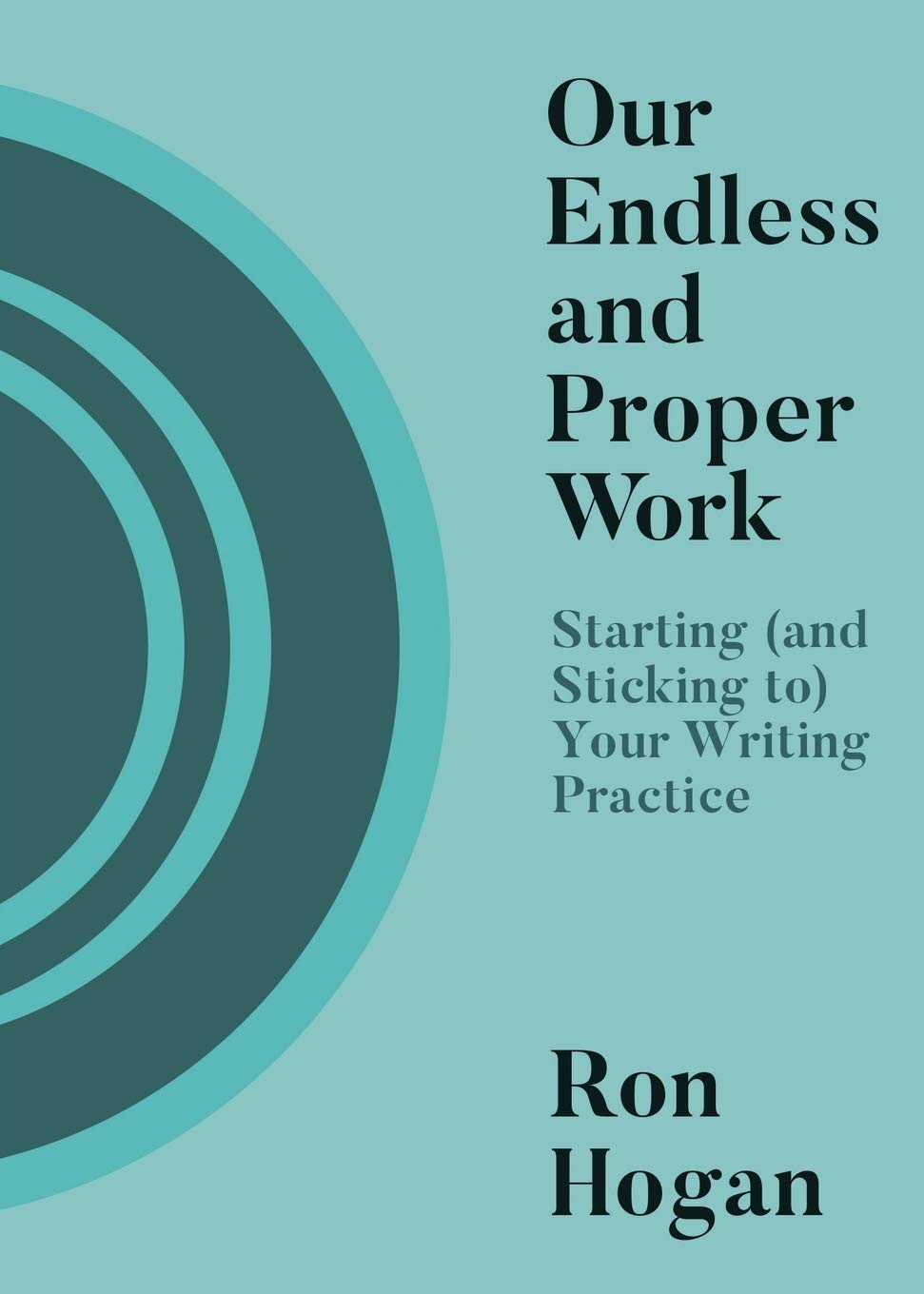 Our Endless and Proper Work is my new book with Belt Publishing about starting (and sticking to) a productive writing practice.