
Watch This: Midnight in Paris

Earlier this month, a publicist for the new Woody Allen movie, Midnight in Paris, asked if I wanted to come to an advance screening—she knows I don’t write much about movies on Beatrice, but, she hinted, there was something in the film I’d likely find very entertaining. I was game, so two weeks ago I dropped by a midtown screening room to see what was what. I’ll admit that it didn’t get off to an especially good start: The relationship between Owen Wilson’s Gil, a screenwriter struggling to reconnect with his literary ambitions, and Rachel MacAdams’s Inez, who doesn’t seem to do much besides have wealthy parents, is quite obviously doomed, what with her constantly undercutting his dreams privately and in front of her (decidedly not their) friends. I don’t mind stacking the narrative deck a bit, but there’s such a thing as overdetermination, after all.
Still, I figured the publicist was thinking about something bigger than “Gil’s a writer” when she invited me, and, sure enough, about a third of the way into the picture, Gil pauses on a Paris side street and finds himself in the era for which he’s most nostalgic, the “Movable Feast” of the 1920s. A lot of historical cameos ensue; none of them have any particular dramatic punch, but some of them are greatly entertaining; Corey Stoll, for example, does an excellent job of delivering Ernest Hemingway’s lines in a Hemingwayesque manner, and Adrien Brody is clearly having fun in his one scene as Salvador Dali. Of course, if there were nothing more to Gil’s trips back and forth in time than the “postcards from the Lost Generation” vibe, things would get boring fast, so it makes perfect dramatic sense that on his second night in the past, he should become infatuated with Picasso’s latest mistress, Adriana (played by Marion Cotillard).
Gil is able to express his authentic feelings and enthusiasms with Adriana (with all of ’20s Paris, really) without the fear of ridicule that comes with being around Inez and her family and friends, which serves to widen the crack in his engagement until it’s irrevocably severed. At the same time, by watching Adriana’s obsession with the Belle Epoque, he’s also able to recognize the shortcomings of his own nostalgia and, after the final reel, one assumes he’ll learn to readjust his priorities to making the most of the creative opportunities in his present surroundings—enjoying the cultural highlights of the past without getting caught up in them. (The fact that he’s met a French woman who’s ten years younger than Inez—so, no, that’s not the Carla Bruni cameo—but loves Cole Porter as much as he does presumably speeds that process along.) It’s not so much a romantic comedy as a breakup comedy that hints at a better romance, and as I mentioned earlier it can be a bit too obvious on that front, but the historical sequences are cleverly entertaining, and I wound up liking Midnight in Paris more than I thought I would.
photo: Sony Picture Classics
23 May 2011 | watch this |
Polly Samson: Haunted by “The Apple Tree”
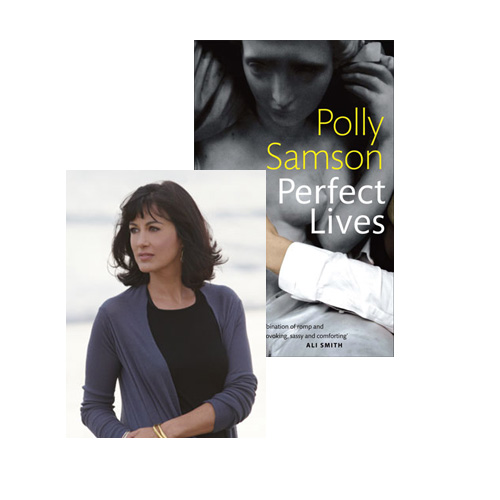
Polly Samson links the stories in Perfect Lives, her second collection, by overlapping characters in the same community—the family featured in one story will be the last clients of the piano tuner in the next story; his first client will be a friend to the unnamed woman whose first-person account of her marriage and family life is revisited several times. (This narrator also has an intense love of photography, drawing upon Samson’s personal passions). Some of her characters are just millimeters away from a breakdown, others are already behaving quite erratically, but a few have managed to carve out moments of comfort and passion; they all, however, tend to be at best tangentially aware of the dramas being played out around them. Samson has written the introduction to a collection of some of Daphne du Maurier’s earliest work, The Doll and Other Stories, so it makes sense that she would invoke du Maurier for this “Selling Shorts” essay—and the nervous energy in so many of her characters makes the choice even more apt.
As a child in London, I suffered so badly from nightmares that my mother took me to the doctor. I remember clearly the doctor in half moon glasses solemnly writing out a prescription for warm milk at bedtime, and yet I remember very little about the nightmares themselves: just a feeling of darkness, and trying to run, of gnarled roots and branches closing in around my head.
I stopped having bad dreams when we moved to Cornwall when I was eight. My suddenly peaceful sleep was odd, considering that we now lived in an old granite vicarage said to be haunted by a murderess and which was situated beside an ancient graveyard from which our terrier would bring the occasional femur. It wasn’t far from Fowey, where Corwall’s greatest novelist—Daphne du Maurier—lived and work, and this was real du Maurier country: open moors, windswept, sparsely populated… As I headed into my teens, I found I shared du Maurier’s passion for this wild landscape over which my own imagination had been freed to roam. I lost myself in her novels and slept peacefully at night.
I don’t know why I didn’t read her short stories until much later. I don’t think I ever came across them at the time; perhaps they weren’t even in print. I remember being surprised that two films that had truly terrified me—each causing a resurgence of nightmares—Alfred Hitchcock’s The Birds and Nicholas Roeg’s Don’t Look Now were, in fact, based on du Maurier short stories.
As terrifying as I found the movies, I found that The Birds and Don’t Look Now wound the tension even tighter on the page than on the screen; du Maurier can do atmosphere and menace like no one else, and her short stories make my pulse race faster than her novels. In the smaller space, she hasn’t had to think too much about pace or form, so the stories seem more instinctive. In the more concentrated form, she is able to tap into fears that are so deeply subconscious you don’t even know that they are yours.
20 May 2011 | selling shorts |
 Our Endless and Proper Work is my new book with Belt Publishing about starting (and sticking to) a productive writing practice.




