
Read This: The Borrower
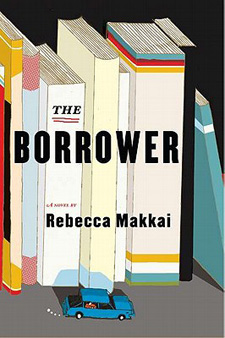 Last week, while I was interviewing authors at BookExpo America, my latest Shelf Awareness review ran—and it’s a change of pace from my usual science fiction/fantasy fare. Rebecca Makkai’s debut novel, The Borrower, is the sort of story which, had it been published ten years ago, or even five, might have been unironically published as “chick lit.” Or maybe not: Makkai has a three-year consecutive streak of appearing in the Best American Short Stories anthologies, so she could easily be positioned in the same literary matrix in which authors like Curtis Sittenfeld have flourished. As it is, there’s both literary and commercial potential here, which is why I wound up describing The Borrower as “a young woman’s ‘dramedy’ in the vein of early Jennifer Weiner or Marian Keyes.
Early on, there are hints that it might even be an issue-oriented commercial novel à la Jodi Picoult, as Makkai introduces us to Lucy Hull, a twenty-something children’s librarian in a Missouri town who discovers that the parents of one of her regular patrons have enrolled him in a fundamentalist program that promises to cure teenage and pre-adolescent boys of homosexual tendencies. The library is one of the few sources of solace in ten-year-old Ian’s life, especially since Lucy eagerly fuels his love for children’s literature that draws his mother’s scorn for not having “the breath of God in them.” (There is a lot of namechecking of kid’s books along the way, constantly reinforcing Lucy’s coolness—and, by extension, Makkai’s.) The situation escalates when Lucy comes in to work one morning and finds Ian hiding in the library after having run away from home; somehow, this leads to her driving him out of Missouri, first to her parents’ apartment in Chicago and then to various points further east.
But while the issue of Ian’s “escape” never completely fades away, the emphasis shifts towards Lucy’s psychological state. This has its advantages; the more time we dwell on Lucy’s quarterlife crisis, the less time we have to think about the utter implausibility of the “kidnapping” plot, especially the ways in which that trouble never actually catches up with Lucy. (This is particularly unrealistic given that, early in their flight, they run into the guy she’s sort of seeing, who she then proceeds to dump, and he goes back to Missouri and never says a word to anybody about seeing Ian with her.) At the same time, there’s always just enough attention paid to Ian’s dilemma to keep Lucy from coming across as too self-absorbed, and Makkai does a good job of keeping Lucy’s concern about Ian’s emotional well-being from turning into overt Christian-bashing. Or, at least, doing it with self-deprecating humor: “Obliquely comparing his family to the Nazis,” Lucy reflects after one conversation, “was maybe not my finest moment.”
Yes, the well-read young librarian vs. Christian fundamentalist parents setup is a bit too easy, but it’s not as if one comes to that premise expecting a balanced social critique. As an affirmation of liberal, book-loving values, though, Makkai creates what I described in my review as “an entertaining imaginary space.” It’s a bit uneven: Sometimes the literary “playfulness” of things like Lucy’s reframing of her situation in various modes of children’s literature gets in the way of the story; sometimes, as I mentioned earlier, the suspension of disbelief wavers. When it works, though, The Borrower is a strong enough debut that I’m definitely curious to see where Makkai goes next.
1 June 2011 | read this |
What I Did at BookExpo
I spent most of last week at BookExpo America, the annual trade show where publishers large and small try to generate excitement among booksellers for what’s coming out over the next few months. I was filing dispatches from the convention floor for Shelf Awareness, but I also participated in two author showcases where my background as the science fiction and fantasy reviewer for Shelf came in handy.
 On Wednesday afternoon, I moderated a discussion with three authors from Tor’s summer lineup. Carrie Vaughn told us about the stories in Kitty’s Greatest Hits, a short story collection which explores some of the side paths she doesn’t normally have a chance to pursue in her popular urban fantasy series about Kitty Norville, a werewolf with a call-in radio talk show. My pal John Scalzi was promoting his just-released Fuzzy Nation, which has just debuted on the extended New York Times hardcover fiction bestseller lists. And Vernor Vinge shared some insights into The Children of the Sky, a sequel to his award-winning classic A Fire Upon the Deep which fans have been awaiting for nearly two decades.
Tor.com has an excellent write-up of this panel; there was a lot for us to talk about and not a lot of time to do it, but we still managed to have a very freewheeling discussion. Each of the three books is fantastic in its own particular way; I wasn’t even familiar with Vaughn’s urban fantasy series—although I’m very much looking forward to reading another recently published book of hers, After the Golden Age—but you can walk right into the stories with no confusion whatsoever. And I don’t want to spoil the fun of the Vinge too much for you, because that’s not out until October, but since Scalzi’s book is out now, I can tell you that he does his usual bang-up job of using a riveting story to slip a philosophical time bomb under your brain’s radar. Like much of his fiction, Fuzzy Nation is easy to read, but it stays with you.
The next day, I was on a similar panel with authors of middle-grade fantasy, including Matthew J. Kirby (Icefall), Lisa McCann (The Unwanteds), and N.D. Wilson (The Dragon’s Tooth). Younger fantasy fans will find a lot to enjoy in each of these novels; heck, I think older fans of, say, Neil Gaiman might also get sucked into Wilson’s story about two orphans forcibly recruited into a magical secret society. I really enjoyed this conversation, too—there’s some highlights in a Shelf Awareness BookExpo wrap-up. And with everything I learned about upcoming releases wandering around the display booths when I wasn’t up on stage, I’ve got plenty of reading to keep me busy until I find out who I’ll be interviewing at next year’s show…

31 May 2011 | events |
 Our Endless and Proper Work is my new book with Belt Publishing about starting (and sticking to) a productive writing practice.




