Extracts from My Social Calendar

Last week, on assignment for Shelf Awareness, I met up with Christopher Boucher, the author of How to Keep Your Volkswagen Alive, a wonderfully surreal debut novel that’s been one of the pleasures of my holiday weekend. We got together to discuss his book tour—he had wanted to drive a VW Beetle from Los Angeles to Boston, stopping at bookstores along the way, but the care he picked out for the journey just wasn’t up for the task. (But he and his wife had a great time on the road, all the same.)
I’m lucky enough to be able to attend a number of literary events each month, so many that there isn’t always space in Shelf for every dispatch I send them. I thought I’d take a moment to share with you some moments from the last few weeks I haven’t told readers about yet…

Staking a claim to “the first fall reading” at Manhattan’s McNally Jackson bookstore last night, Rob Spillman introduced the short story collection Fantastic Women: 18 Tales of the Surreal and the Sublime from Tin House, which expands upon a 2007i issue of the literary magazine dedicated to women writing fiction that breaks away from realism and incorporates fantastic elements, including some from mythology and folklore, in the tradition of pioneers like Angela Carter and Ursula K. LeGuin. (And, at least in some critical readers’ eyes, these contemporary writers are doing an excellent job of it; the anthology came about when Spillman discovered that the magazine was being bulk ordered for use in college classes.)
Spillman’s wife, short story writer Elissa Schappell, pinch-hit for Karen Russell, who was stuck in Philadelphia after a train fell across the railroad tracks. They were joined by two contributors to the collection, Gina Zucker and Samantha Hunt.
5 September 2011 | events |
Ben Loory Keeps an “Appointment in Samarra”
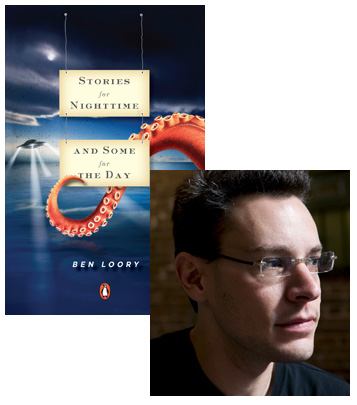
I’ve been dipping into Stories for Nighttime and Some for the Day, the debut story collection from Ben Loory, whenever I get a chance these last few weeks. His short-short stories are the perfect length for reading on quick subway rides, and the dazzlingly weird details ensure that each one will stand out in your mind: The one where the duck falls in love with a rock, the one where a woman becomes infuriated by the popularity of a book filled with blank pages, the one about the man who self-published his poem, the one where the man refuses to move out of a graveyard even though the dead keep trying to drag him off to some unknown fate… and dozens more like them. For his guest essay, Loory’s chosen to write about a weird story that’s become even more well-known than the novel named after it—one that’s inspired him as a reader as much as it did as a writer.
I grew up in a house filled with books. My parents were both English teachers. They’d met in graduate school, in a seminar on Milton. We didn’t have a television. Over dinner, my dad would lecture us about Joyce; my mom would counter with Virginia Woolf. I remember learning all about T.S. Eliot and the objective correlative when I was seven years old.
Of course, I wasn’t interested in books like that. I was interested in books about space. Space, and ghosts, and monsters, unsolved mysteries… and then, when I was ten, I discovered Tolkien. From there it was off in fantasy for years; I went through everything I could get my hands on. And from there I verged on into horror, then into crime, and came out one day through detective fiction. At that point (this was when I was finished with college), I made the leap from Dashiell Hammett to Ernest Hemingway. I remember thinking it was an important moment. It felt like I was growing up.
I remember finding a list one day—it wasn’t too long after that. It was the Modern Library’s list of the 100 Best English-language Novels of the Twentieth Century.
I’m going to read all of these, I said.
And so that’s what I did. I read Faulkner, Conrad, F. Scott Fitzgerald, Nabokov, D.H. Lawrence. I read Jean Rhys, Henry James, Elizabeth Bowen; I read James Joyce and Virginia Woolf. Those books led to others that weren’t on the list; I read everything by every author I liked. After each book I’d call my parents and talk to them about it. Either one of them or the other; sometimes both.
This went on for a couple years. My parents and I talked a lot about style. And I found a lot of favorites as I went—I really liked Richard Hughes’ A High Wind in Jamaica. I really liked Tobacco Road and The Magnificent Ambersons. I really liked Catch-22. I really liked Ragtime and Under the Net. I really liked A Handful of Dust.
Then one day, something happened: I picked up John O’Hara’s novel Appointment in Samarra. It was one of the few books on the Modern Library list I still had never read. I remember opening it up, ready to start, and reading the opening epigraph. It’s a single paragraph—a retelling of an ancient tale, done by W. Somerset Maugham.
31 August 2011 | selling shorts |
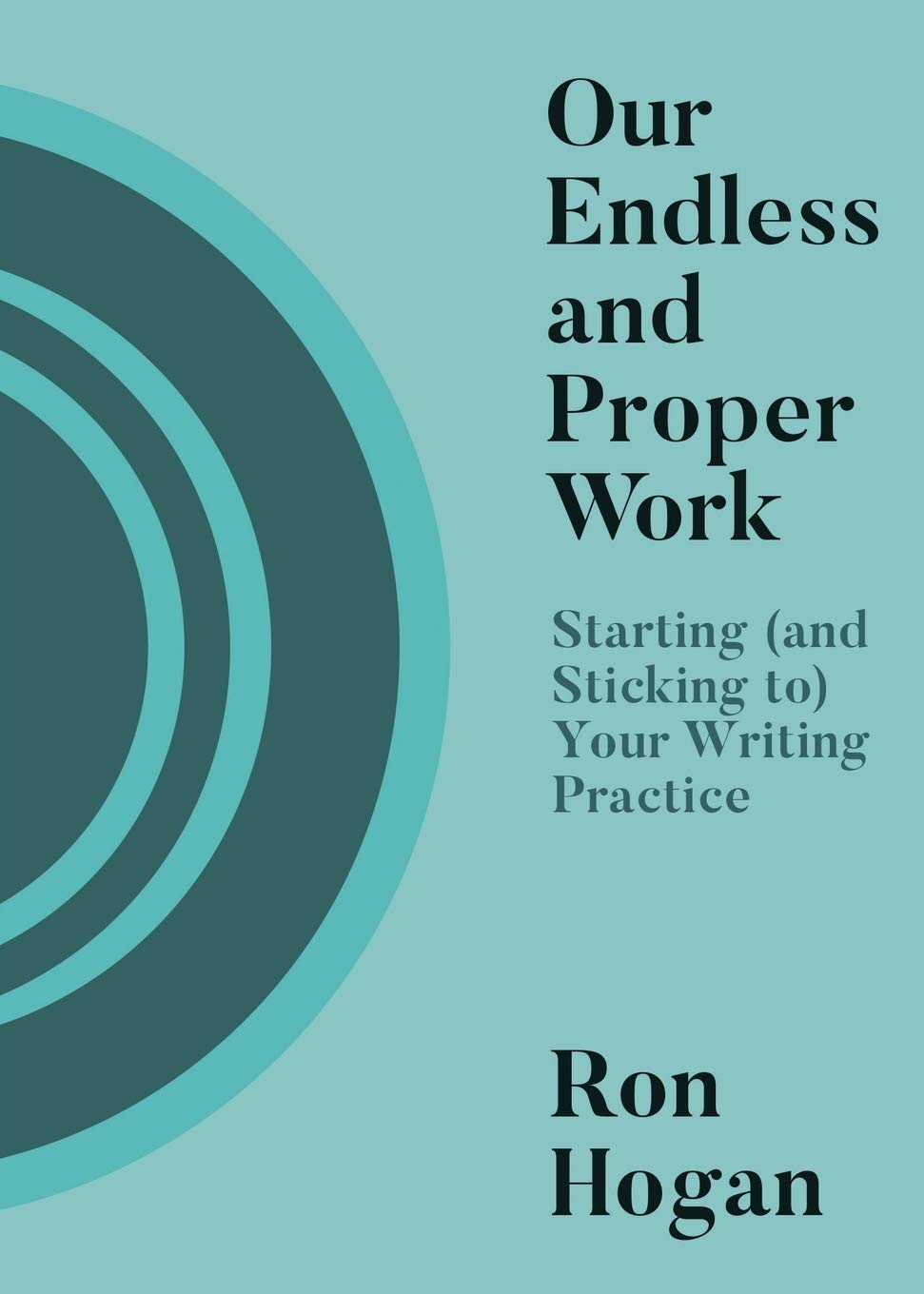 Our Endless and Proper Work is my new book with Belt Publishing about starting (and sticking to) a productive writing practice.