Read This: Becoming Ray Bradbury
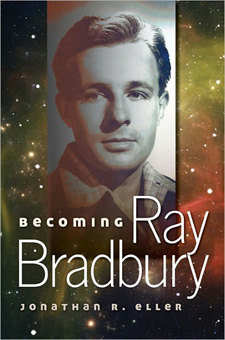 A while back, I did a review for Shelf Awareness of Becoming Ray Bradbury, a critical biography that pays close attention to Bradbury’s formative years, showing how his early love for science fiction and fantasy was tempered on the forge of literary ambition to create a distinctive voice, a steady process of refining his craft that culminates (at least in this particular analysis) with the publication of Fahrenheit 451—perhaps the one science fiction novel any random American under the age of 60 is likely to have read, thanks to generations of junior high and high school English teachers. And yet that very ubiquity can make it easy to forget that Bradbury wasn’t always quite so iconic; Jonathan Eller does an excellent job of recounting Bradbury’s long struggle for acceptance by literary lions, not just as the one science-fiction guy they could stand but as a “real” writer.
Fortuitously, Harper Perennial has just put out the paperback edition of A Pleasure to Burn, a collection of several of the stories Eller discusses—stories in which Bradbury first began to grapple with the themes of Fahrenheit 451. There are stories about book burning, and about the resistance that can be offered against it—and the resistance that can be offered against any attempt to stifle our imaginations. But there are also stories about the rise of the type of government that would believe book burning would be an acceptable form of social engineering, where walking along a sidewalk becomes a suspicious activity and contingency plans have been drawn up for the garbage trucks to collect the corpses after a nuclear war. And there are the two novellas, “Long After Midnight” and “The Fireman,” that serve as “trial runs” for the novel, both centered on the fireman Montag and his growing attraction to the forbidden books and the freedom of thought they represent. (Note: “Long After Midnight” is not the story which appeared years later in a short story collection of the same name; essentially, it’s a first draft of “The Fireman.”)
I had a great time with Eller’s biography; he’s extremely rigorous about tracking the details of Bradbury’s literary development without getting bogged down in an academic prose style. So my interest never flagged, and though I knew the rough outcome—I read Fahrenheit 451 in junior high, too—I wanted to hear all the details. And I really want the sequel that Eller ought to write, since he ends the story just as Bradbury is about to head off to Ireland to write a screenplay of Moby DIck for John Huston. That’s a story I want to hear…
27 August 2011 | read this |
My Work-Related Reading List
Earlier this month, I got to interview David Nicholls about how he adapted his own novel, the international bestseller One Day, into a screenplay for a movie starring Anne Hathaway and Jim Burgess, which opens in American theaters today. There are some significant changes in the film’s version of the story—some early scenes that took place in Rome in the novel, for example, were moved to Paris because the production was already going to Paris, and why add the cost of going to yet another country when you don’t have to? Some of the other changes, though, have a more distinctive narrative import; I won’t give away too many details in this post, because I don’t want to give away any spoilers, but Nicholls and I had a really interesting conversation about how the film might have actually improved upon the fifth act to a certain degree, reworking some scenes and streamlining some character relationships.
Despite all the changes, though, the film does preserve the emotional core of the story, which follows two friends from their college graduation through the 1990s and 2000s as their relationship matures, occasionally fumbles, then deepens—but only ever checking in on them on July 15. As A.O. Scott notes in today’s New York Times, the film isn’t perfect, but there’s a lot to like in it, including some very strong performances. (I was delighted to see Matt Berry from The IT Crowd in a single, hilarious scene midway through the picture.)
What else have I been reading lately? For the USA Character Approved blog, I talked about Penn Jillette’s God, No!, a collection of essays where he talks about why he’s an atheist and a libertarian, tells a few showbiz stories, and shares some truly raunchy anecdotes from his past, from the time he had sex while scuba diving to a bizarre accident involving a certain body part and a switched-on hair dryer. So it’s not Why I Am Not a Christian, but it will definitely get you thinking, and if you’re a fan of Penn & Teller (which I am), it’s certainly an afternoon’s entertainment.
Over at Shelf Awareness, I’m back on the science fiction beat, reviewing Drew Magary’s debut novel, The Postmortal, a look at what happens to society when we discover a drug that will stop the body’s aging process. The story is very dark, and very satirical; I described it as “[hitting] the sweet spot between Margaret Atwood and Kurt Vonnegut.” If you like SF at all, you should definitely give this one a try.
Oh, and as long as I had David Nicholls in front of the video camera, I made sure to ask him about the book he was reading for the “Whatcha Reading?” series at inReads.com. He’s reading Great Expectations, which he’s currently adapting into a screenplay for a new production, directed by Mike Newell, which is scheduled to shart shooting this fall. But Nicholls has loved the book for a long time…
19 August 2011 | read this |
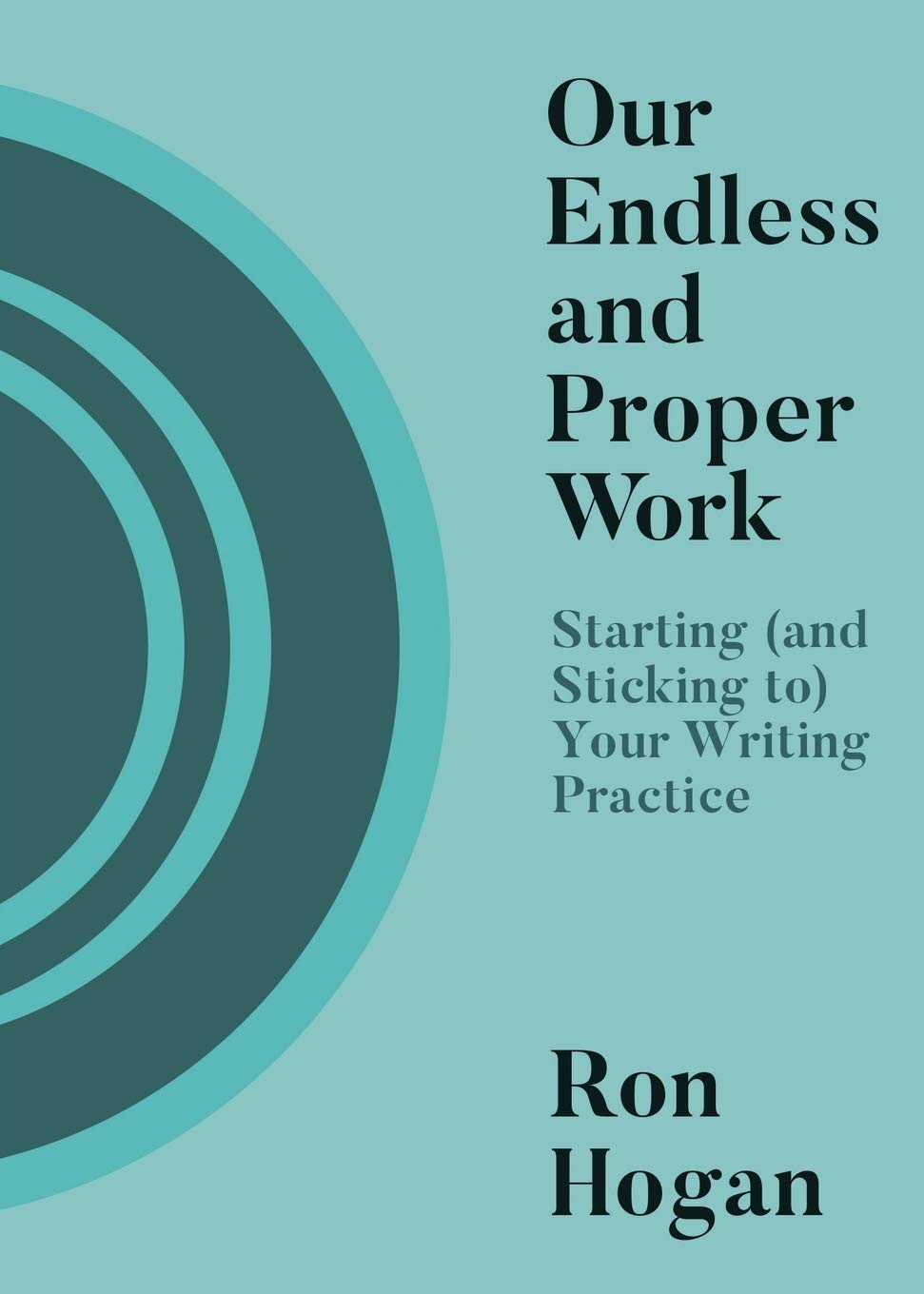 Our Endless and Proper Work is my new book with Belt Publishing about starting (and sticking to) a productive writing practice.