
Leslie Brody & The Inspiration of Jessica Mitford
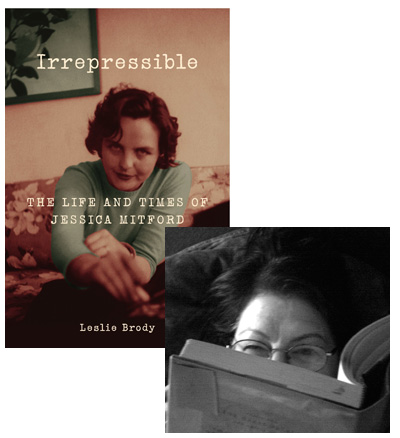
You know, we haven’t had a biographer drop by Beatrice in a while, so I’m delighted to share this essay from Leslie Brody about what led her to write Irrepressible: The Life and Times of Jessica Mitford and the inspiration she drew from her subject. I confess I haven’t had a chance to do more than glance at this title yet, for reasons that will become apparent over the next few days, but Mitford’s life sounds fascinating—I’m looking forward to eventually learning more.
I wanted to write a biography about someone who managed to hold on to the dreams of her youth. This elusive art was exactly what Jessica Mitford, as writer and provacateuse, triumphantly practiced all her long and adventurous life.
When I first read Mitford’s memoir Hons and Rebels, I was charmed by her rebellious and funny voice, and delighted to discover that she had left home at seventeen and set off to change the world on a utopian model. My escape at the same age was considerably less dramatic and I was fortunate to find a home in a counterculture that supported my initial wanderings and exercises in journalism.
In the early 1980s, I found work as a part-time librarian at the same San Francisco College of Mortuary Science that Mitford had eviscerated in The American Way of Death (grateful for a job that demanded no credentials). Four mornings a week, I would sit at a gigantic oak desk, inhaling formaldehyde and the must of unopened books, as I revised the plays I’d begun to write. I would filch announcements off the bulletin boards for weekend workshops in “head reconstruction,†and “grief counseling Bar-B-Ques,†and stash these away. Nobody would visit my library for weeks on end, except one young mortician-in-training who desultorily flipped through some books, then finally asked me out. He thought I might enjoy a tour of the building and I did. I saw the classrooms, laboratories, embalming rooms, and in the back yard what looked like twenty plastic gasoline cans full of blood. Once as I was snooping on my own, amid the back issues of “Mortuary Management†and “Casket and Sunnyside,†I found a file folder marked “Jessica Mitford.” I wish I could tell you there were explosive secret documents inside but it was empty. I always thought she’d get a kick out that, but I never met her—that is until I started to research this book.
8 November 2011 | guest authors |
Read This: In Other Worlds & 11/22/63
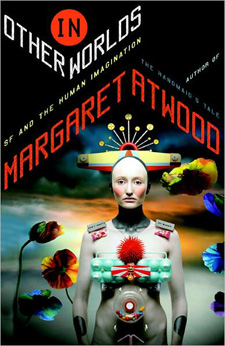 Yesterday, I had a review in Shelf Awareness for Readers, talking about In Other Worlds: SF and the Human Imagination, a collection of essays where Margaret Atwood elaborates on her relationship to science fiction—what she thinks it is, and why she wasn’t writing it all those times you thought she was writing it, although she has tried writing it and she likes some of the things other people have done with the genre.
I found a lot of things to like in In Other Worlds, but I wasn’t completely satisfied, and in a paragraph that was excised from the final, shorter version of the review, I explained why:
“The problem is that this is all rather a hodgepodge: While the opening section does offer a cohesive theory on the literary roots of modern science fiction—including some interesting glimpses at Atwood’s early academic specialization in a tradition she identifies as the “English metaphysical romance”—the middle section basically extracts SF-themed material from the more expansive essay collection Writing With Intent and adds a few reviews that she wrote after that book was published. Readers will learn that science fiction contains ‘all those stories that don’t fit comfortably into the family room of the socially realistic novel or the more formal parlour of historical fiction,” but they’ll only gain scattered impressions of what those stories might be like, not a comprehensive critical history such as you might
find in the late Thomas M. Disch’s (highly opinionated) The Dreams Our Stuff Is Made Of.”
It’s basically a question of how tightly Atwood ties all her disparate thoughts on science fiction together: None of her thoughts are uninteresting—in fact, they all struck me as sound, although the opening essays are a bit conventional—they just didn’t seem to gel for me. But she’ll give you plenty to think about, so I encourage you to check the book out if you get a chance, anyway.
I had another review in the daily Shelf, taking on Stephen King’s 11/22/63, a nearly 900-page fantasy about a high school English teacher who’s shown a hole in the space-time continuum that leads back to 1958 and is recruited to spend five years in the past, verify that Lee Harvey Oswald wasn’t part of a conspiracy, and then stop him from assassinating John F. Kennedy. As a story, though, that’s practically an abstraction, even to the protagonist, so King gives Jake Epping more substantial personal motivations to go back in time and then stay there—first to right a tragedy that befell one of his adult GED students as a child, then to preserve his relationship with a librarian in a small town outside Dallas. As I wrote, 11/22/63 “reveals the capacity of ordinary people for extraordinary moments of love and courage,” but keep in mind: When Stephen King puts his characters to the test, he tests them hard.
(And, yes, King fans: Not only does the second act take place in Maine in 1958, it takes place in exactly the town you’d want it to, under those circumstances.)
26 October 2011 | read this |
 Our Endless and Proper Work is my new book with Belt Publishing about starting (and sticking to) a productive writing practice.




