
Whatcha Reading, Henry Rollins?
Earlier this year, I began shooting short interviews with writers, based around a single question: “Whatcha Reading?” While the videos have been hosted on YouTube, the accompanying blog posts appeared at inReads.com… but since I’ve got a backlog of interviews, and more on the way, I’m going to start featuring them here.
Henry Rollins, the former lead singer of Black Flag and the Rollins Band, has done his share of traveling. “Rock’n’roll will get you far and wide,” Rollins told a crowded room full of fans at the McNally Jackson bookstore when he came to New York a while back. “You can be broke and see the world if you’re in a band.” These days, he’s more likely to be out on a spoken word tour, or filming on location for National Geographic, or maybe just heading out for his own reasons. Wherever he is, he takes his camera with him, and he recently compiled some of his best photographs from more than 20 different countries in Occupants, which also includes a strong dose of his uncensored thoughts on political and economic globalization. “I leave for about 100 days at a time with my backpack and my other backpack, which has camera gear,” Rollins said. “The only times I’ve ever had to run for my life have been in America, where I almost got killed.”
Rollins takes an eclectic assortment of books with him on the road, in a combination of print and digital formats. Recently, he’s been reading the memoirs of President George W. Bush and Vice-President Dick Cheney, which he describes as “crime fiction,” culling them for raw material to use in his speaking engagements. He’s also reading books about the history of Haiti, the life of Abraham Lincoln, and a century of Middle East conflicts. It’s not an unusual mix for Rollins, who describes himself as “to the left of most people, except maybe my mom and Joan Baez.”
(I was so stoked to do this interview, because I’ve been a fan of Rollins since discovering Black Coffee Blues and his band’s CD The End of Silence near-simultaneously in college.)
4 December 2011 | whatcha reading |
Read This: Zone One & the Literary/Genre Blur
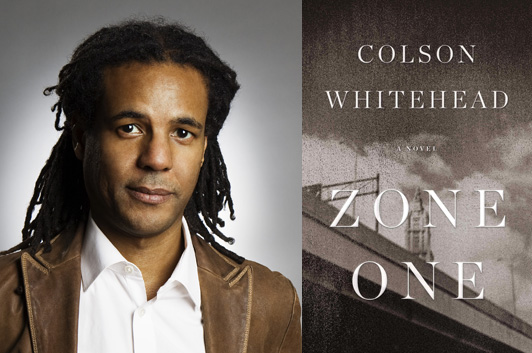
Last month, one of my Character Approved book selections was Colson Whitehead’s Zone One, a novel about a foot soldier in the battle to reclaim lower Manhattan after the zombie apocalypse. It’s a great story, especially if you’re already a fan of Whitehead’s cool, detached voice, which fits this world—where everybody suffers from one form of “post apocalypse stress disorder” or another—perfectly. Like many classic zombie stories, Zone One has its share of satirical social commentary, including some unsettling echoes of Abu Ghraib, but at its core, this is a story of existential isolation… with some kick-ass action sequences.
Much of the critical reaction to Zone One centers around the “fact” that Whitehead is a “literary” author who’s decided to move into genre—which sort of ignores the weirdness of his first novel, The Intuitionist, but Whitehead himself doesn’t care about the distinctions between literary and genre fiction: “They don’t mean anything to me,” he says in an Atlantic interview. “They’re useful for bookstores, obviously. They’re useful for fans. You can figure out what’s coming out in the same style of other books you like. But as a writer they have no use for me in my day-to-day work experience.” Some critics, and critical institutions, care a lot, which is how you wind up with ridiculous, insipid statements like the lead sentence of Glen Duncan’s NYTBR review of Zone One: “A literary novelist writing a genre novel is like an intellectual dating a porn star.”
At first glance, one wonders why the New York Times would assign a “genre” novel to somebody who is so actively resentful of genre fiction and its fans—even as he makes big money from Knopf off werewolf stories—when they’ve already got a thoughtful critic of horror fiction in Terrence Rafferty. Maybe he just didn’t want to revisit zombies after surveying the topic back in August, or maybe the book review’s editors set out to deliberately provoke the sort of controversy that generates a lot of page views. Your guess is as good as mine. (Meanwhile, Charlie Jane Anders did a fine job of demolishing Duncan’s two-pronged cultural snobbery.)
Using Zone One as a prominent example, Joe Fassler wrote an article for The Atlantic about the increased presence of genre tropes in literary fiction, and I think that article gets at some salient points about how “today’s serious writers” are “yoking the fantasist scenarios and whiz-bang readability of popular novels with the stylistic and tonal complexity we expect to find in literature.” I’d suggest, though, that the “sea change,” to use Fassler’s description, isn’t in what “serious writers” are doing but in what “serious critics” are noticing and/or willing to discuss. We’ve always had writers who’ve combined “genre tropes” and “literary grace” in their fiction; some of them were published as science fiction or fantasy, some as mainstream literary fiction. (The principle holds true for other genres as well.) And this recent wave of high-profile novels with genre elements certainly hasn’t negated the persistence of realism as a literary device… More thoughts in this vein soon.
 Our Endless and Proper Work is my new book with Belt Publishing about starting (and sticking to) a productive writing practice.




