
Whatcha Reading, Diana Abu-Jaber?
Diana Abu-Jaber describes her latest novel, Birds of Paradise, as an integral part of coming to terms with the move she and her husband made from Portland to Miami several years ago. “If we were going to have a child we were going to raise it in Miami,” she explains. “A commitment to a child was also a commitment to a place. I wanted to fall in love with Miami. I knew that living there wasn’t going to suffice. I had to start giving myself to the place and demanding that it give itself to me.” As she began writing, she discovered that the novel was tapping into a fear she hadn’t even known she’d had. “The local news was all about missing kids and runaways and I realized that was one of my big parental nightmares,” she says of the decision to base her story around a family coming to terms with the eighteenth birthday of their runaway daughter. “Writing a book about what scares me is a way of trying to become braver.”
Abu-Jaber still teaches at Portland State University, and she told us about the reading lists for her two classes this semester. For a course on modern Arab-American literature, she’s assigned books by Randa Jarrar, Naomi Shihab Nye, and Mohja Kahf, “all of them approaching cultural difference from unique perspectives, and talking about what it feels like to be caught in that collision between places.” She’s is also teaching a course on the art of writing the novel, and she’s picked out several books that are “masterful in the way they approach the construction of the novel” and can give other writers valuable insights into matters of craftmanship like character, voice, and structure. Those books include:
- Super Sad True Love Story, Gary Shteyngart
- The Emperor’s Children, Claire Messud
- Olive Kitteridge, Elizabeth Strout
- Tinkers, Paul Harding
- Gilead, Marilynne Robinson
- The Maytrees, Annie Dillard
22 December 2011 | uncategorized |
Marian Schwartz on Getting the Voices Right
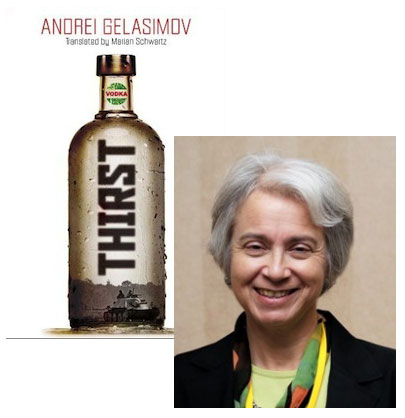
Andrei Gelasimov’s Thirst is a short but powerful novel about Kostya, a Russian soldier who, burned beyond recognition in Chechnya, now spends most of his days drinking alone in his apartment, sometimes venturing next door when his neighbor wants to scare her young son into doing what he’s told. Gelasimov’s narrative bounces around in time, from the present day to Kostya’s wartime experiences to his childhood memories, each juxtaposition bringing us closer to understanding him as a character. Marian Schwartz does an excellent job of easing English-language readers through the time shifts and, as she explains in this guest essay, a large part of that lies in giving her translation of Thirst an overall consistency while recognizing the specific demands of each scene.
Gelasimov makes it look so easy. One moment you’ve sat down to Thirst, and the next you look up and time has passed and apparently you’ve swallowed the book whole. Thoughts about what it means to be maimed and images of a refrigerator full of vodka, flashbacks to an exploding APC, and little Nikita’s Superman toy are swirling in your head—and you’re smiling.
That was my experience when I first read Thirst in Russian, and that is precisely the experience I endeavored to capture for my reader. Critical to this was accurately conveying Gelasimov’s subtle depiction of Kostya’s ongoing adaptation to life as a man with no face—a freak—while telling a classic army-buddies-take-a-road-trip story through telling use of the spoken word—the conversations—and the unspoken word—thoughts.
Gelasimov sequences through sections about Kostya’s present—his personal trials, his search with his friends for their missing buddy, his interactions with both his neighbor Olga and her son Nikita and with his estranged father and his new family—and his past, not just the immediate past of his injury in Chechnya but his childhood and the story of his parents’ estrangement and divorce. Space breaks signal each shift, but so do the changes in vocabulary and register. A conversation between Kostya and his friends sounds very different from his conversation with his father, as well it should.
Kostya’s memories of his youth and his mother and father quarreling become impressionistic, and so does the language. He recalls a day at the beach when his father’s wandering eye spurs his mother’s jealousy:
Because those young women were there. And my father was playing with them.
The ball sails over our heads. Smack! A ringing blow. My eyes follow its flight. I hear them laughing. Once more—smack! Again I look up. The ball is turning into the sun, and I have tears streaming from my eyes. I can’t see a thing. Smack! Next to me someone screams, ‘Get out of the water! Come here this instant! What is that you have?’ Smack! ‘Throw that filth out this minute! You’re going to get it!’ Smack! ‘Catch it, catch it!’ Smack! And then two times quickly—smack! smack! But the sound is a little different and very close. ‘Did you get that?’ And in reply a child’s cry. ‘Don’t cry or you’ll get it again.’ Smack! . . .
The paragraph continues with that dual use of “smack”—for the ball and for the child—as we picture the swirl of the beach crowd, to cinematographic effect.
19 December 2011 | in translation |
 Our Endless and Proper Work is my new book with Belt Publishing about starting (and sticking to) a productive writing practice.