The Beatrice App: A Status Update
Recently, I announced plans to create an app version of Beatrice that will combine feature-length interviews with fiction and nonfiction writers and streaming video highlights from those conversations. I wanted to make the initial release of the app free, so I launched a Kickstarter campaign to raise enough funds to develop the app, get it into Apple’s App Store, and include at least three free interviews to start readers off. (After that, new interviews will be available in bundles of three or four for something like $1.99 or $2.99.)
I’m about halfway through the campaign, and so far, people have pledged nearly half of the requested funds. I’m grateful for the support that they’ve shown so far—as I told people on Twitter earlier today, I’m at a stage now where all it will take to make this campaign a success is 250 people deciding to pledge $10, and get ebooks full of advice from 50 great writers as a thank-you gift. (Or 125 people pledging $20 for advice from up to 75 writers…) I saw an article recently that said Kickstarter might raise more money than the NEA to support arts projects in 2012, and that’s pretty amazing.
It reinforces something I noticed in Tricia Tunstall’s Changing Lives, a fantastic book about LA Philharmonic conductor Gustavo Dudamel and El Sistema, the Venezuelan musical education program that helped nurture his talent from early childhood. There’s a lot of talk in the book about American efforts to duplicate the El Sistema model, and at one point, a seminar leader makes this observation: “We in the arts world are so marinated in scarcity thinking. It can seem inconceivable to us to reach for something as grand as El Sistema.”
The book world, I think, is equally susceptible to scarcity thinking, but what I’m learning is that if you believe in something like the Beatrice app passionately enough, you can convince other people your vision is worthy of their support. The resources are out there; you just have to commit yourself to creating the amazing thing you want to create.
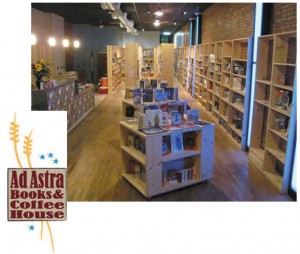 This campaign has also reminded me about the importance of the literary community, a lesson that I’ve been able to apply in what I hope will be a powerful way. You see, I learned about a newly opened independent bookstore in Salina, Kansas, called Ad Astra Books and Coffee that started to raise capital to expand its business through live events and a statewide marketing campaign, among other efforts. I pledged $10 to the store, but then I contacted William Justice, one of Ad Astra’s owners, and I made him an offer I’m delighted to say he accepted.
Here’s the deal: If I raise my $4,500 and Ad Astra raises its $15,000, I’m headed to Salina to emcee a multi-author event at Ad Astra later this year, plus I’ll interview the authors we line up for that event and publish those conversations in the Beatrice app for free. We’ll figure out the details when we need to, but I have a feeling this could be a really fantastic event, the kind of thing I’d eventually like to bring to bookstores and other literary centers across the country. Does that sound like something you’d like to see? If so, I hope you’ll support the Beatrice app now, and set the ball rolling. In essence, you’re not just supporting an app, you’re making it that much easier to sustain a thriving literary community that provides space both online and in the bricks-and-mortar world where we can celebrates awesome writers and their accomplishments.
6 March 2012 | uncategorized |
How Alethea Black Fell in Love with “Natasha”
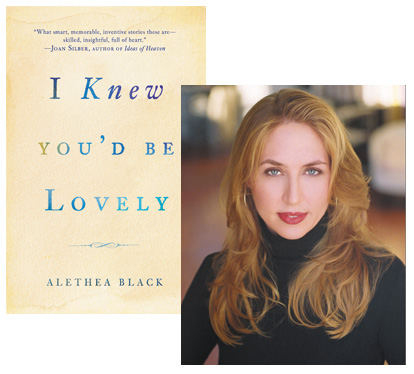
I’ve been friends with Alethea Black for a couple years now, and I’ve had the pleasure of reading some of the stories in her debut collection, I Knew You’d Be Lovely, when they were first appearing in literary magazines. In recent months, she’s been taking part in pretty awesome events, like the WordTheatre reading at Soho House that’s coming up on March 4, 2012, where one of her stories will be read by Maggie Siff (of TV’s Mad Men and Sons of Anarchy). In this guest essay, Alethea talks about a David Bezmozgis short story that showed her on just how many levels great fiction can move us.
At Thanksgiving in 1994, my sister Ashley gave me an orange paperback volume of The Best American Short Stories, edited that year by Tobias Wolff; she didn’t know that she was changing my life. Unlike the staid, obligatory short stories I’d been assigned in high school, these contemporary tales struck me as often funny and fresh and always absurdly, fiercely true. Before that, I’d had little exposure to writing that was simultaneously playful and profound, as eloquent as it was informal. It was like discovering a bootleg Bible that was full of jokes. And it made me want to be a writer.
I spent the following ten years reading and studying contemporary short stories, in pursuit of a sort of home-school MFA—although I don’t think I realized that’s what I was doing at the time. A decade after my Best American initiation, Michael Chabon’s introduction to the 2005 volume expressed what I’d learned. “Entertainment has a bad name. Serious people, some of whom write short stories, learn to mistrust and even to revile it. The word wears spandex, pasties, a leisure suit studded with blinking lights… Entertainment, in short… is bad for you—bad for your heart, your arteries, your mind, your soul.†He goes on to say—in a wildly amusing way—that the problem lies not in stories that amuse, but in our impoverished respect for the power of amusement. When I read that introduction, I was still two years away from publishing my first short story, and six years away from publishing my first book. But Chabon’s words became a call that I would try to answer in my own work.
The stories in Chabon’s edition of Best American bend lithely beneath the limbo bar of his introduction, and include some miraculous feats of entertainment: Tom Bissell’s “Death Defier,†Joy Williams’s “The Girls,†George Saunders’s “Bohemians.†But the story that inspired me most is David Bezmozgis’s “Natasha,†about a young Soviet Jewish immigrant’s first experiences with sex and betrayal. I love its energy (opening line: “When I was sixteen, I was high most of the timeâ€); its easy yet inventive voice (“I thought it had to do with the forbidden. The attraction to the forbidden in the forbidden. The forbiddenestâ€); and its humor (“She dropped down into one of the two velour beanbag chairs in front of the television. Chairs that I had been earnestly and consistently humping since the age of twelveâ€). I love the way it makes its own rules—Bezmozgis introduces his characters’ speech with em-dashes, forgoing quotation marks and dialog tags—and fearlessly encompasses masturbation, pornography, Nietzsche, Bob Marley, the Israeli–Palestinian conflict, Led Zeppelin, and Bizet’s Carmen. I love that it has a character named Rufus.
Any fan of screwball comedies or Alfred Hitchcock thrillers knows that just because something is exhilarating and enjoyable doesn’t mean it can’t also be edifying and true. What’s more entertaining than flat-out, buck-naked genius? Kafka described a book as an axe for the frozen sea within, and Chabon names the breaking pleasure. “Because when the axe bites the ice, you feel an answering throb of delight all the way from your hands to your shoulders, and the blade tolls like a bell for miles.†In my forty-two years on the planet, I’ve yet to find anything with a greater capacity to curl my toes and widen my mind and upend my heart than a perfectly-hewn short story. Then again, maybe I don’t get out enough.
2 March 2012 | selling shorts |
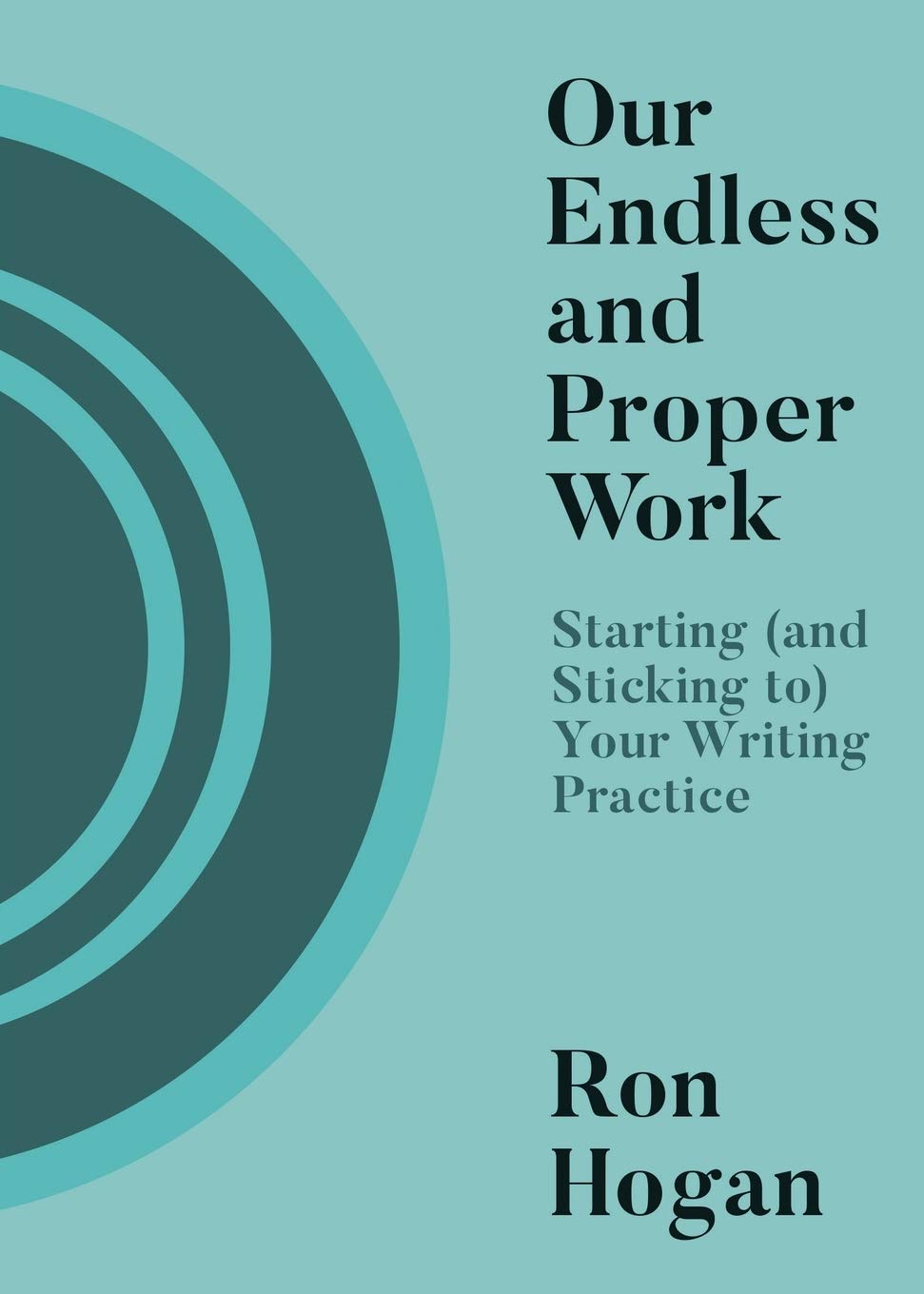 Our Endless and Proper Work is my new book with Belt Publishing about starting (and sticking to) a productive writing practice.