
Life Stories #3: Rachel Shukert & Rev Jen
This episode of Life Stories, my podcast series of interviews with memoir writers about their lives and the art of memoir, was recorded in front of a live audience at Manhattan’s Wix Lounge. (There’s also some video footage which was recorded by Arcade Sunshine that I’m aiming to show y’all later on.) It features my friend Rachel Shukert, the author of Everything Is Going to Be Great, and Rev Jen, the author of Elf Girl.
You’ll notice a bit of echo here and there; I got most of it out during the sound editing process, though, and I’m hoping that what remains isn’t too distracting for listeners. This turned out to be a great conversation—the two authors have done events together before, so they were very comfortable with each other, and it shows once Rev Jen steps in about halfway into the show.
One of Rachel’s comments about the memoir as a genre struck me as underline-worthy, given some of the recent conversations I’ve been having online (and occasionally writing about here) about the visibility of women writers in terms of what gets reviewed by mainstream literary critics:
“I’ve always said that for a woman, just positing that she is inherently interesting is already a radical act on some level, because women really do still have this sort of harder row to hoe when it comes to proving what they have to say is worthwhile. And to just say, this experience is interesting because I lived it and I have something to say about it, to me is very feminist… I think that for my generation of women deciding that their experience is something other people can learn from the same way men have always done, is very important.”
Listen to Life Stories #3: Rachel Shukert & Rev Jen (MP3 file); or download the file by right-clicking (Mac users, option-click).
14 March 2012 | life stories |
Jessica Shirvington & the Power of Love Triangles
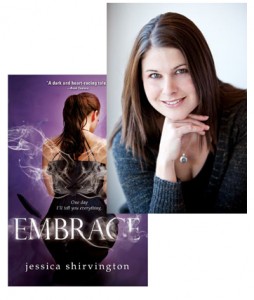
Jessica Shirvington‘s debut YA fantasy, Embrace, kicks off a trilogy about a teenage girl who discovers that she’s descended from angels. (It’s an increasingly common theme in young adult fiction; remember Lauren Kate’s Fallen?) In the case of Violet, the novel’s protagonist, the discovery comes with an equally shocking revelation about Lincoln, the slightly older physical trainer (22 to her 17) that she’s had a crush on for years that steers her emotions in the direction of another character. In this guest essay, Shirvington talks about how love triangles can be an effective engine for driving a story’s forward momentum.
There is rarely a better tension builder than a good love triangle. They can make the development of a romance so much richer. That said, a love triangle comes in many forms and is certainly not restricted to the strictest definition of two direct love interests. It can be between love interest and best friend, between family and career—anything that pulls the protagonist’s heart in two conflicting directions and results in choice making and consequence.
The beauty of a love triangle is that it offers opposition to the heart. And opposition is always interesting.
Sometimes love triangles can seem a little superficial, but, for a writer, they offer an endless supply of emotion and conflict that helps explore the depths of the main characters and the lengths they will go to when challenged. As a reader, we are given the opportunity to formulate our own choices, too. We become invested in the decision-making and we read on to see if the protagonist lives up to our expectations.
Often love triangles are heavy on one side; that’s because there are many different types of love, lust, and allure—especially in YA characters. It wouldn’t be honest storytelling if the more whimsical of emotions didn’t interfere with the longer lasting ones. Who can honestly say that when they were growing up, they didn’t make impulsive decisions that ended in regret?
Love is our most basic and complex emotion at the same time. It is the first we generally experience, and the last we fully understand. We can all relate to love—we all have expectations of it, we all like to be bathed in it. One more thing about love: we all want more of it. You can tire of anger and hate, become bored by lust, joy can dwindle—but love… more, please!
And so … love triangles are inevitable elements of stories.
In Embrace, Violet faces a triangle of her own, one that is influenced by many outside factors not always in her control. She is so sure of her heart at one stage, but when she discovers that everything she believed was true had been in fact false, she is forced to question everything, including her so-sure heart. It’s a confusing time for Violet, and it sets her on her path of heart finding. It’s a path we all take one way or another—a love triangle just ups the ante!
12 March 2012 | guest authors |
 Our Endless and Proper Work is my new book with Belt Publishing about starting (and sticking to) a productive writing practice.