Let’s Meet Up at BookExpo America
 We’re coming up on BookExpo America, the annual bookselling industry’s national trade show, in a few weeks—and I’ll be pitching in at a few events again this year. First of all, on Monday, June 4, I’ll be a panelist at the Book Bloggers Conference, one of several folks who’ve been invited to talk about how to make money as a book blogger. Except that I won’t actually be talking about how to make money blogging, but about my recent efforts to produce an app version of Beatrice, delivering “premium content” that expands upon the mission I’ve been working on at this site all these years—introducing readers to writers. I’ll be joining BlogHer senior editor Rita Arens, Thea James of The Book Smugglers, and Sarah Pitre of Forever Young Adult; we’ll all be fielding questions from Scott Fox, the author of Click Millionaires, a handbook for creating “Internet lifestyle businesses” designed to draw upon your passions and expertise so you can start working more for yourself. I’ve just started digging into it, but I’m looking forward to talking about his ideas while we’re all on the stage.
Then on Tuesday, June 5, I’ll be introducing everyone who swings by the Downtown Stage at 11:00 a.m. to four of the authors of this year’s buzz titles: novelists Antoine Wilson, Rachel Joyce, and Vaddey Ratner, plus memoirist Susannah Cahalan. This is rather a short session, so I’m planning on staying out of the way and letting these writers tell you about the books they’ve got coming out later this year, and why you should keep an eye out for them. (I’m starting to get my advance copies in the mail, and I’m looking forward to digging into them next week!)
Oh! And on Monday night, you should totally swing by Lady Jane’s Salon, the monthly reading series dedicated to romance fiction I helped launch three-and-a-half years ago. Our guests that evening are Cara Elliot, Taryn Rose, Mari Mancusi, Diana Peterfreund, and Beatriz Williams—and we’re hoping that a lot of romance fans who are coming to New York City for the BookExpo will drop by and introduce themselves! At the end of the year, the net proceeds from our $5 cover are donated to a local women’s charity, so you’ll be supporting a good cause as well as having a good time.
Then, of course, there’s all the wandering around the Javits Convention Center I’m likely to do while BookExpo is in full swing: catching up with publishers from outside New York, taking notes at industry panels, standing in line to get autographed books… If there’s any decent cell-phone reception, which is unfortunately never a given at the Javits, I’ll be tweeting some highlights, so keep an eye out!
21 May 2012 | events |
Jefferson Bass: Forensic Science & a Religious Icon
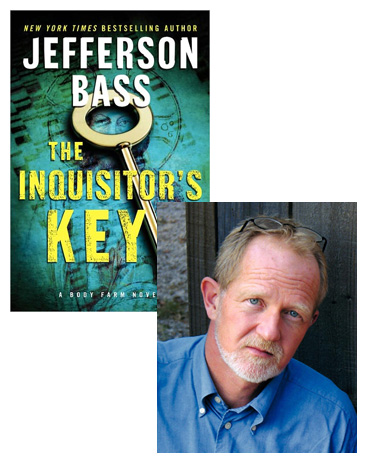
Jefferson Bass is known for “his” crime thrillers centered around the Body Farm, an anthropology research facility where forensic techniques are used to unlock the secrets a corpse contains about… well, how it became a corpse. I say “his” because, in reality, the novels are co-written by Dr. Bill Bass, the founder of the real life Body Farm, and Jon Jefferson, a journalist and novelist. Their latest collaboration, The Inquisitor’s Key, is quite a change of pace—oh, there’s still plenty of forensic science, but this time it’s being used to determine whether an skeleton uncovered in a former papal estate might be Jesus. (Actually, some alternative theories come up early in the game, especially interesting if you know your 14th-century theological history…) Though the skeleton is fictional, the novel does connect it to a real religious relic—at the very least, “real” in the sense that, whatever you think about its origins or properties, it’s a thing that exists. And Jon Jefferson kindly elaborates on its role in the story…
I write forensic fiction—crime novels that revolve around high-tech forensic science (especially forensic anthropology—the stuff of the hit TV show Bones). While researching and writing The Inquisitor’s Key, which is set in Avignon, France—the home of the popes for most of the 14th century—I found myself peering through the lens of science at the world’s most famous religious relic: the Shroud of Turin. The Shroud is a 14-foot strip of ivory-colored linen imprinted with a faint, reddish-brown image that appears to be the bloodstained form of a crucified man. Revered by millions as the burial cloth of Jesus, the Shroud thickens the novel’s plot when it’s linked to a mysterious skeleton, one that our 21st-century anthropologists unearth in Avignon’s 14th-century Palace of the Popes.
The Shroud of Turin made its first indisputable appearance in 1357—not in Turin, Italy, but in Lirey, France, a town due north of Avignon. It’s Christendom’s most famous relic, but it’s far from the only one. The Middle Ages were the heyday of religious relics: artifacts (often human bones and body parts) intended to inspire devotion—and to draw pilgrims to the churches that possessed them. The relics trade was brisk and bogus-laden. A very incomplete list of medieval relics includes two heads of John the Baptist; three corpses of Mary Magdalene; six (count ’em, six) foreskins from the circumcised penis of the baby Jesus; vials of Jesus’s tears (and Mary’s breast milk!); 30 “holy nails” used in the crucifixion; and enough wood from the True Cross to build a small armada.
20 May 2012 | guest authors |
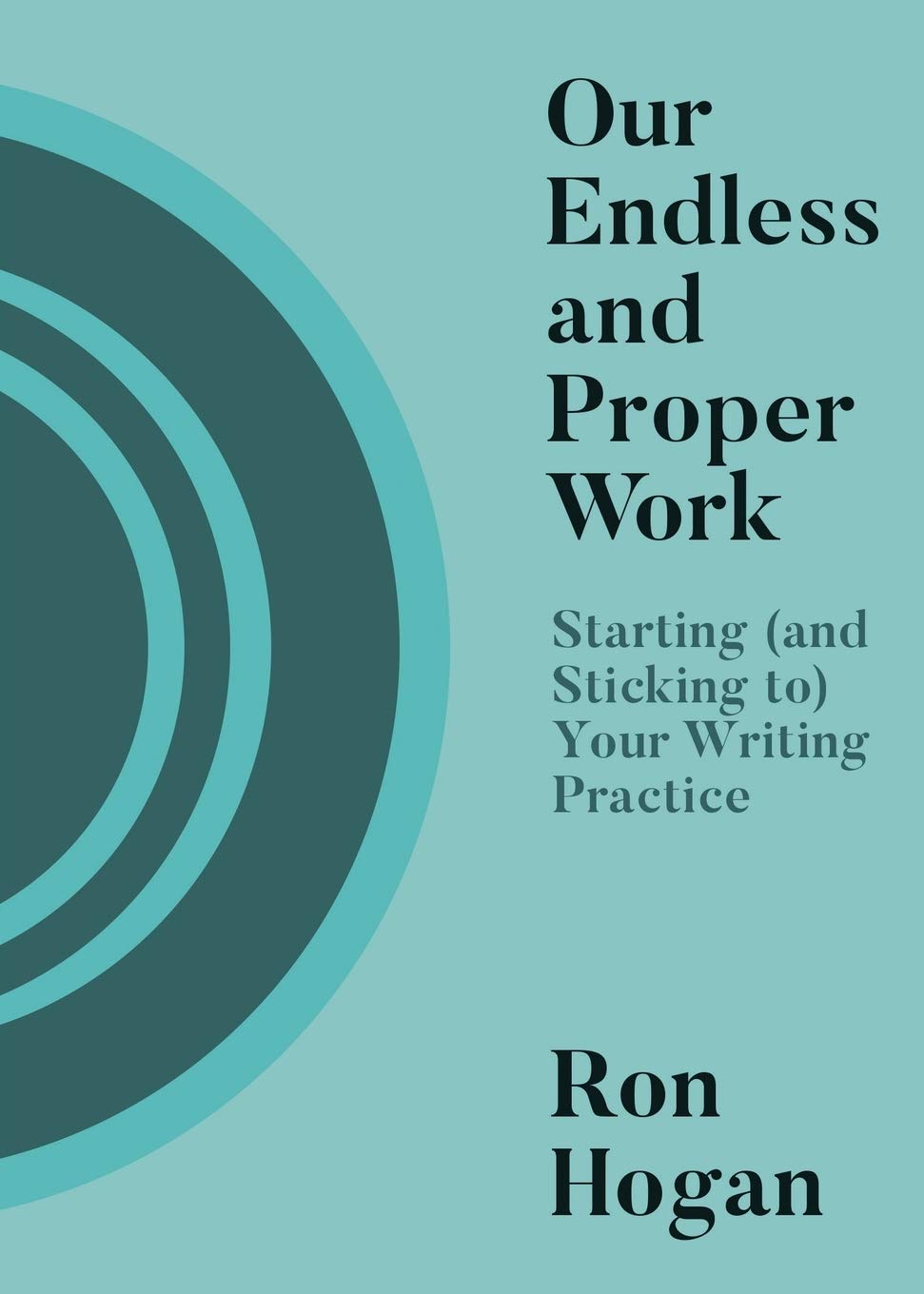 Our Endless and Proper Work is my new book with Belt Publishing about starting (and sticking to) a productive writing practice.