Robert Anthony Siegel’s Visual Muses
I went to see Robert Anthony Siegel read from his latest novel, All Will Be Revealed, about a month or so ago at a furniture gallery in SoHo, where he set up a slide projector and interspersed his excerpts with illustrated mini-lectures about some of the book’s themes. And that’s when I knew I wanted him to talk about his creative process for Beatrice. You can also read a new short story from Siegel this week on the Five Chapters website, which if you haven’t discovered it yet is pretty nifty.
My first novel, All the Money in the World, was set in the world of my youth: New York in the 1970s. For my second book, the novel that eventually became All Will Be Revealed, I wanted to go in the opposite direction and explore a world I didn’t know firsthand, a world I would have to make my own through an act of imagination. What I decided to do was go back in time to the close of the so-called Gilded Age, at the end of the nineteenth century. The period had always fascinated me because it seemed like the birthplace of our own strange contemporary scene: obsessed with celebrity and spectacle, in love with illusion, unsure where fantasy ends and reality begins.
In 1896, the year in which my protagonist, Augustus Auerbach, guides his wheelchair into the parlor of the spirit medium Verena Swann, lower Broadway was lined with “museums” in which one could view a whale kept in a tank of water (slowly starving to death—they didn’t know what to feed it), throw bits of meat to a supposedly man-eating plant, or play chess against an automaton (with a boy or a dwarf hidden inside). If you got tired of the life-size diorama of the battle of Gettysburg, you could step into a spirit photographer’s studio and get your picture taken with a dead relative: the ghost would appear, nearly transparent, in the background.
What I saw in all this was the first stirrings of our own “virtual” world, a world in which imitations of life—TV shows, movies, and images on the Internet—threaten to become more real to us than life itself. Going back to the Gilded Age thus offered me a chance to think about my own creeping sense of unreality, but with the perspective that a hundred years’ distance can provide.
4 June 2007 | guest authors |
Elizabeth Hickey’s Lives of the Artists
When I got word of Elizabeth Hickey‘s second novel, The Wayward Muse, I was intrigued—I knew that Hickey’s first novel, The Painted Kiss, had looked at the relationship between Gustave Klimt and Emilie Flöge, and now here she was tackling the romantic triangle between Dante Gabriel Rossetti, Jane Burden, and William Morris. How, I wondered, had she come to focus on the lives of artists as a recurring theme for her fiction? Fortunately, I’m in a position to get answers to those kinds of questions…It’s funny that she mentions Irving Stone, because he was actually one of the names I was prepared to invoke regarding her work.
The truth is that I’ve been unintentionally training for this particular niche my entire life.
Fall 1977, Louisville, Kentucky: The first day of first grade at St. Matthews Elementary. Since I can already read, the teacher sends me to the library, where I ask the surprised librarian where the biographies are. I read about Florence Nightingale, Jenny Lind, Helen Keller, Babe Didrikson Zaharias—the few women who are considered important enough to have biographies written about them. Later, I graduate to adult biography and my new heroines are Laura Ingalls Wilder, Louisa May Alcott and Marie Curie. Marie Curie, I learn, kept her husband Pierre’s brain in a jar in her room. Even then I had an eye for the curious detail.
Summer 1983, Northwest Harbor, Maine: I am twelve, and my vacation reading is The Agony and the Ecstasy by Irving Stone. I fall in love with Michelangelo. I fall in love with sculpture. I fall in love with Italy, with the Medici, with the artist’s romances. I can still picture Vittoria Colonna’s pale, lovely face.
28 May 2007 | guest authors |
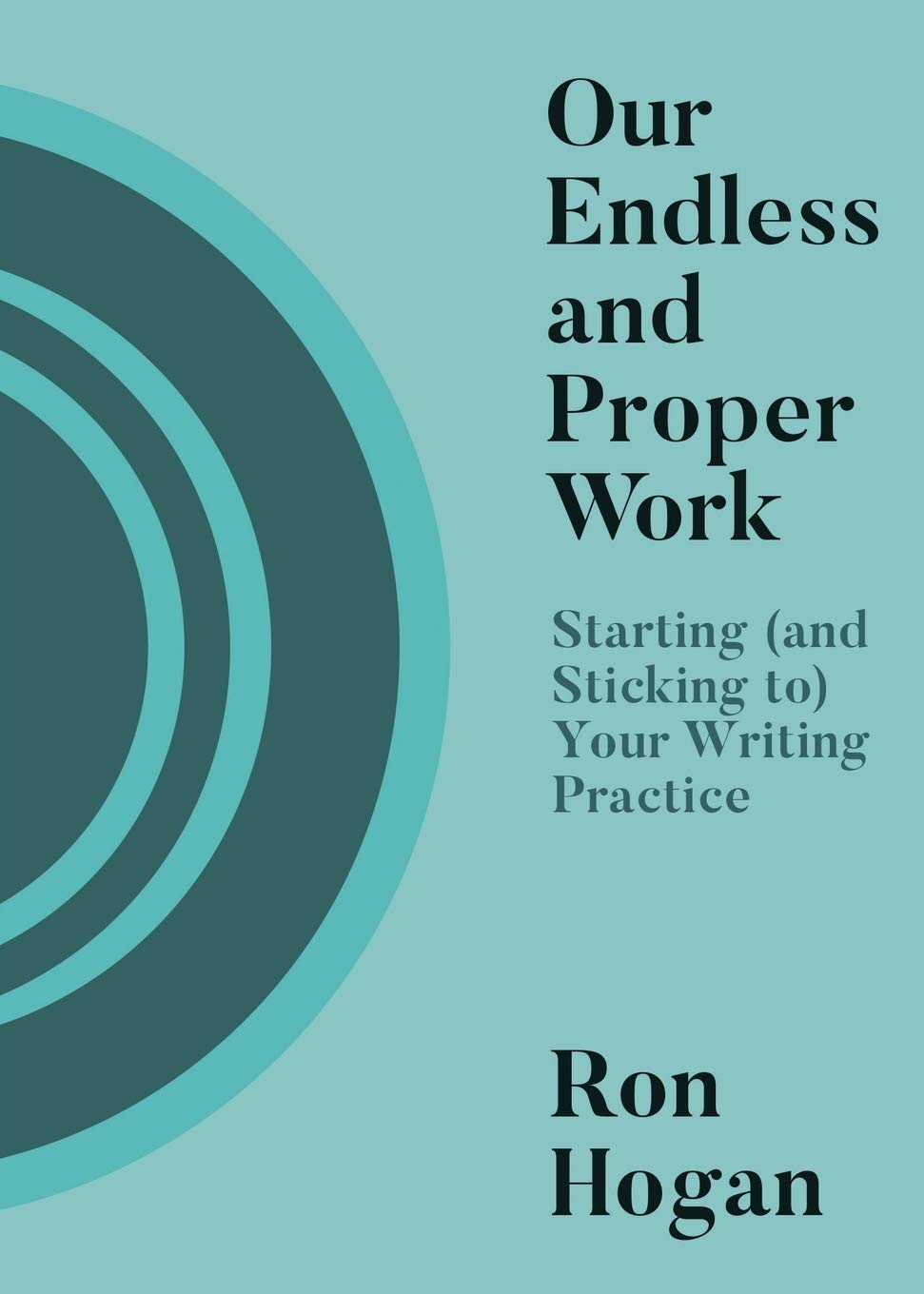 Our Endless and Proper Work is my new book with Belt Publishing about starting (and sticking to) a productive writing practice.