
Gerald Stern, “Stepping Out of Poetry”

What would you give for one of the old yellow streetcars
rocking toward you again through the thick snow?What would you give for the feeling of joy as you climbed
up the three iron steps and took your place by the cold window?Oh, what would you give to pick up your stack of books
and walk down the icy path in front of the library?What would you give for your dream
to be as clear and simple as it was then
in the dark afternoons, at the old scarred tables?
Gerald Stern’s Early Collected Poems gathers together much of the verse from six books first published between 1965 and 1992. In an essay published last month at Norton’s Poets Out Loud website, Stern looks back at his early efforts: “I was interested in that which was overlooked, neglected, and unseen, from a political, religious, and personal point of view and a voice that bespoke this in the simplest, most honest manner,” he writes. “I found myself returning to early—to fundamental—experiences, as I found myself discovering a new language. This constituted a celebration as well as a kind of mourning or elegy… [It] was a difficult road to hoe, for it expressed neither formal, academic niceness nor bohemian madness.”
Other poems in this collection include “Kissing Stieglitz Goodbye” (at the Academy of American Poets website, which has an audio recording of “Sylvia” as well), “Waving Good-by” (the Poetry Out Loud website), and “Another Insane Devotion” (Poetry). Earlier this year, The New Yorker published a new Stern poem, “Dream IV.”
27 July 2010 | poetry |
Robin Black & the Heart of “A Stone Woman”
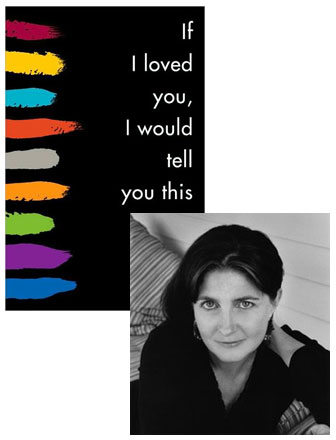
In her guest essay, Robin Black recalls an early teacher’s description of her stories as “domestic angst,” and how she took it at the time as a minimization of her work. But when you read If I Loved You, I Would Tell You This, you come to both the accuracy of that brief phrase and the strengths it implies. Many of Black’s stories test the stress points of family relationships—husbands and wives, parents and children, brothers and sisters—to the extreme, exerting pressures from within and without, and the results are emotionally raw and all too plausible. But, as she explains here, Black found inspiration for the persuasive realism of her most powerful stories in a fantastical source…
“At first, she did not think of stones.” So begins A.S. Byatt’s “A Stone Woman,” the story of a middle-aged daughter whose grief over her mother’s death transforms her into a being of myriad crystals, taking her from animal to mineral. From my very earliest reading, “A Stone Woman” entered my consciousness like news I had been waiting to hear. It became mine, a touchstone of sorts, in the way certain stories do for us all, which initially puzzled me because I haven’t ever been particularly attracted to magical stories. In fact, it’s fair to say that pretty much as soon as trees start talking or shoes begin walking on their own, I’m apt to tune out, more pushed away than swept away. Yet this story of transformation, with its evocation of Icelandic mythology and utter disregard for the prosaic rules of reality, seemed to have something, something essential, to tell me about my own work.
Trying to describe why you’re in love with a story is like trying to describe why you’re in love with anything, or anyone. In the end—says the woman who just claimed she doesn’t much like magic—there’s a magic that can’t and arguably shouldn’t be dissected. But maybe at the heart of all romances is the sensation of being able to be oneself, the vision of being loved as the person you think you are.
26 July 2010 | selling shorts |
 Our Endless and Proper Work is my new book with Belt Publishing about starting (and sticking to) a productive writing practice.




