Read This: Thomas Disch’s Supernatural Minnesota
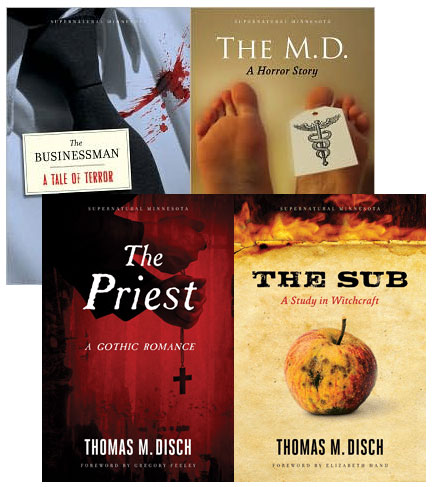
Last week, I had the opportunity to give Tor.com readers a “guided tour” of four horror novels by Thomas M. Disch, originally published between 1984 and 1999 and recently reissued by the University of Minnesota Press—starting with The Businessman: A Tale of Terror and making my way through The M.D.: A Horror Story, The Priest: A Gothic Romance, and The Sub: A Study in Witchcraft. The assignment (well, I volunteered, really) was a pleasure: These are four fantastic novels, very dark but also very funny, and it was interesting to see, reading them one right after the other, how they connected with each other… and to have additional input from Tor.com readers whose comments filled in things that I hadn’t noticed.
One of the aspects of this series that I came to appreciate is that it isn’t really a “series,” at least not in the sense I had expected. The “Supernatural Minnesota” label assigned to the four novels had initially given me the impression that Disch was setting his stories in something like the Castle Rock of Stephen King, with a coherent history spread out over multiple stories. But that’s not quite right: Yes, locations and characters overlap from one novel to another, but I came to realize that even if the same characters showed up in different stories, they weren’t necessarily the same people, even if they seemed awfully similar.
As I wrote in one of the reviews, instead of Castle Rock, it’s a bit more like the London of Michael Moorcock’s “Jerry Cornelius” stories, where the names and places are starting points, but the stories are likely to go off in very different directions. That’s why, when two secondary characters in The Businessman show up to play key secondary roles in The Priest, Disch doesn’t offer any follow-up to the storyline from the first novel. Yes, it would have been a nice in-joke for people who remembered The Businessman, but, heck, that was over a decade ago, and anyway the supernatural parameters he’d set for the first story didn’t jibe with the second one. So you accept Disch’s Minnesota as a consistent environment, but not a “shared world.” And the individual novels are, I think, stronger and more subtle in their workings for that.
You don’t have to take my word for it, though, and I heartily recommend that you buy and read The Businessman, The M.D., The Priest, and The Sub and see how Disch used a deeply caustic and ironic voice, and a keen sense of family drama, to carve out a unique place for himself in late 20th-century horror. (As one of the Tor.com fans and I concluded, these novels had the plotting and character strengths of early Stephen King, without all the narrative flashing lights that let readers know when something important has happened.) You don’t have to read these books in any order, now, so I would recommend starting with either The M.D. or The Priest—the sharpest and most suspenseful of the bunch—and then picking up the other two whenever you get a chance.
14 November 2010 | read this |
We Are All Book Banners Now
Somebody found a book in Amazon’s Kindle Store Wednesday. I’m not going to tell you what the book is, but I will tell you that it is sympathetic towards what may well be the only truly universal taboo in Western sexuality, so you can pretty much guess at how disgusting it is, and if I owned a bookstore, I would have absolutely no qualms about not carrying it or ordering it in. It’s not a First Amendment issue, because a corporation is not a government. When I worked at Amazon in the late 1990s, however, there was an absolute commitment to providing customers with access to any (legally published) book they wanted, and a firm line drawn against recognizing demands that Amazon stop making any given book available.
“We don’t think customers want us picking what we think is appropriate for them to read” was the official response in 2007, when a similar controversy erupted over the sale of dogfighting-themed magazines and videos—which tied in with the attitude I described as prevailing when I was an employee: “If you give in on the really blatant ‘boylove’ stuff, the reasoning ran, eventually somebody comes after you for the Jock Sturges and Sally Mann books, so you had to keep the goalposts all the way at the end of the field to keep everything in play.” If you give in to one demand to suppress a book from inventory, you invite future demands, and once you’ve set the precedent, it makes it that much harder for you to tell the next person “No.”
Because, make no mistake about it: While this isn’t a First Amendment issue, everybody who began demanding Amazon stop carrying that book was, at the level of intentionality, the equivalent of a book banner. If you don’t think so, ask yourself this question: How would you react if your public library carried that book? “I am doing exactly what I MOST hate about book banners,” Ana from The Book Smugglers admitted. And Harry Markov conceded the dilemma: “if I demand to censor it, I betray the principle I stand behind. If I don’t demand something be done about this book, then I betray the values I have been brought up with. In this situation I feel so helpless.”
So, yes, it’s instructive to watch people who would ordinarily deplore book banning confront a book that genuinely appalls them, and for those who value the suspension of moral judgment in the interest of customer satisfaction, it was encouraging to see Amazon initially stand by its position of carrying everything for everybody, even as offended consumers threatened boycotts—which are themselves a perfectly fine consumer response. (If you think a company is doing something you can’t support, by all means stop supporting them.) The problem was that, as the day progressed, thousands of consumers started making those demands, and then the mainstream press started to fan the flames.
Fortunately, for Amazon, a loophole existed: Because the Kindle edition (the only available edition of the book, as far as anybody can determine) was self-published through technology that Amazon provides, it was able to fall back on “Digital Content Guidelines” which state, in part: “What we deem offensive is probably about what you would expect. Amazon Digital Services, Inc. reserves the right to determine the appropriateness of Titles sold on our site.” At least I assume that’s the loophole Amazon used; the company never actually said anything about their decision to yank the title from its inventory late Wednesday night, and as of Thursday night still hadn’t said anything. It just happened.
12 November 2010 | theory |
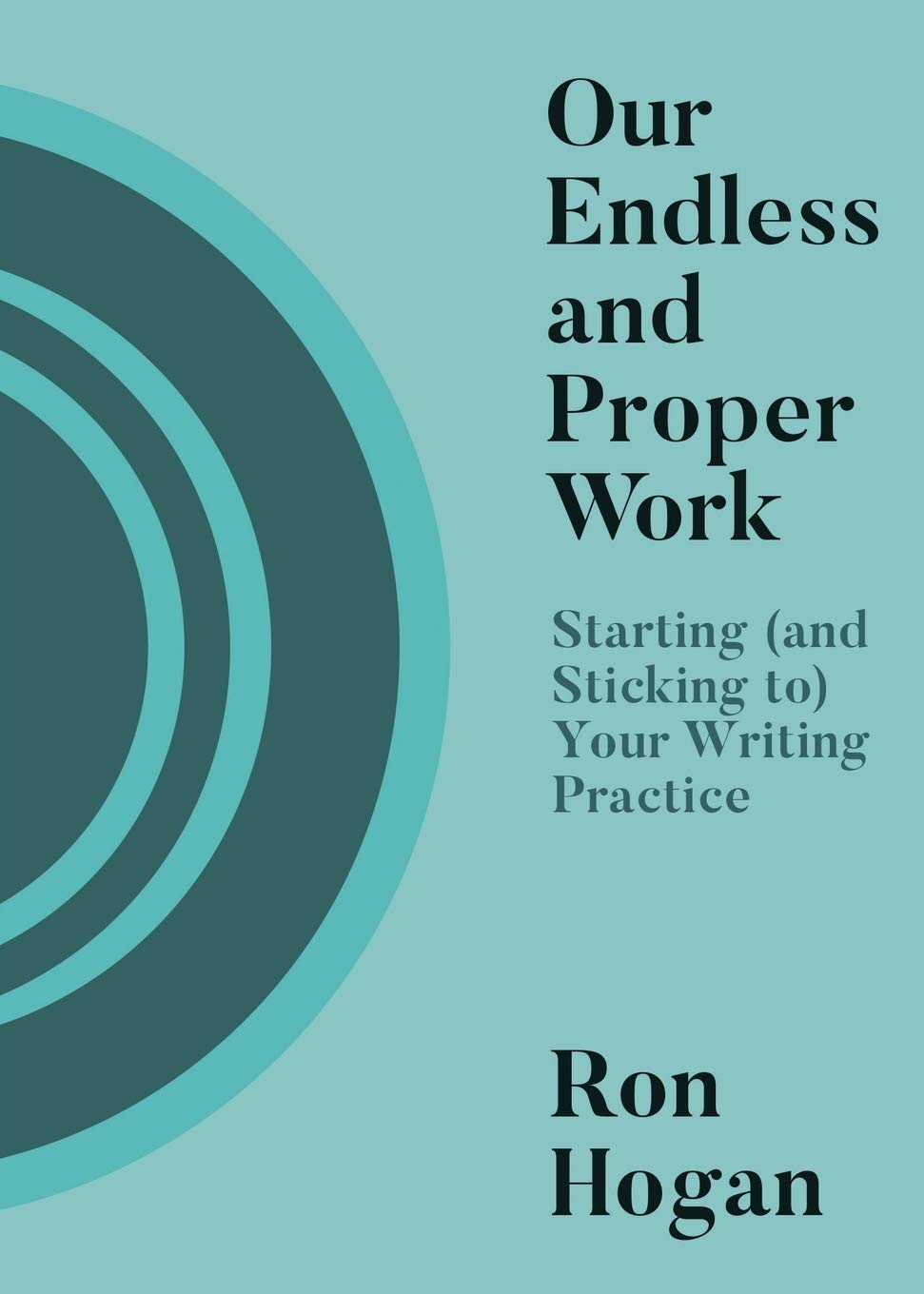 Our Endless and Proper Work is my new book with Belt Publishing about starting (and sticking to) a productive writing practice.