
Caridad Ferrer’s All-Too-Timely Ballet Novel

Earlier this week, a friend of mine on Twitter mentioned a link to an essay at BlogHer.com about how the ballet critic for the New York Times had been making cracks about ballerinas’ body shapes, and the incredibly lame defense he’d offered for doing so after the initial protests: “If you want to make your appearance irrelevant to criticism,” he wrote, “do not choose ballet as a career.” (Right: It’s not about the moves, it’s about whether you look right making them. Sure.)
As the discussion about the article continued, my friend Caridad Ferrer observed that this controversy provided much of the emotional fuel for her new novel, When the Stars Go Blue, about a recent high school graduate and aspiring ballerina who takes a detour through the drum and bugle corps when an opportunity to play Carmen arises. I figured Caridad had a lot more to say about this than you could fit into a 140-character tweet, so I invited her to write an essay for Beatrice…
Alistair Macaulay is an unmitigated jackass.
Okay, had to state that right off the bat. Just get it out there. Sadly, however, he’s an unmitigated jackass to whom I owe something of a debt and believe me when I say, I wish that wasn’t the case.
Right now, you’re probably wondering “Who?” and “Why?”
Alistair Macaulay happens to be the ballet critic for The New York Times. As to why I owe him a debt—well, it’s because his recent critique of the New York City Ballet’s holiday production of The Nutcracker (as choreographed by George Balanchine) provided a timely reinforcement of a plotline from When the Stars Go Blue. My lead character, Soledad Reyes, is a dancer. About to graduate from an elite high school for the arts in Miami, she has aspirations to become a professional—her focus primarily on ballet—even though she knows the odds are stacked against her, even more so than they would be for anyone desiring a career in such a demanding profession. Because, you see, Soledad is what one might consider a non-traditionally sized ballerina.
17 December 2010 | guest authors |
Your Attacks on Genre Fiction Grow Tiresome
Basically, there are only two reasons to invoke genre when discussing literature, and both of them are about marketing. You can classify a book as belonging to a genre in order to underscore its appeal to a potential reader: If you liked this and this and this, then you may like this, for it is similar to the others. Or you can classify a book as not belonging to a genre in order to underscore its appeal to another potential reader: “Genre novels are all alike,” a book snob might tell you, “every literary novel is literary in its own way.”
No, really: That’s pretty much Edward Docx’s argument in a recent Guardian essay, only he never quite boils it down that succinctly. For him, it’s about how “even good genre… is by definition a constrained form of writing,” so “if you are following conventions, then a significant percentage of the thinking and imagining has been taken out of the exercise.” One assumes that the opposite must therefore be true of the “literary” novel, the author of which can make innovative textual decisions without any thought to convention or precedent, merrily re-inventing the very medium of the novel with each keystroke. One must assume this, because even Docx doesn’t have the audacity to actually set something that ridiculous into print.
OK, I lied at the beginning, because there’s actually a third good reason to talk about elements of genre, the discussion of typology and convention for the purposes of criticism—seriously, it’s like Docx never even cracked open a copy of Northrop Frye’s Anatomy of Criticism, for if he had, he would have been reminded that the very novel is itself a genre. (And, too, he would surely have recognized that the role of a public critic, such as he is playing for The Guardian, is not scholarly or scientific, but rather another artistic contribution to the history of taste. Much like this!)
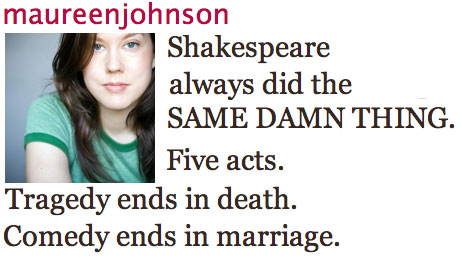
Even the most literary literature is, at its foundations, generic. Would Docx suggest that Hamlet was easy for Shakespeare to write because so much of the thinking and imagining had been done for him beforehand?
16 December 2010 | theory |
 Our Endless and Proper Work is my new book with Belt Publishing about starting (and sticking to) a productive writing practice.




