
Read This: Begin Again
 Towards the end of October, Lincoln Center launched a three-week “White Light Festival” dedicated to “music’s transcendent capacity to illuminate our larger interior universe,” juxtaposing performances of Western classical composers such as Brahms, Bruckner, and Bach with a dance company composed of Shaolin monks or a troupe of Manganiyar siingers from the Muslim communities of northern India. Mrs. Beatrice and I were fortunate enough to attend a “Magnificat” recital by the Tallis Scholars, primarily focused on Arvo Pärt but also including pieces by Palestrina, Tallis, Allegri, Praetorius and Byrd, that was breathtakingly beautiful; I also had the opportunity to attend two panel discussions moderated by WNYC’s John Schaefer on the themes of “Silence” and “Sound,” the latter being preceded by pianist Pedja Muzijevic’s performance of, among other works, John Cage’s 4’33”.
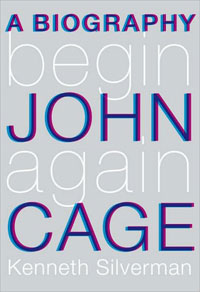
“We often think of sound and silence as opposites,” composer John Luther Adams noted as the event moved into its discussion phase, but 4’33” points the way towards what Adams described as “ecological listening”: “When we start listening to where we are, we hear things that usually we might not think go together, but they do, in the world.” One of the immediate effects of that afternoon’s discussion was to compel me to re-read the chapter on Adams in Alex Ross’s excellent Listen to This, and to start listening to two of his major compositions, Earth and the Great Weather and In the White Silence. What took a little longer was for me to sit down with Kenneth Silverman’s new biography of John Cage, Begin Again.
I was already somewhat familiar with (the concept of) 4’33”, and with the development of Cage’s musical thought up to the point of its creation, thanks to Kyle Gann’s insightful No Such Thing as Silence, but Silverman provides additional biographical context for those early years, as well as covering the second half of Cage’s life. There’s a lot of detail on the processes that Cage used to compose his unconventional works, as well as the non-musical endeavors of his later years, like his eager apprenticeships in chess and engraving. It makes you wonder, perhaps, if intellectual curiosity and boundary-pushing experimentation might be the thread that links Cage to the otherwise seemingly disparate subjects of Silverman’s previous biographies: Cotton Mather, Edgar Allan Poe, Harry Houdini, and Samuel Morse. (Granted, Mather would seem to be the odd man out in that lineup.) Begin Again doesn’t appear to be a substitute for reading Cage’s own essays on music and creativity, but then I don’t imagine it was intended as such—as an introduction to and an engaging invitation to learn more about an important American artist, however, it works quite neatly.
26 December 2010 | books for creatives, read this |
Read This: Christmas Romances

I’ve been reading historical romances for a while now, but I’ve still got a lot of catching up to do, and thematic elements that are probably old hat to established fans can still catch me off guard sometimes. For example, both Cathy Maxwell’s His Christmas Pleasure and Jennifer Haymore’s A Season of Seduction both use the device of a property in a remote location, or at least remote to London—Northumberland in the one case, Cornwall in the other—which is discovered to be in much worse shape than anticipated, but which the romantic heroine (with or without the assistance of the hero) is able by dint of hard work to restore to functional domesticity. The two scenarios play out rather differently, but it was still a bit jarring to see the basic premise appear twice in quick succession; I’m assuming that it’s a convention I just haven’t come across before now—one that I was almost tempted to attribute to the Christmas-themed historical romance, but I’m guessing the application is a bit broader than that.
The two novels share another basic plot element in common: Both heroes are eager to rush into marriage with a well-off woman in order to gain access to her funds, but come to fall in love with her for herself. Again, though, Maxwell and Haymore take very different approaches to this convention, and for my own tastes I’m inclined to give the edge to His Christmas Pleasure—it gets the elopement between its two leads out of the way fairly early, then focuses on relationship building (which is where that dilapidated estate comes in) then puts the marriage to one last, massive challenge. Haymore also brings her characters together very quickly in the sexual sense, but the story is less concerned with building a relationship than with throwing increasingly difficult obstacles in the relationship’s path and focusing on the separate emotional transformations of the hero and heroine as they are made ready for marriage. One of the biggest obstacles Haymore’s couple faces is that the hero is being blackmailed by a mentally unhinged ex-friend, though, and I confess that of all the generic conventions I’ve discovered in my romance reading, the mentally unhinged antagonist is the least satisfying, especially since I’ve yet to find a book in which it’s handled convincingly, rather than played as an over-the-top melodramatic twist. Maxwell also has a highly melodramatic secondary character, but she’s not so much an antagonist as an annoyance—the ways she lashes out emotionally, and the ways in which other characters react to her outbursts, feel that much more authentic… as do the rest of her supporting cast.
(For what it’s worth, the “Christmas” elements in both these stories are primarily confined to their big finishes; Maxwell’s story takes place over three months, and Haymore’s over two. But Maxwell does at least get into some detailed discussion of holiday customs.)
24 December 2010 | read this |
 Our Endless and Proper Work is my new book with Belt Publishing about starting (and sticking to) a productive writing practice.




