What’s In Your Ultimate Blogroll? (2012 Edition)

Randall Munroe’s XKCD
Nearly four years ago, I wrote a post for GalleyCat called “What’s In Your Ultimate Blogroll?” I was riffing off a book called Ulimate Blogs where Sarah Boxer laid out some info on her 27 favorites. (The book’s still available, though as far as I know it’s never been updated; I wasn’t convinced by all her selections, but the attempt was certainly commendable.)
Then, a few weeks back, I was talking with a friend about some projects that I’m lining up for 2012 when I mentioned a post I’d recently read at one of my ultimate blogs, John Scalzi’s Whatever. My friend had never heard of it, so I started telling her who Scalzi is and what his site’s about; back in 2008, I’d described it as “a perfect example of how a writer’s blog can be a promotional tool without being uselessly annoying about it,” and that’s basically how I put it that night, too. (If you’re looking for a more detailed introduction, you’re in luck: Scalzi just wrote one.) Afterwards, my friend said something along the lines of how she wanted to know what the blogs I read every day are, which is why I’m revisiting (and revising) my ultimate blogroll and sharing some of those links with you tonight.
(Of course, I haven’t actually used a “blogroll,” in the sense of a list of blogs that I access through an active web page, in years—instead, I use Google Reader to keep up with blogs through their RSS feeds. But the metaphor still holds up.)
I follow a lot fewer book blogs than I used to, but I’m always interested in what Maud Newton has to say about literature and culture (and literary culture), and the romance fan blog Smart Bitches, Trashy Books continues to teach me how to write about genre fiction with an authoritative passion. That’s actually the same reason that I’m a huge fan of Comics Alliance, even though I’m actually reading fewer comic books and graphic novels these days; editor Laura Hudson has put together a roster of sharp critics who challenge the sexual and racial assumptions of mainstream comics on a near-daily basis, but also aren’t afraid to give themselves over to the fun of great storytelling. When it comes to literary blogs affiliated with mainstream media institutions, the only one I admire enough to pay attention to regularly is Carolyn Kellogg’s Jacket Copy at The Los Angeles Times, although The New York Daily News launched a book blog in late 2011 called Page Views that I hope works out. (As for the other “corporate” book blogs, I count on the people I follow on Twitter to ferret out the must-read posts and bring them to my attention, though sometimes I’ll spot-check if I’m looking to see if anybody’s talking about a particular book.)
For professional inspiration, I keep an eye out for new posts at 43 Folders and Presentation Zen, and Seth Godin usually posts about once a day (sometimes more). Personal inspiration comes from my friends Gretchen Rubin (The Happiness Project) and Jonathan Fields.
Finally, when I just want to be entertained, the following webcomics never let me down: Randall Munroe’s XKCD, David Malki’s Wondermark, and Kate Beaton’s Hark! A Vagrant. Each has a particular type of “geek humor,” so there’s very little thematic overlap between the three, but they all “work” at a consistent level of excellence.
As I mentioned, these aren’t the only blogs I follow regularly, but they are among the best, and I encourage you to pay attention to any (or all) of them, and see for yourself what rewards that attention will bring.
1 January 2012 | housecleaning |
Should Indies Compete with Amazon on Pricing?
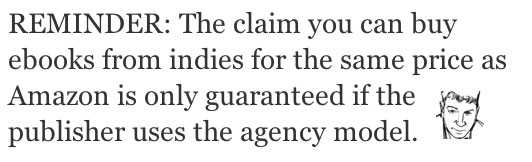
There’s been a lot of hype recently about the Indiebound reader app, which was developed by the American Booksellers Association’s Indiebound program to encourage consumers to buy Google eBooks from their local independent bookstores rather than buying Kindle-formatted ebooks from Amazon. (Yes, I spelled “ebooks” two different ways; in the case of Google, it’s trademarked with a capital B.) One of the chief selling points of this campaign is the assertion that you can buy ebooks from indies for the same price as Amazon. Unfortunately, while this is true in principle, it is not universally true in practice.
As many of you know, the “Big Six” publishers—the New York-based conglomerates generally, for better or for worse, acknowledged as the “core” of the book publishing industry—price their ebooks according to what’s known as the “agency model.” This means, that rather than charging booksellers a wholesale price, after which the bookseller can charge consumers a retail price of its own choosing, these publishers have chosen to set a fixed price for their ebooks, and then authorize individual retailers to sell those ebooks at that price. The only way the price changes is if the publisher decides to change it, and no retailer has a competitive price advantage.
Any ebooks from those publishers, then, do cost the same when purchased through an independent bookstore as they would at Amazon, or Barnes & Noble, or the Google eBookstore. So Robert K. Massie’s Catherine the Great, published by Random House, is $14.99 wherever you go, including Powells.com, the indie bookstore with whom I’ve had a commission-based relationship for several years. But what about ebooks from publishers who don’t use the agency model? Let’s look at Stephen Greenblatt’s National Book Award-winning The Swerve, published by W.W. Norton, as one example. On the day I’m writing this post, the Amazon Kindle edition is $9.43, a price that the Google eBookstore matches. If you want to read this book on a Barnes & Noble Nook, though, it’s $14.01—which is still a significant savings from the $23.92 you’d pay to buy the ebook from Powell’s. And at least one independent bookstore is charging the sticker price of $26.95.
It’s also worth considering that some independent publishers have Kindle-compliant digital editions for sale through Amazon with no counterpart editions available at the Google eBookstore… and thus not available through independent bookstores working with Google.
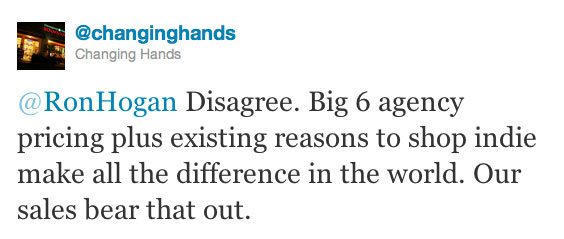
When I raised this issue on Twitter, I observed, “Announcing you charge the same price for an item as a national retailer isn’t impressive when said price is fixed by the manufacturer.” Other folks pointed out, and I recognize the truth in this, that it’s still worth mentioning when that national retailer has a prominent reputation for beating its competitors on price. Brandon Stout, who handles publicity and marketing for Changing Hands, an indie bookstore in Tempe, took further issue with my reasoning:
30 December 2011 | theory |
 Our Endless and Proper Work is my new book with Belt Publishing about starting (and sticking to) a productive writing practice.