Let the Hate Flow Through You
Slate has run an article by Jacob Silverman bemoaning “the mutual admiration society that is today’s literary culture, particularly online,” because authors connecting with their readers, and with each other, is going to ruin everything.
“if you spend time in the literary Twitter- or blogospheres, you’ll be positively besieged by amiability, by a relentless enthusiasm that might have you believing that all new books are wonderful and that every writer is every other writer’s biggest fan. It’s not only shallow, it’s untrue, and it’s having a chilling effect on literary culture, creating an environment where writers are vaunted for their personal biographies or their online followings rather than for their work on the page.”
“Not to share in the lit world’s online slumber party,” Silverman continues, “can seem strange and mark a person as unlikable or (a worse offense in this age) unfollowable.” He seems to be suggesting that panning a book is seen as bad form, “making it harder and harder to hear the voices of dissent—the skeptical, cranky criticisms that may be painful for writers to experience but that make for a vibrant, useful literary culture.”
That’s right: Silverman says negative reviews keep literary culture from becoming irrelevant.
Silverman does get much of the backstory to this issue right, particularly when he talks about how the alternate literary discourses that have flourished in the online era created a siege mentality among that class of people who reviewed books for mainstream media outlets. And it’s true that there are reviewers, and review editors, who prefer to accentuate the positive. (In fact, I’ve written for such outlets, including my current freelance contributions at Shelf Awareness and a recently concluded gig with the USA Network.) Where he goes wrong, I think, is in believing that there’s a problem that needs solving.
After all, there’s still plenty of negative reviewing out there, if you put in a little effort to look for it. Hell, Jonathan Franzen gets panned, and he’s supposed to be the darling of literary culture. Even online book lovers, who Silverman accuses of “cloying niceness and blind enthusiasm,” are known to get in on the criticism. Now, let’s stipulate for the record that there’s currently a “movement” online in which people are so put out by criticism that they’ve taken it upon themselves to shame negative reviewers into silence—but it’s also pretty well established that we recognize those people as assholes. For the most part, I think you’ll find that reasonable, sane people who like books and participate in online forums like what they like, and if you don’t like what they like, they’re fine with that—unless, of course, you’re stupid or condescending about it, like, let’s say, a literary snob who thinks it’s still au courant to snark about chick lit. Then, you’ll get the smackdown you so richly deserve.
I can’t speak to anybody else’s motivation for choosing to write positive book reviews over negative ones, but this is where I’m coming from: Life is too short to waste on books I don’t like, unless I’m getting paid to read them. I do make exceptions for some books that make our culture actively worse by their existence, but for the most part, I’m content to tell you about books and writers I believe matter… and why I believe it.
3 August 2012 | theory |
D. Nurkse, “Sonny Stitt at the Blue Coronet”
Jeremiah Kuhlfield
His fingers don’t seem to move
as he rips through secondary dominants
of “Boplicity,” “Simone,” “Ray’s Idea.”
The alto is a golden fishhook.Why such blazing tempi when he’ll die
in six weeks? Perhaps in heroin
there’s a calm in which you can fit
a thousand notes into one beat.Drums, bass, Hammond organ—
these are unnamed men, faces
you’ve met all your life
and bargained with, nodded to,
yet they have no difficulty
with the subtlest modulation.The audience is three drunks,
one cursing an imaginary waitress,
one mumbling apologies, one sleeping.Now try to eat your extremely salted cashews
so slowly there will always be one left.
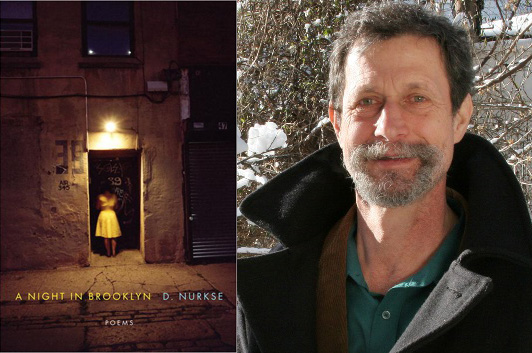
A Night In Brooklyn is the tenth collection of poems by D. Nurkse, the borough’s former poet laureate. It includes “Summertime” (originally published in The Atlantic), “The North Side” and “There Is No Time, She Writes,” “The Bars,” and “Damariscotta” (which was originally published under the title “Newfane”). Several poems appeared in Poetry; in addition to the poem that gives the collection its name, there’s The Rain-streaked Avenues of Central Queens,” “Psalm to be Read with Closed Eyes,” “The Dead Remember Brooklyn,” and “August in the Dolomites” (originally called “Engagement in the Dolomites” and then “A Marriage in the Dolomites”).
Drunken Boat first published “Letter from Home,” and they also have an audio file of Nurkse reading it.
2 August 2012 | poetry |
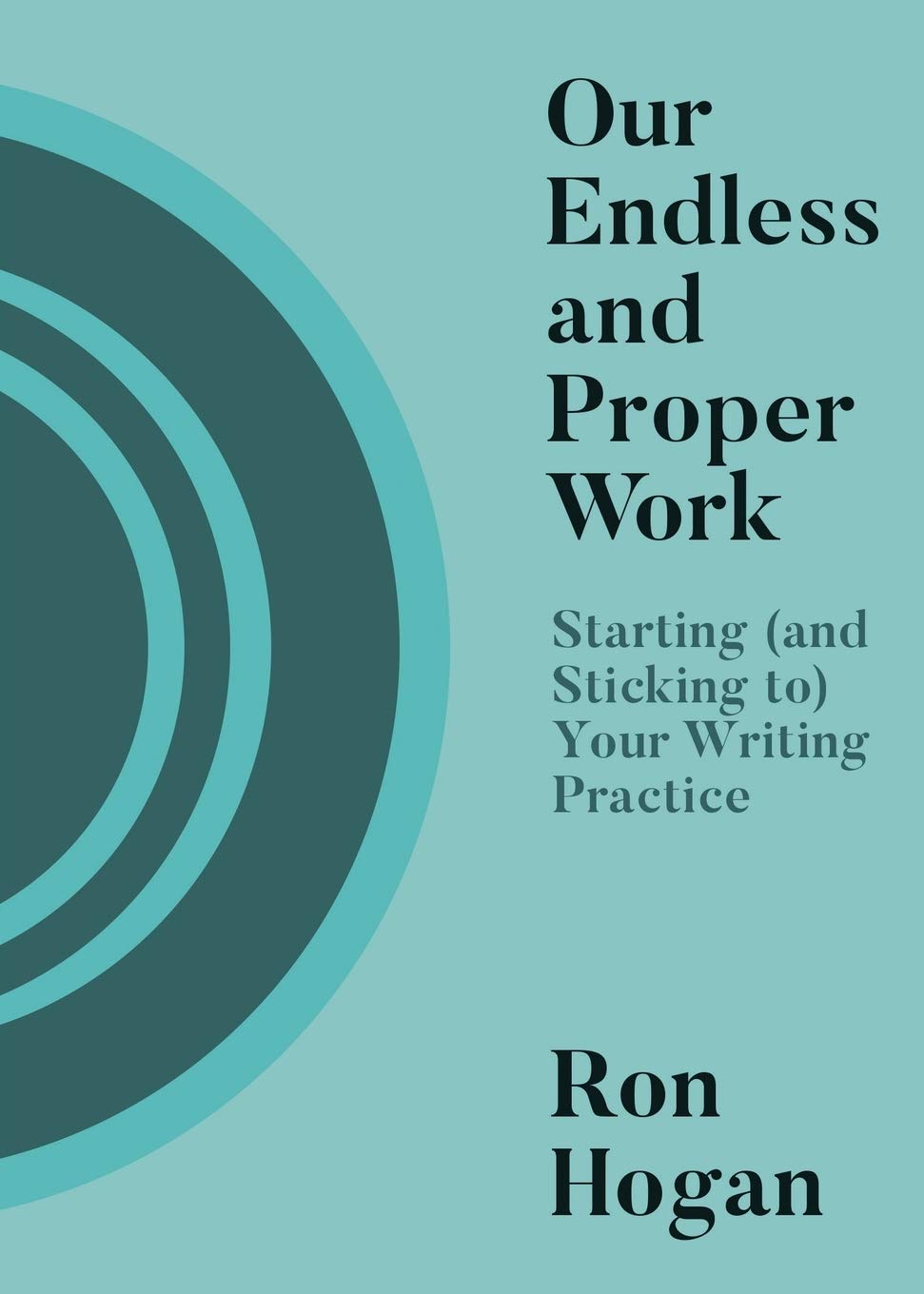 Our Endless and Proper Work is my new book with Belt Publishing about starting (and sticking to) a productive writing practice.