
Joe Kubert, 1926-2012
DC Comics
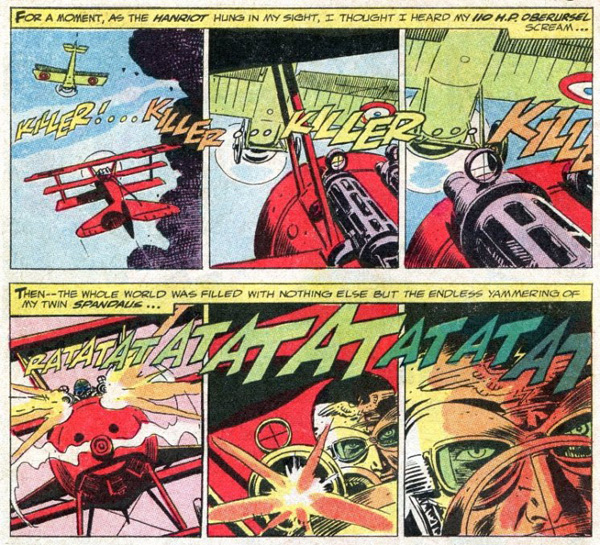
I was saddened yesterday afternoon to hear about the death of the comic book artist Joe Kubert. Although I came of age about a decade too late to be reading Kubert’s work when it came out, I did see a lot of references to those comics, especially Sgt. Rock—but once I had a chance to catch up with the stories, I actually leaned more towards the doomed German WWI fighter pilot Enemy Ace, from which the brief excerpt above is taken.
If you get the chance, you should track down the DC Showcase editions for those two characters; the stories are filled with one amazing example after another of Kubert’s cinematic approach to laying out a story in sequential panels. The example I’ve chosen is fairly conservative; in other stories, Kubert could produce stunning layouts that presented “close-up” panels embedded within larger panoramas, nimbly calling attention to the most important story elements while—and this is crucial—not being so virtuosic that you’d be paying attention to him rather than the story. He also had a wonderful eye for historical detail, which you’ll see in every page. He did do superhero comics at various points throughout his career, but there’s a realistic tone to his best work that… well, when I first started getting into it, the closest comparison I could come up with to explain it to other people was the equally great Will Eisner.
During his lifetime, Kubert founded a school for cartooning and graphic arts, which became a training ground for artists like Tim Truman, Steve Bissette, Rick Veitch, and Amanda Conner. He also raised two sons, Andy and Adam, who are themselves accomplished comics artists; in fact, Kubert’s last gig appears to be inking Adam’s pencils on one of DC’s Watchmen prequels. I haven’t actually read any of it, but the artwork I’ve seen online has an old-school vibe I suspect fits the project well.
13 August 2012 | obituaries |
Dorianne Laux, “The Rising”

John Campbell
The pregnant mare at rest in the field
the moment we drove by decided
to stand up, rolled her massive body
sideways over the pasture grass,
gathered her latticed spine, curved ribs
between the hanging pots of flesh,
haunches straining, knee bones bent
on the bent grass cleaved
astride the earth she pushed against
to life the brindled breast, the architecture
of the neck, the anvil head, her burred mane
tossing flames as her forelegs unlatched in air
while her back legs, buried beneath her belly,
set each horny hoof in opposition
to the earth, a counterweight concentrated there,
and by a willful rump and switch of tail hauled up,
flank and fetlock, her beastly burden, seized
and rolled and wrenched and winched the wave
of her body, the grand totality of herself,
to stand upright in the depth of that field.
The heaviness of gravity upon her.
The strength of the mother.
The Book of Men, the fifth collection of Dorianne Laux‘s poems, is the winner of the 2012 Paterson Poetry Prize. The book is dedicated to Philip Levine; the poem “Mine Own Phil Levine” originally appeared in Valparaiso Poetry Review. Orion published “Juneau” (as “Juneau Spring”) and “Roots.” Willow Springs published “Staff Sgt. Metz,” along with a short essay about its creation.
(In 2007, Beatrice featured Laux’s “Moon in the Window.”)
10 August 2012 | poetry |
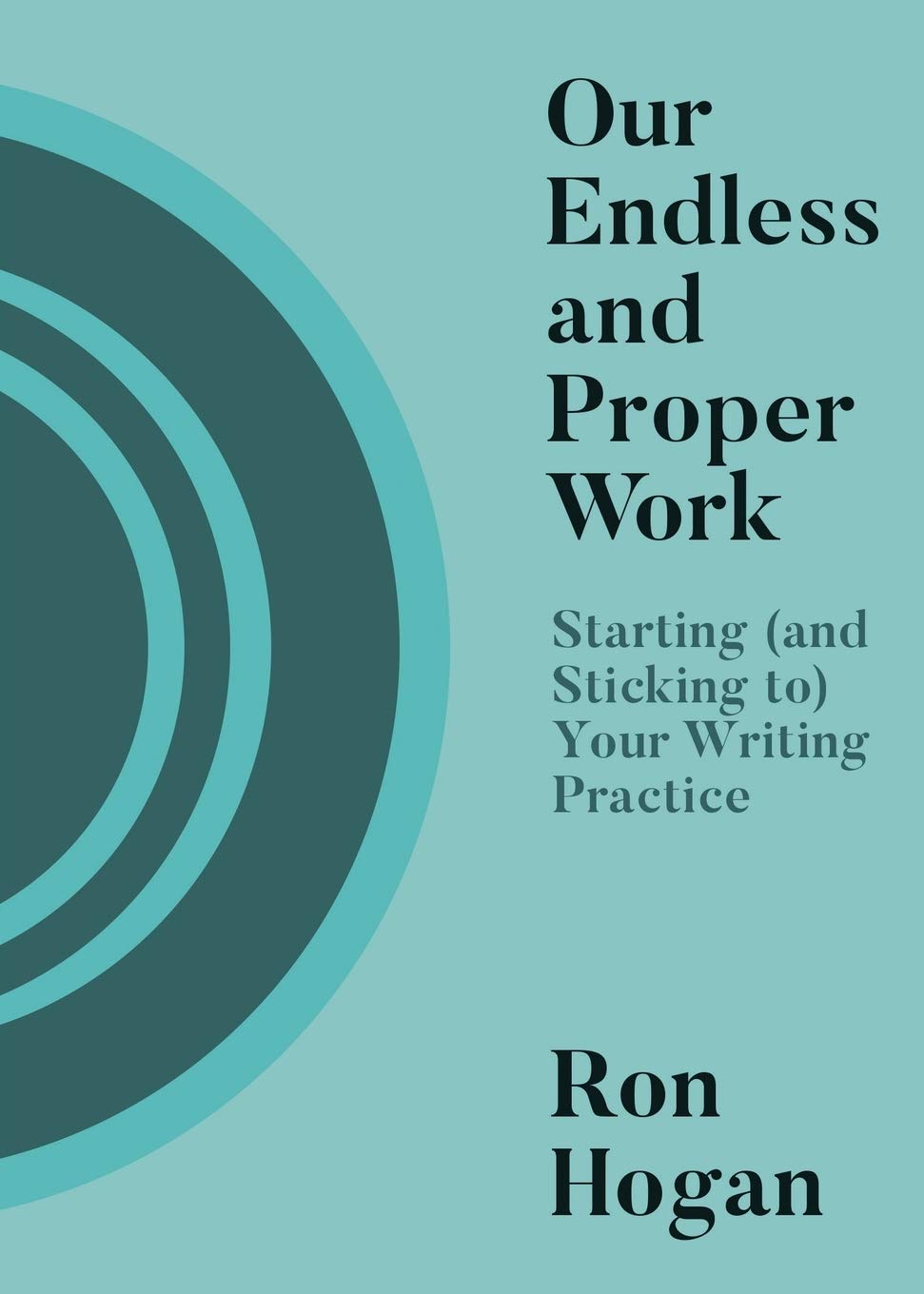 Our Endless and Proper Work is my new book with Belt Publishing about starting (and sticking to) a productive writing practice.