
Did the National Book Awards Need Fixing?
In recent years, the National Book Awards have come under a heavy amount of public criticism for the books they’ve proposed as the most outstanding in American letters in a given year. The criticism is almost exclusively aimed at the fiction selections, with the general thrust being that the writers who are appointed to the selection jury have some sort of elitist writerly criteria for picking precious, obscure books rather than books that ordinary people might have heard of. I’ve never gone in for that reasoning, and I’ve always value the perspective of the NBA juries—I may be fairly well-read by most statistical standards, but I know I’m barely skimming the surface of what’s available, so as far as I’m concerned calling my attention to excellent books I might have missed is a fine thing.
(In the interest of full disclosure, I should add that I’m friendly with several folks at the National Book Foundation as well as outspokenly sympathetic to their aims, to the point where I’ve contributed to their website.)
Now, there have been some changes in the NBA selection process, which in and of themselves are not so remarkable or unsettling. In fact, putting literary critics on the selection juries is actually a return to the way things used to be, as Foundation director Harold Augenbraum notes in the press release—in an ideal world, his prediction that “by enlarging the judging pool new and exciting voices will again deepen and enrich the process” is absolutely on target. Likewise, announcing preliminary ten-book “longlists” for each of the NBA categories a month before the traditional five-book finalist announcements, could well be an opportunity to expand the conversation around those books.
It’s when the rationale for these changes is elaborated to the media that I start to feel less enthusiastic; specifically, the remarks by Foundation board member Morgan Entrekin (who’s also the publisher of Grove/Atlantic and—again, full disclosure—somebody I’ve always respected and been delighted to run into as one does in the not-so-large world of mainstream book publishing) essentially conceding that the fiction shortlists have been “very eccentric” and affirming that the goal of a wider slate of candidates is to make the lists “a little more mainstream,” reducing the possibility that the award would go to what he seems to dismissively refer to as “a collection of stories from a university press.” (Two such books have actually been nominated in recent years, with Bonnie Jo Campbell’s American Salvage and Edith Pearlman’s Binocular Vision.) As far as he’s concerned, there’s plenty of prizes for books like that; the National Book Awards, he seems to suggest, should be about something bigger.
15 January 2013 | theory |
Eat This: Potato-Cucumber Salad
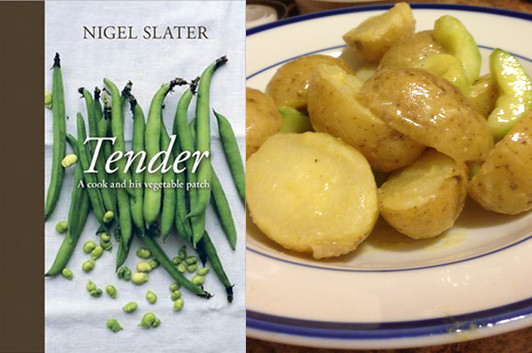
I got a new cookbook for the holidays—Nigel Slater’s Tender—and I’ve spent the last week or so poring over the gorgeous photography and Slater’s stories about how he began growing vegetables in his backyard in London. One of the easiest recipes I found during my initial reading was for a salad of boiled potatoes with cucumber slices, in a Dijon dressing (with a bit of cider vinegar, olive oil, and crushed juniper berries). So I tried it last night, and it came out really well! It’s very simple to make, maybe a half hour from start to finish, and the end results were delicious.
I think the next time I make this dish, I’ll probably do a few slight adjustments: I used the high end of the recommended range of potatoes to boil, and that was probably more appropriate for a party of four, rather than just for me and my wife, so I’ll bring that down a notch. And I suspect I could’ve added a little bit more black pepper to the dressing as I was mixing it; I gave the grinder a fair number of twists, but the dressing feels like it could stand a few more. I’m also vaguely curious about what swapping out the juniper berries with crushed garlic cloves might do in terms of flavor, but I won’t be getting around to that for a while. (For one thing, I’ve got all these juniper berries left…)
This salad was so easy to prepare, though, that it encourages me to dive even further into Tender, and its fruit-themed sequel Ripe for additional healthy recipes. The winter’s a great time of the year, after all, to be experimenting with potatoes and other root vegetables…
9 January 2013 | cooking |
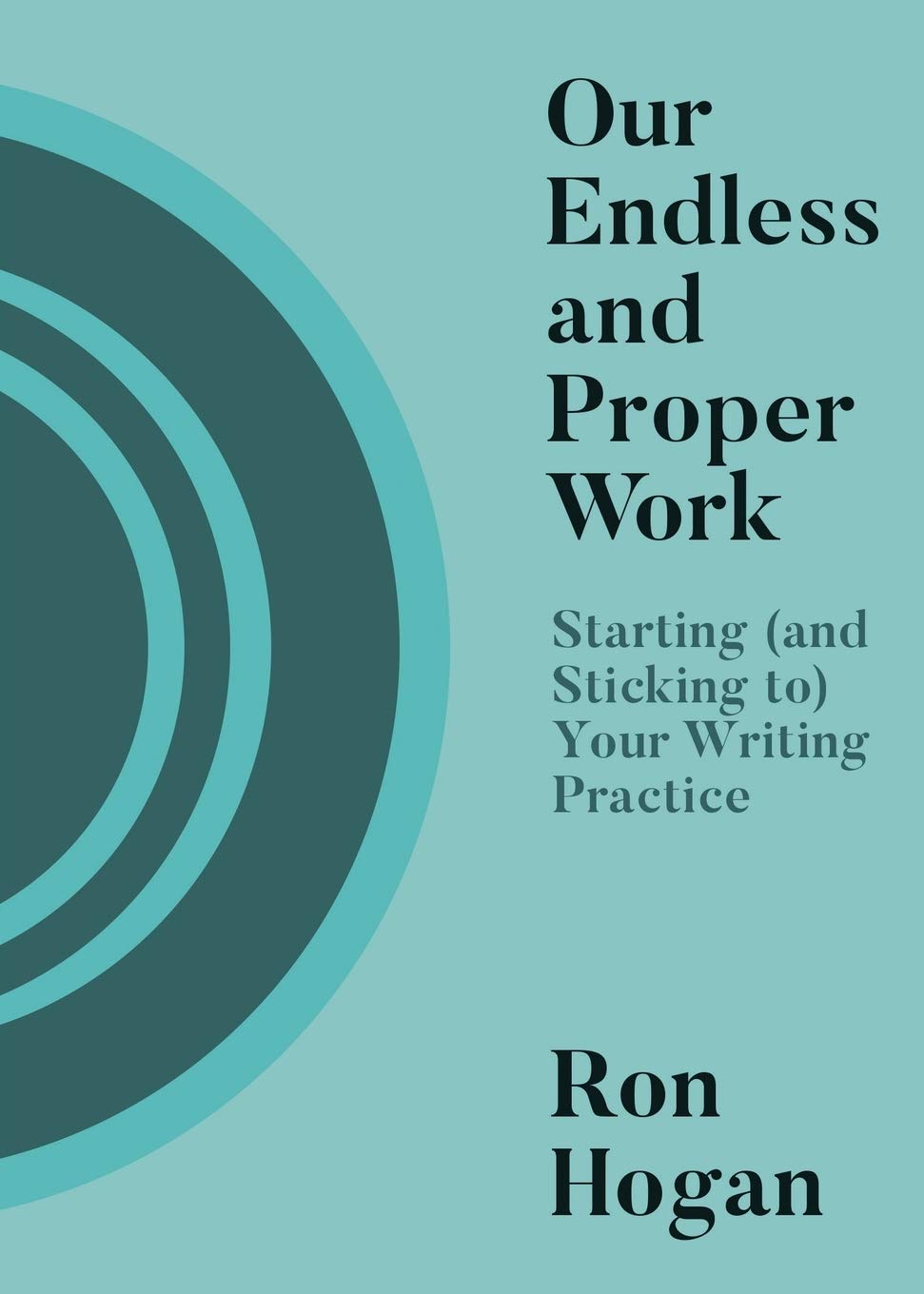 Our Endless and Proper Work is my new book with Belt Publishing about starting (and sticking to) a productive writing practice.