NYPL Prez: Libraries Are Here to Stay
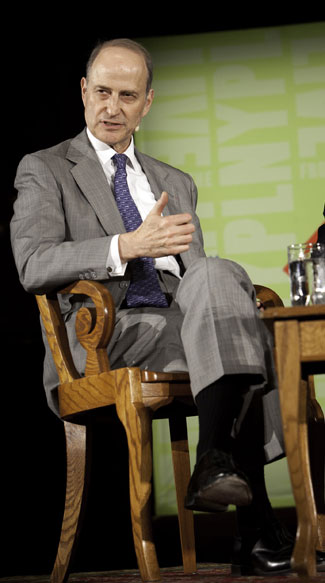 “I don’t have any patience for people who think libraries are going to become an anachronism any time soon,” New York Public Library president Paul LeClerc (right) said towards the end of a discussion with Bruno Racine of France’s Bibliothèque Nationale held at the NYPL’s Celeste Bartos Forum last week. “If there’s any sort of organization that’s deeply entrenched in American life, it’s libraries.” LeClerc had already spoken eloquently about libraries as “places that help build human capital” and emphasized the important role libraries can play in times of economic hardship: “A lot of our patrons can no longer afford to buy books. They don’t have wireless access at home.” The library was as much an anchor for the community, he noted, as a place for scholarly research.
But when it came to scholarly research, he was very enthusiastic about the impact of the Google Books program, to which the NYPL had contributed 300,000 scanned public domain volumes. “If your books are put online,” he said, “they will be used more often, and maybe more deeply, than they ever were before.” And he rejected the notion that putting these books online would cut into the publishing industry’s revenues. “Our purpose at the New York Public Library is to let people have access to our material,” he said forcefully. “Physically and, when we can, online. We drew—not a line, but a trench, in the sand, when it came to copyright, and we’ve never even approached the edge of that trench.”
One key issue moving forward, then, is making the library a more attractive place for scholars and writers to be at when as researching remotely online becomes easier. “My sense is that we should let everyone who’s going to be here with us for an extended amount of time… make their presence known,” LeClerc said, brainstorming scenarios where visiting researchers could use social media tools to see who else in their field was also around, forming impromptu communities online or at the library itself. It’s not the one thing that will either make or break any library’s future, but his ideas do point towards the welcome opportunities for any large library to become not just a repository for knowledge but an engine for generating new knowledge, too.
photo: Jori Klein
5 May 2011 | uncategorized |
 Our Endless and Proper Work is my new book with Belt Publishing about starting (and sticking to) a productive writing practice.