
Susan Higginbotham: Discovering a Story in Edward II’s Court
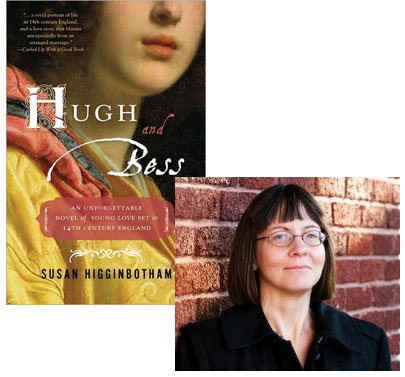
I’m a sucker for historical fiction, so when I heard that Susan Higginbotham was making the rounds on the book-lovin’ Internet, introducing readers to her second novel, Hugh and Bess, my curiosity was piqued—not least of all because, based on what I’d gleaned from my preliminary readings, she’d dialed back the “epic” approach of her first novel, taking up a secondary character from that book and looking at him through a more intimate perspective. What, I wondered, led Higginbotham to that story? She was happy to explain.
When I first encountered Christopher Marlowe’s Edward II in graduate school, my professor told us, “Every English schoolboy knows how Edward II died.” Not being English or a schoolboy, I hadn’t heard of this king before; in fact, I would have been hard pressed to name any English kings before the Henrys in Shakespeare’s history plays. I most certainly couldn’t sort them out by Roman numeral. I read the play, and like my classmates duly shuddered when poor Edward meets his dreadful (and probably apocryphal) end. Then I forgot about him.
Over fifteen years, several moves, and two children later, I was surfing the Internet one night and came across an online version of the Marlowe play. I began reading a scene here and a scene there, and soon I simply gave in and re-read the whole play from start to finish. For some inexplicable reason, what I had found merely an interesting story back in the 1980’s had become a fascinating one to me now. I don’t know why, but I like to think it was simply because I was smarter in the 2000’s than I was in the 1980’s. Maybe it was because I no longer had those 1980’s shoulder pads wearing me down.
In any case, I am one of those people who feel compelled to read everything I can on a subject in which I become interested. (There’s probably something in the Diagnostic and Statistical Manual of Mental Disorders about this; I’m better off not checking.) My quest for reading about all things Edward II soon took me to the local university library, and that’s where I discovered the tragic Despenser family, the most famous of whom were the father-and-son favorites of Edward II. From the thirteenth-century Hugh le Despenser, who fell in battle at Evesham beside Simon de Montfort, to the fifteenth-century Richard le Despenser, who died at age 18, each Despenser heir had died violently, young, or both.
My interest in the Despenser family had coincided with my newfound interest in fiction writing. As I began looking for information about the family, I discovered Eleanor de Clare, wife to Hugh le Despenser the younger and niece to Edward II. Her story, which took her on several revolutions of Fortune’s Wheel, begged to be told, and it turned into my first published novel, The Traitor’s Wife. (Along the way, I finally got all of my King Henrys and King Edwards straight. I still have trouble with the Georges.)
With The Traitor’s Wife complete, I suffered from the dreaded second novel syndrome. Lots of subjects intrigued me, but I found it difficult to settle down to write about one. After some false starts, I decided to write the story that I’d probably always wanted to write in the first place—the story of Hugh le Despenser, Eleanor de Clare’s son. I’d left him single and slowly working his way back into royal favor. He’d become one of my favorite characters in The Traitor’s Wife, and I wanted my readers to like him as much as I did.
Hugh had an advantage over his ill-fated father and grandfather: he lived in a time of peace within England, a time when a glamorous young king and his beloved queen sat on the throne and where the English enjoyed military victories over the Scots and the French. This was good for Hugh and his countrymen in the 1340’s, but for me as an author, it meant that I had a much smaller canvas to work on. Because of this, I decided that I would tell a very different story than that I told in The Traitor’s Wife: the love story between Hugh and his reluctant young bride, Bess de Montacute.
I knew enough about the historical Hugh to get a basic idea of what sort of person he was, but Bess was a different matter. I knew whom she had married, when she had died, what lands she had held, the names of her children, and where she was buried. (Thanks to the delightfully ghoulish Victorians, I even knew what she looked like when her tomb was opened in the 1800’s.) But I knew nothing about her personality, so I had the freedom to invent one for her. I can only hope that I did her justice; but in case I didn’t, I’ll be watching out for falling masonry when I next visit her burial place, England’s lovely Tewkesbury Abbey.
8 August 2009 | guest authors |
 Our Endless and Proper Work is my new book with Belt Publishing about starting (and sticking to) a productive writing practice.