Kwei Quartey Re-Embraces the Ghana of His Youth
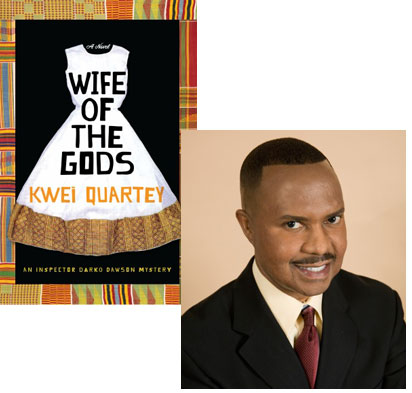
Wife of the Gods introduces a new contender in the international police procedural genre—Kwei Quartey. The novel is set in the West African nation of Ghana, shifting between the capital city and smaller villages several hours’ drive away, and incorporates local superstitions and controversial cultural traditions into the investigation of the death of a young medical student volunteering to teach the villagers about AIDS awareness. Quartey was born in Ghana but, because his mother was an American citizen, he had dual citizenship—a fact that came in handy when he became a “person of interest” to the military government after being caught putting up anti-government posters. He came back to the U.S., and eventually went into medical school; today he practices in the Los Angeles area, but he’s never abandoned his love of writing. I was curious to hear what it was like writing a mystery set in a land he hadn’t seen in many years, and he was kind enough to send the following essay by way of explanation.
I had been living in the United States many years when I began Wife of the Gods. Originally, I set the story in an imaginary West African land, but a literary agent wondered why I had not used Ghana for the setting. After all, I had once lived there. Ostensibly it was because I had been in the States for so long without returning to Ghana to visit that I wasn’t confident that I could portray the country accurately. On a deeper psychological level, though, I seemed more comfortable with a “Ghana-like” country than the real nation with which I had an emotional link. Was I, for some reason, skirting those emotions?
It then became a matter of re-embracing Ghana. When I finally did so, the writing became plainly more enriching. It was like taking a plunge in the pool and discovering that the water was just fine.
I’ve always had a scientific mind. As a boy growing up in Ghana, I was crisply confident that almost everything in life was of a biological, chemical, physical, psychological or medical nature. In my teens, I chose a science curriculum at school, the path that took me on to the study of medicine.
Outside the cocoon of my scientific convictions, there was an alternative world in Ghana. We sometimes heard about juju, which is a fetish or charm, or the magical powers attributed to such an object. At one point in Accra, Ghana’s capital, there was a lively rumor about a juju “going around” the city and making men impotent. Naturally, this was the stuff of nightmares for any believing human male. My amusement at this story of juju-induced impotence was tinged with disdain.
The comfortable bubble of my scientific world was similar to my family’s socioeconomic status. My brothers and I were the children of two lecturers at the University of Ghana, arguably an ivory tower where life was detached from the common man, woman and child. That was but one example of the inequalities we saw in Ghana. Of course, such contrasts also exist in developed countries, but in emerging nations the disparities, much starker, assault one’s sensibilities.
What does the novel’s title, Wife of the Gods, mean? How does a woman become a wife of the gods? In essence, how does one connect the physical, tangible world with a realm in which gods dwell? For some in Ghana, the answer would be that there is no need to join the two, as they already coexist. Case in point: In the novel, a young woman is murdered and protagonist Detective Darko Dawson soon discovers that some people believe the death is the work of a curse from the gods.
These kinds of convictions come to involve Darko personally. His son, Hosiah, suffers from congenital heart disease. Both the boy’s grandmother and the traditional healer to whom she takes him believe that evil spirits are occupying the boy’s chest and causing his symptoms.
As a physician, I would have provided a well-packaged medical explanation of the mechanism of the Hosiah’s illness, but the evil spirits theory seeks to clarify the why as well as the how. If I were still the self-assured teenager that I was, I would have dismissed such “unscientific” notions out of hand. Now, as an adult and a writer, I examine them with curiosity and fascination, realizing that it is as difficult to prove that curses and evil spirits do not exist as it is to prove they do.
It’s been said that once you’ve been in Ghana, you can’t get Ghana out of you. Indeed, things Ghanaian, dormant in me for years, have been roused and channeled into Wife of the Gods: the flavor of the place, the sights and smells, the traditions of drumming, dancing and libation. But not those alone. So too have the contrasts that I once dismissed or took for granted: status alongside disadvantage, scientific theory versus belief in magical powers, and westernized as against traditional medicine. All of these contrasts also test Darko’s mettle as he investigates the murder of a smart and beautiful young woman.
7 July 2009 | guest authors |
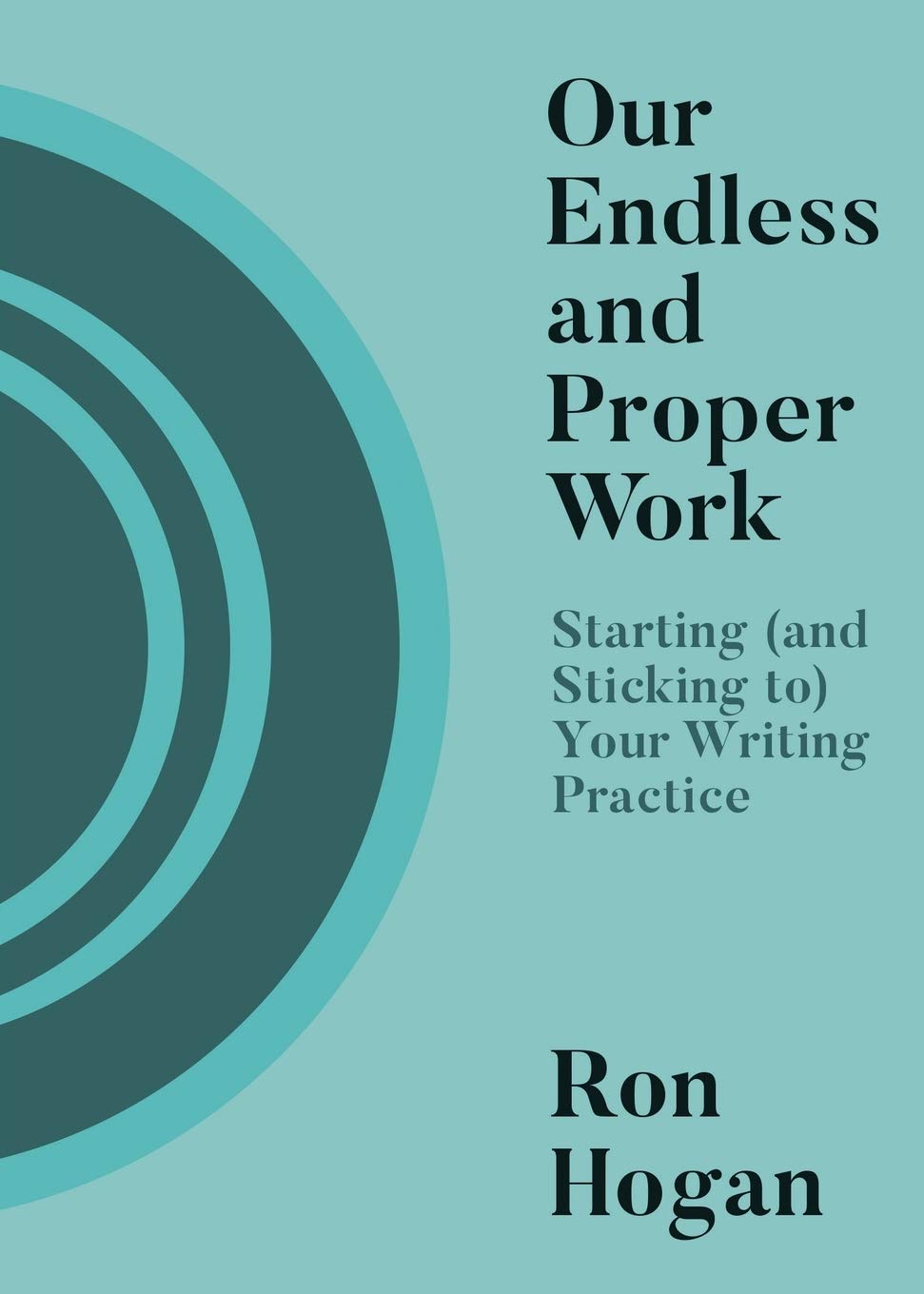 Our Endless and Proper Work is my new book with Belt Publishing about starting (and sticking to) a productive writing practice.