Daphne Beal & Matthew Quick @ The Merc (10/1)

The Beatrice.com reading series at the Mercantile Library Center for Fiction continues Wednesday, October 1, with two more debut novelists—and though their stories are very different (one’s set in Nepal and Bombay, the other during football season in Philadelphia), they share a common theme in their explorations of how difficult it can be to really know the people closest to you.
Daphne Beal (In the Land of No Right Angles) was on the editorial staff of the New Yorker and educated at Brown and NYU. Matthew Quick (The Silver Linings Playbook) earned his creative writing MFA through Goddard College.
This should be a fun evening, and possibly the last Beatrice @ The Merc reading that will be held at the library’s original midtown location (17 E 47th St.), so I hope you’ll come join us at 7 p.m. Wine and light refreshments will be served after the reading, and books will be available for you to buy and Daphne and Matthew to sign.
29 September 2008 | events |
Sana Krasikov: Two Stories Worth the Challenge
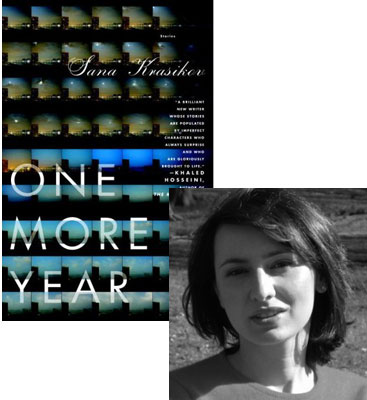
Last week, Sana Krasikov was named one of the National Book Foundation’s “5 Under 35,” an honor bestowed annually on five young American writers chosen by fiction writers who’ve already been nominated for National Book Awards. And this coming Friday (October 3), she’ll be taking part in one of the first panels of this year’s New Yorker Festival, appearing with Manil Suri and Yiyun Li. And while that buzz might prompt some readers to check out her debut short story collection, One More Year, they’ll stay with it because Krasikov’s characters—often precariously balanced between their old lives in Russia or Georgia and uncertain futures in the United States—are so powerfully drawn. They are not happy stories—but in this essay, Krasikov explains that she draws a different kind of inspiration from short stories that force readers to consider the world from an unsettling perspective.
There is a story by Peter Ho Davies, published in the Paris Review in the summer of 2002 that, if it isn’t yet a classic of short stories, I hope will be one day. Titled “The Ends,” it is no more than two pages long, and narrated by a Nuremberg Nazi war criminal, one of a dozen awaiting execution. From their cells, he and the others listen to the sounds of a basketball game being played by the GIs who guard them. It becomes quickly apparent that the bap bap of the ball is really the hammering of gallows. The men know the Americans are in charge, and that they hang men differently from the British, who follow a mathematical formula of weight per length of rope. The Americans use a standard length so that that “some have their necks snapped swiftly and some strangle slowly.” The ends, Ho Davies writes, are the same, the means different. The Nazis’ darkly humorous survey of execution methods underscores deep divisions between the Europeans and Americans. The Americans believe a standard length is measure of equality and democracy, but Goering, the star war criminal, sees this disregard for scientific rationality as being tantamount to lynching (he prefers the French guillotine, with its elegance and “a touch of the aristocrat”).
Getting the better of his executioners, Goering ends his own life with a cyanide pill, which the narrator of the story believes was obtained from the British who “with their god-like disdain for a scene” hoped to avert the spectacle of a fat man like Goering being decapitated. Moreover, he sees the pill as a symbol of the orderly British’s sympathy with the Germans’ “ends” if not with their means. In a page and a half, Peter Ho-Davies takes a reader from a basketball game to the concealed, split allegiances of whole nations. The story moves quickly from examining Goering’s immediate predicament to contemplating the rhetoric of “efficiency,” which won so many adherents during the 20th century and was used to justify so many of its crimes.
I’m often surprised when I hear readers talk about whether they are “enjoying” a book. The pleasure of reading takes many forms, but the conversations I’m referring to rarely move beyond the likeability of the characters (are they sympathetic?) or the narrative’s emotional tone (does the story offer hope or is it depressing?). Or we read anthropologically—to learn about an exotic culture, or to “get a glimpse” into a closed world. In other words, what’s interesting about the story is the information we take away from it. But such an approach to reading feels so much like one rooted in consumer culture. After all, why read something if it doesn’t have utility for the reader, if it doesn’t make you feel either better or smarter?
29 September 2008 | selling shorts |
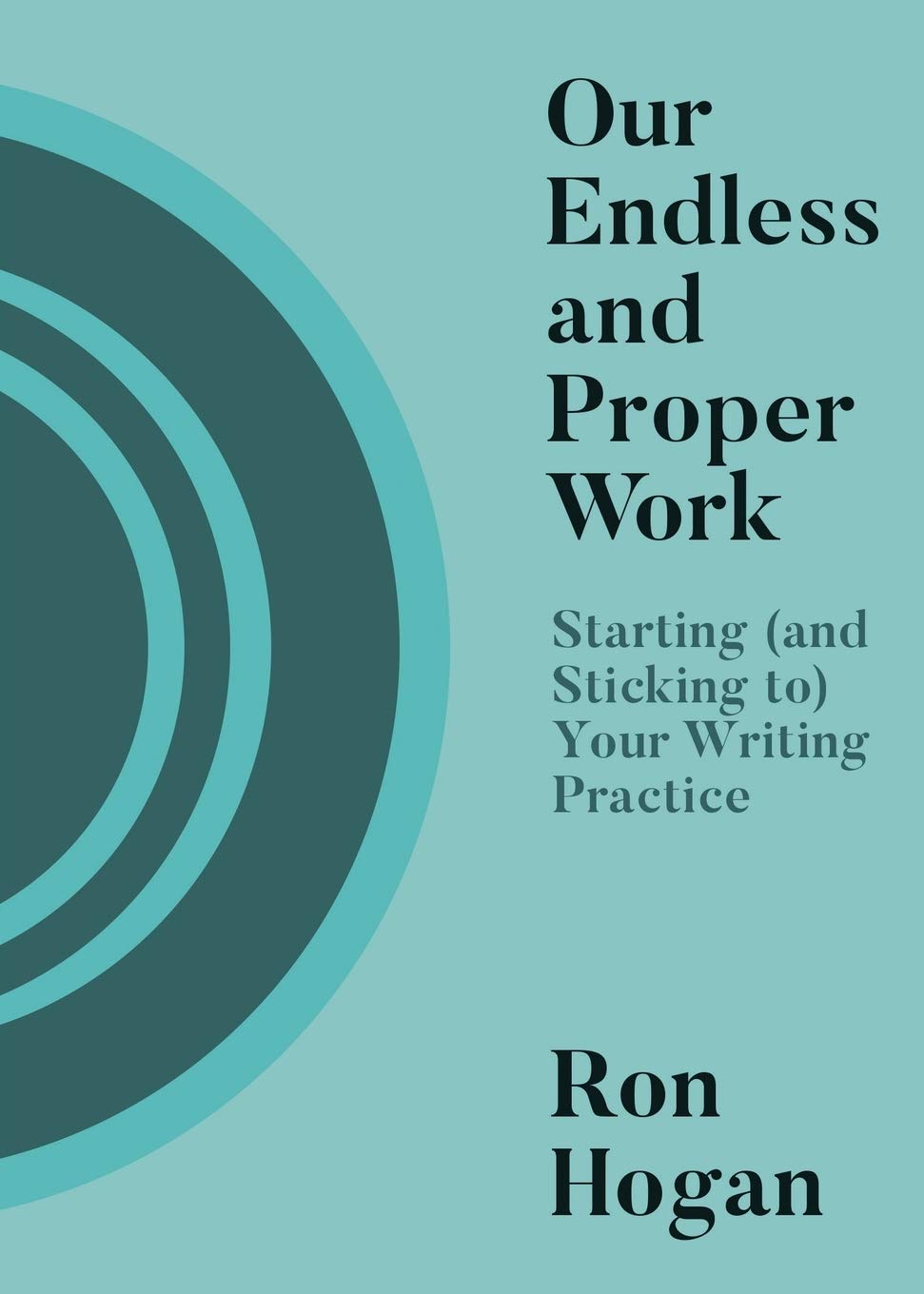 Our Endless and Proper Work is my new book with Belt Publishing about starting (and sticking to) a productive writing practice.