George Will Has Written Books, So This Is On Topic, Right?
Did you see yesterday’s George Will column? It’s so intensely critical of Bush’s nomination of Harriet Miers that Mrs. Beatrice asked not once, but twice, as I read it aloud, “Wait, this is George Will?” My favorite bits:
“[Bush] has neither the inclination nor the ability to make sophisticated judgments about competing approaches to construing the Constitution. Few presidents acquire such abilities in the course of their pre-presidential careers, and this president particularly is not disposed to such reflections.
“Furthermore, there is no reason to believe that Miers’s nomination resulted from the president’s careful consultation with people capable of such judgments. If 100 such people had been asked to list 100 individuals who have given evidence of the reflectiveness and excellence requisite in a justice, Miers’s name probably would not have appeared in any of the 10,000 places on those lists…
“It is important that Miers not be confirmed unless, in her 61st year, she suddenly and unexpectedly is found to have hitherto undisclosed interests and talents pertinent to the court’s role. Otherwise the sound principle of substantial deference to a president’s choice of judicial nominees will dissolve into a rationalization for senatorial abdication of the duty to hold presidents to some standards of seriousness that will prevent them from reducing the Supreme Court to a private plaything useful for fulfilling whims on behalf of friends.”
By now, it’s pretty much expected that Bill Kristol’s going to say he’s “disappointed, depressed, and demoralized” by just about anything Bush does, but for George Will to start slamming a Republican president this hard…well, the possibility came up in discussions here last night that Bush just doesn’t care anymore and is going to spend the next three years phoning it in even more than he did in his first term…
6 October 2005 | uncategorized |
Don Silver: Writing Back from the Brink
 Don Silver is the author of Backward-Facing Man, a novel set during the social upheavals of the 1960s and early ’70s. In this note to Beatrice readers, he explains how he came to write fiction when his own life was turned end over end.
Just before my family’s business collapsed, I’d separated from my wife of nineteen years, and was therefore unable to distinguish between those two great liberations. The company, the girl I married and I had, all three of us, since high school, been a strange ménage a trois—and the splitting apart was both wrenching and inevitable. We’d become as incompatible as different plaids.
The company had once been the biggest and most innovative in its little field, but by the 1980s, was in precipitous decline. I was named President & CEO the same year a vicious family feud was settled for a lot of money, money that was sorely needed to modernize the business. We tried our hardest, but after seven years, the bank modified our loan agreement, hired a turnaround manager and insisted we offer up the company for sale.
The breakup of the marriage was more my doing, or undoing, depending on how you look at it. I was almost forty. My ambition had fizzled and seeing my diminishing chances of being an accomplished athlete, tycoon or virtuoso guitarist humbled, and then hobbled, me, which I’m sure made me a lot less attractive to my wife. I had elaborate fantasies of spending my days reading and writing poetry, activities which I’d forsaken, along with romanticism, in my late teens. I was exhausted from being the sole breadwinner supporting my wife and four children and I was either foolish or clever enough to tell her that. I will spare you the details of our deliberations, the separation, and the reaction of our children, except to say I was fitted with a mouth guard by my dentist and advised by a wincing physician to take as much Xanax as I needed. Really, he told me. Go ahead.
It was under those circumstances that I started writing a novel.
5 October 2005 | guest authors |
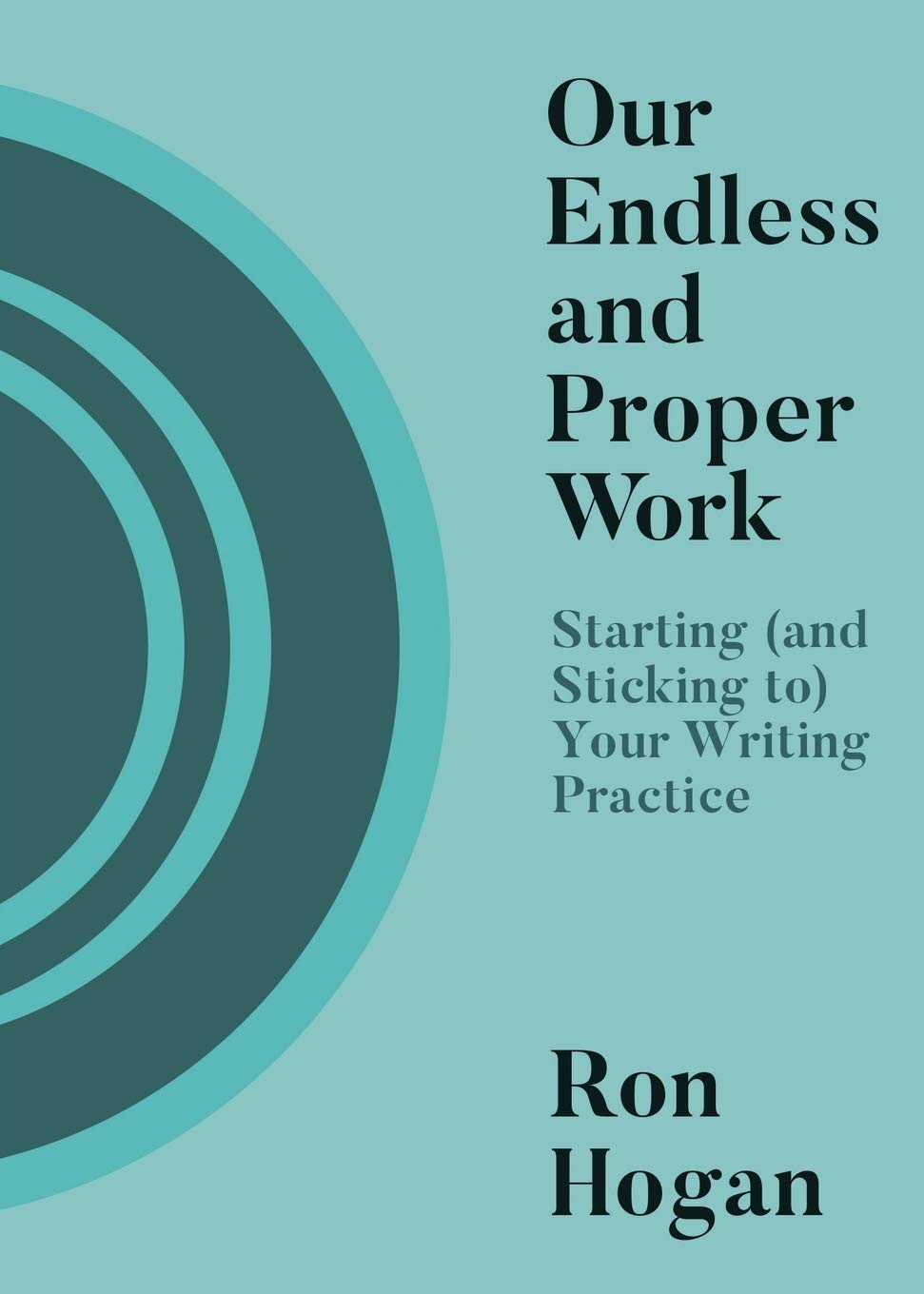 Our Endless and Proper Work is my new book with Belt Publishing about starting (and sticking to) a productive writing practice.