
Patrick O’Keeffe Gets “Carried Away”
I’m launching a new essay feature on Beatrice this week, in which short story writers will be invited to comment upon their favorite short stories or short story writers. It’s called “Selling Shorts,” which is an admittedly egregious pun, and probably a bit mercenary for a bookblog, but I hope it’ll come to grow on you—and the authors will be swell, at any rate.
First off, I’ve invited Patrick O’Keeffe, whose The Hill Road is [UPDATED: the winner] of the second annual Story Prize. He graciously agreed to contribute an essay about Alice Munro’s “Carried Away,” which can be found in the collection Open Secrets.
“Take what you have gathered from coincidence”—Bob Dylan

Alice Munro, in Open Secrets, resembles Tolstoy, in that she convincingly gives you the entire social structure of a place, in her case the town of Carstairs, from top to bottom, each character from the inside out. “Carried Away,” Louisa’s story, is constructed around a set of bizarre, though plausible, coincidences. Louisa is initially a commercial traveler; she later becomes the public librarian, and receives letters from Jack Agnew, a soldier in the First World War. She sends him a photograph, falls deliriously in love with him, but when he returns from the war, he marries the dull, conventional Grace. Louisa, unlike Grace, possesses “some consciousness of herself as a heroine of love’s tragedy.” Jack, however, was engaged to Grace before he went off to the war. He sneaks books out of the library, but never approaches Louisa, whose love for a man she has never seen persists. There is an indication of mythology, of legend, to all this.
Once an outsider and a stranger in the town, Louisa, as time passes, ends up doing well for herself, because she marries Arthur Doud. The Doud family owns the piano factory, which is the town’s chief employer. One afternoon, Arthur visits the library to return Jack Agnew’s books, given to him by Jack’s wife, Grace, after Jack is beheaded in an accident with a mechanical saw in Arthur’s factory. Louisa doesn’t tell Arthur about Jack, and a new episode in both of their lives begins.
24 January 2006 | selling shorts |
How Linda Donn Discovered Her Balloonist
After writing two nonfiction books (which she’ll tell you more about below), Linda Donn has come out with her first novel, The Littlest Balloonist. The story of how she found the subject and setting for this foray into fiction is a happy accident which I hope you’ll find as interesting as I have.
When I began to write about my heroine, Sophie Blanchard, I was surprised to find the little French balloonist as familiar to me as if I had known her for a long, long time.
I would like to explain how this came about.
Years ago, I was writing my first book, a nonfiction story about the friendship between Sigmund Freud and Carl Jung, and I did a lot of research in the Rare Book and Manuscript Division of the Library of Congress. Even on a blistering hot day in Washington, D.C., it is very cold in the archives. It helps preserve the old papers. And so, to warm up—and because you can’t help but get stuck in research sometimes—I would get up and wander around the room and pull out the drawers of files that describe the different collections in the Manuscript Division. There are large lives in there—Kennedys and Roosevelts and Fords and the like. But there is also a little archive, all in French, about the adventures of the early balloonists. I can read French, and so it amused me to read about their escapades—they once sent an elephant up in a balloon, and described as him as ‘superb’ and ‘modest’!
Then, too, I read descriptions of the young Sophie Blanchard, how generous and daring she was, and how she became Napoleon Bonaparte’s official balloonist.
When I finished writing the book on Freud and Jung, I thought of doing a book about that brave little band, but I couldn’t figure out how to structure the story. I mentioned the problem to a friend—who happened to be a Roosevelt—she said, “Oh, you like stories about relationships. You should write about a group of Roosevelt cousins.” Well, I went back to the Rare Book and Manuscript Division and pulled out the drawers of Roosevelts—and found a fascinating story. But on my research visits, inevitably, I would get cold and stuck, and so I’d wander over to the drawer of my French balloonists.
And this time, when I finished my book on the Roosevelt cousins, I pulled out the folders about hydrogen balloons in 19th-century France and went to work.
23 January 2006 | guest authors |
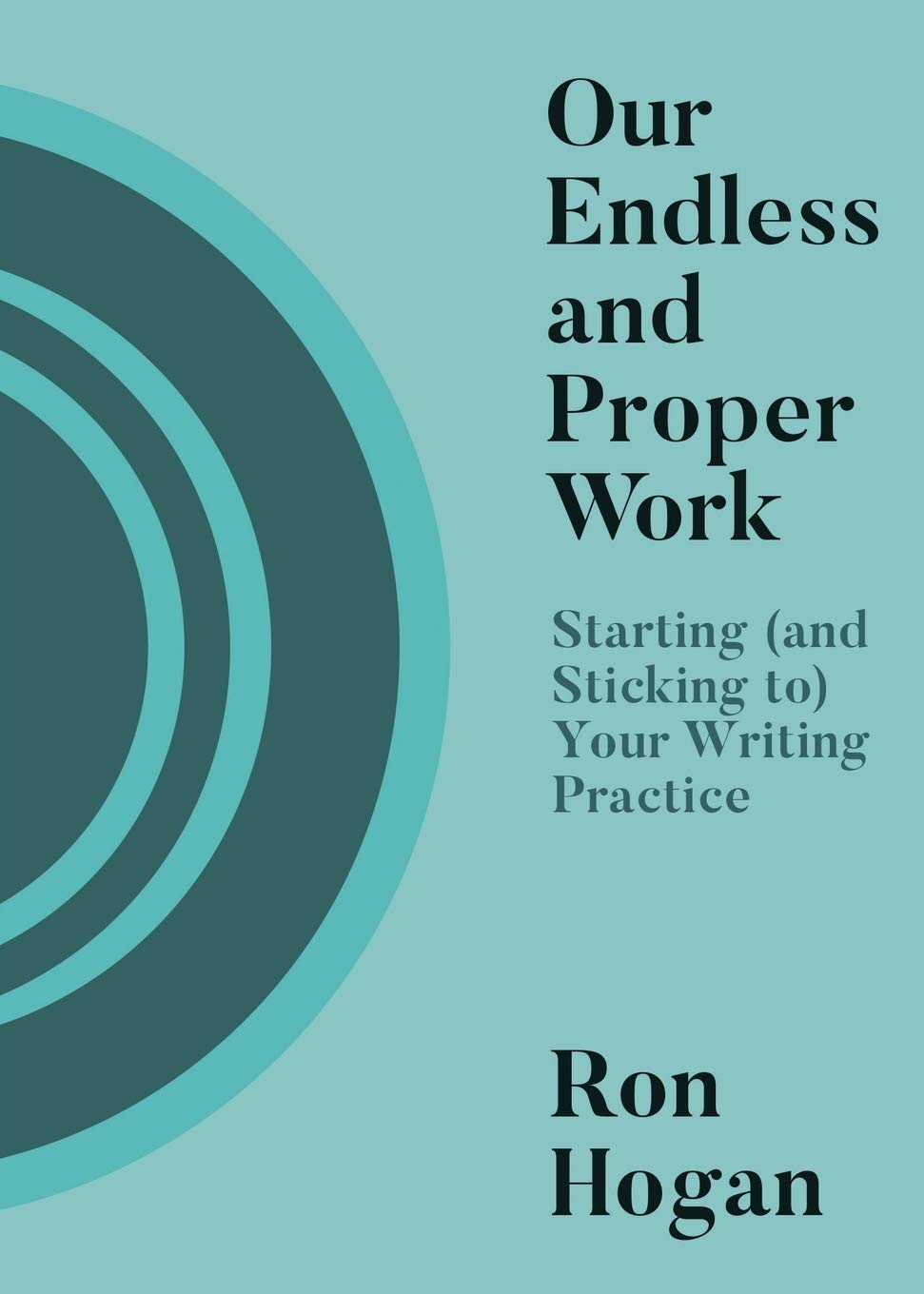 Our Endless and Proper Work is my new book with Belt Publishing about starting (and sticking to) a productive writing practice.