Author2Author: Patrick Ryan & Stephen Harrigan
When Patrick Ryan’s Send Me and Stephen Harrigan’s Challenger Park showed up in my mailbox within a few days of each other, I found their thematic correlations so intruiging that I immediately started thinking about how I could get the two authors talking to each other.
 Patrick Ryan: Reading Challenger Park was like stepping through a looking glass into a parallel universe. I grew up on Merritt Island, Florida, always in the vicinity of astronauts and launches, and have written fiction about characters in the shadows of that whole operation (either as employees with less-than-glamorous jobs or as local residents who just happen to have Saturn rockets and space shuttles climbing into sky over their shoulder while they’re, say, mowing the lawn). Your novel is about actual astronauts, so I felt as if I were reading the story of what was happening on the other side of the glass, so to speak. It was fascinating for me, and interesting that the challenges your characters face are, in some ways, very similar to ones mine face.
Can you talk a little about how the themes of the book may or may not have affected the writing? I could argue that some of Challenger Park‘s themes are regret, self-disappointment, and certainly isolation. Also, there’s the idea of “Ground Control” and what that means. Many of your main characters are in various states of being “ungrounded” (sometimes literally). Do you feel that these themes helped shaped the book as you were conceiving it (before the actual writing), or that they emerged as you began producing pages? I guess another way to ask that is, did you see the themes on your way in, or on your way out?
Stephen Harrigan: I knew I wanted to write a book about a woman astronaut caught between the pull of her own ambitions and the responsibility she feels toward those who depend upon her on earth, so I guess the theme was there from the beginning, though I didn’t announce it to myself as such. The word “theme” has always uncomfortably reminded me of stultifying classes in high school or college, in which a novel or a poem or a story was presented as something that needed decoding. If you could discover the theme, you could understand a piece of writing in some approved way. But I’d be lying if I didn’t admit that I worried and fretted over the meaning of this book all the way through.
I have a day job as a screenwriter, and because screenplays are such relentlessly efficient narrative machines I’ve fallen into the habit over the years of constantly asking myself questions as I write: what is this book or movie really about? What is it that the character really wants? What is in his or her way? Those sorts of questions can be cripplingly didactic to a writer early in his career, when a certain amount of flailing about is probably necessary and healthy, but later on, when you’ve learned a few things about your limitations, it can be liberating. If you keep posing the right questions to yourself, you can begin to shape the story with a clear purpose in mind. You can see what’s crucial to the story, and what you don’t need to write after all.
Send Me is labelled as “fiction” on the jacket rather than, as is usually the case, “stories” or “a novel.” At first I thought this was just some sort of marketing strategy on the publisher’s part, but after I read four or five of the pieces and began to get an idea of how they fit together, I soon realized that the book was earning its unusual categorization. It’s not a collection of short stories, even though each of the chapters has a kind of stand-alone artistry, and it’s not a novel, even though the book has by the end the force of a sustained narrative. I’m such a literal-minded, one-chapter-after-the-next sort of writer I can’t imagine being able to tell a story this way, and I’m filled with admiration for how beautifully you’ve made this book work.
The way you’ve put it together—continually juxtaposing the past against the future, putting bright scenes of family togetherness in one chapter, then leaping ahead to expose the chilling dissolution of that family in the next—ensures that the reader is always following the fortunes of these people with a haunted awareness of what they are trying to escape from and what is in store for them. So to finally get to my question: Were you consciously focusing on the structure of this book all the way through and writing to achieve a specific overall effect, or did you write the various pieces as they occurred to you and then felicitously found the perfect order in which to link them?
Patrick Ryan: I think I would have the same reaction you did to seeing the moniker “fiction” on the cover (wondering if the book was simply unwilling to commit to being either a novel or a story collection), and I’m delighted that you found an overall sustaining sense of narrative in the book. Calling the book simply “fiction” was actually my idea, and I was surprised and very happy that my editor saw why I wanted to use the term and that she was in favor of it. My earliest conception of the book was of an interwoven series of narratives about a family—six main characters—whose lives constantly intercept and profoundly affect one another. I saw it as a book that would have a half-dozen overlapping arcs, as opposed to one dominant arc that a reader would normally expect from a novel. There were storylines I outlined and never wrote, of course, and some I tried to write and dropped. I played around with the order the parts might be arranged in, but I always wanted them to be presented out of chronological sequence.
To answer your question more succinctly, I did consciously focus on the structure of the book from the first day I started taking notes on it; I just wasn’t sure where all the pieces would land. Some of them, once they were written and revised, clearly announced themselves as wanting to be placed near the beginning or near the end or—as was the case with the longest piece, “Woman in a Fan Chair”—smack dap in the middle of the book. And some of the pieces I moved here and there to see how it would affect the overall narrative.
18 March 2006 | author2author |
Read This: Jack Fish
 So I’ve been dipping back into J Milligan’s Jack Fish, in anticipation of his appearance tonight at Coliseum Books, and it’s reminding me all over again why I like it so much. Sure, a lot of it has to do with its New York-specific, and for that matter outer-borough-specific, humor, but saying it’s “just a New York book” would be like saying The Brother From Another Planet is “just a New York movie.” And, yeah, I chose that example quite deliberately. Here’s the thing: I love science fiction that stays true to its central conceits, but doesn’t feel the constant need to take itself so damn seriously. So I dig the Pohl & Kornbluth collaborations, I dig Robert Sheckley and Frederic Brown, and now I’m digging J Milligan.
16 March 2006 | read this |
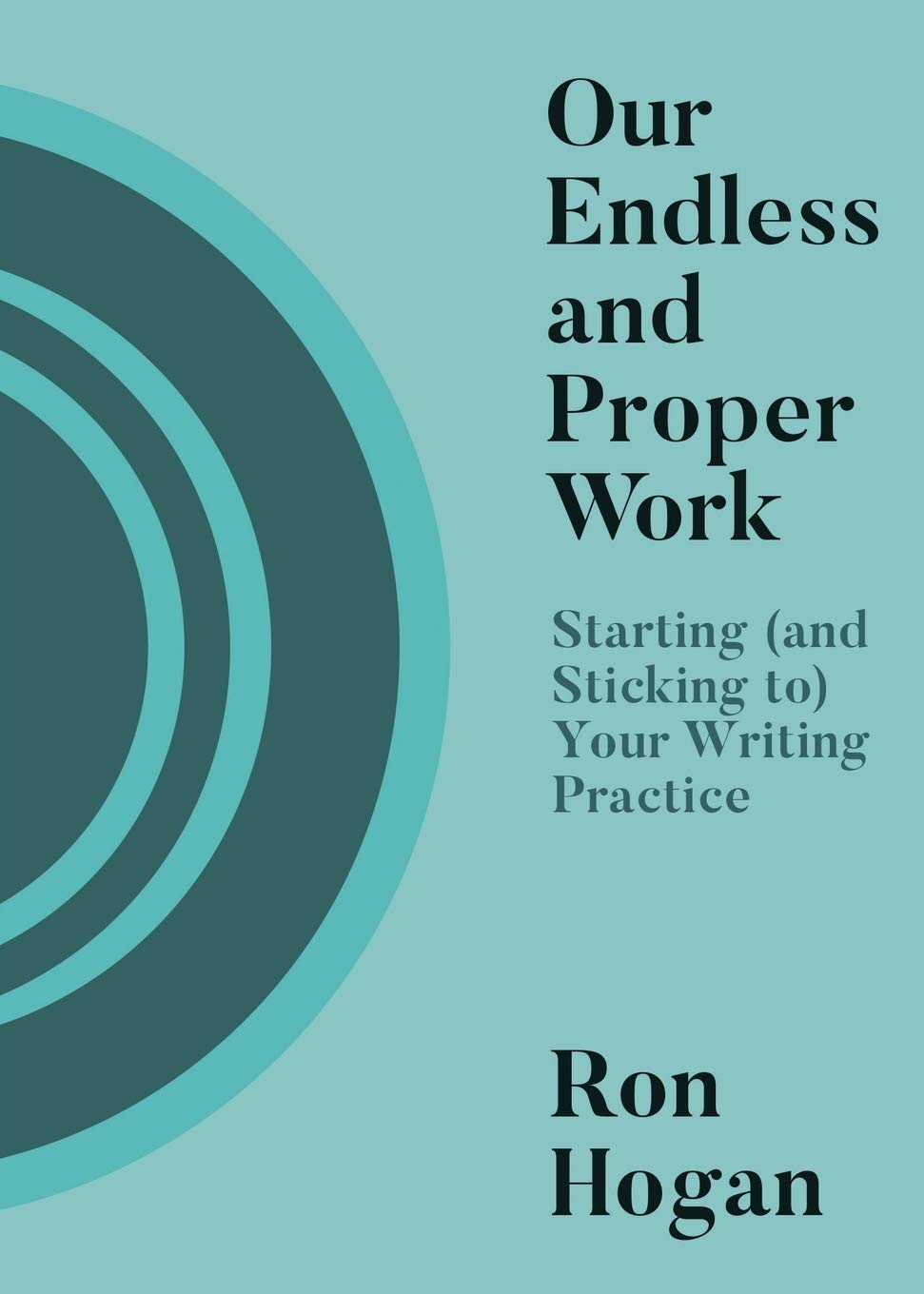 Our Endless and Proper Work is my new book with Belt Publishing about starting (and sticking to) a productive writing practice.