
Sci-Fi Speaks to Our Modern Condition
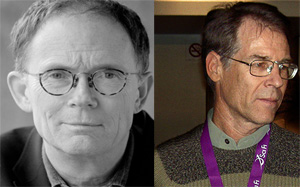 In an interview with The College Crier a month before his new novel, Spook Country, comes out, William Gibson (left) speaks to the cyberpunk world we live in. “When I was writing a novel like Count Zero I would just invent some other level of imaginary technology or invent some part of the back story of my future history that would account for me having a way to scoot past that bit of illogic in the story,” he reflects. “When you’re writing about a present, whether it’s imaginary or not, and there’s some major imaginary elements in Spook Country, the rules are different… I have to come up with something that allows me to suspend my disbelief in my fantastic narrative and which I hope will allow the reader to suspend their disbelief. So actually, it is more work.”
Meanwhile, Kim Stanley Robinson talks to Wired News about the real-world environmental concerns that propel the trilogy of near-future political novels that recently concluded with Sixty Days and Counting. “I’m hoping the scientific community continues to go off like a fire alarm in a hotel, just as they have for the last five years, and that that will do the trick. If they do, the democracies, the political leadership and even big business will all recognize that this is a real threat. And we’re seeing enough of the effects, even without catastrophic weather,” Robinson says. “Even India and China therefore have compelling reasons to get serious. Their own populations will be hammered by the loss of the Himalayan glaciers. So many effects are combining. I don’t think we need the kind of minus-50-degree winter I described in the books. “
9 July 2007 | uncategorized |
Ron Currie, Jr.: The Brat Who Killed God
I love God Is Dead, the debut novel from Ron Currie, Jr. Well, it’s more of a collection of linked stories, really, pitch black comedies in the George Saunders vein about what happens to human civilization after God comes down to Earth as a Dinka woman, is shot dead during military unrest in Darfur, and eaten by a pack of feral dogs. (Hint: It doesn’t go well for anybody, not even the dogs.) As the continuity unfolds, the world transforms in bizarre ways, but no matter how outrageous the circumstances, the emotional cores of these stories work. And now Currie’s going to explain how the stories all came together. It’s not the answer I was expecting, but it makes perfect sense…
His legs pumped in protest, mini-sneakers drumming the base of the restaurant booth. His face was red with the effort of sustained screaming. He shoved and slapped at his father with his adorable little hands. He was sitting right next to me. I had murder and a bacon cheeseburger on my mind. In that order.
The kid’s father, though, was the very picture of patience. He was an obvious believer in the progressive parenting philosophy that exchanges corporal punishment for repeating requests—in this case, “Eat your dinner, please”—a thousand times to no effect whatsoever. And then, as a last resort, unleashing the dreaded “time out.”
But this kid had long since sacked and pillaged the time out. He was psychotic. He had superhuman reserves of furious energy. And rather than box the little bastard’s ears and tell him he had two choices, eat or starve, the father continued trying to bring him under control by absorbing one-two combos and murmuring in soothing tones.
What should a normal person do when he bears witness to such a mind-numbing example of parental overindulgence? Roll his eyes and shake his head, most likely. Exchange whispered comments with his companions. At most, maybe ask to be re-seated on the far side of the dining room, away from the offending brat, or else just get up and walk out in a lame protest no one will notice anyhow. Any of these, even the last, would probably be considered a normal reaction.
Going home and writing a book probably would not. Nevertheless, that’s what I did.
6 July 2007 | guest authors |
 Our Endless and Proper Work is my new book with Belt Publishing about starting (and sticking to) a productive writing practice.




