
November 12: Deb Olin Unferth & Diane Vadino

Come see Deb Olin Unferth and Diane Vadino in the last “Beatrice @ the Merc” reading of 2008! Since its launch earlier this year, the series has turned into a popular new venue for New York City readers to discover debut novelists.
Diane Vadino (Smart Girls Like Me) was the inaugural main staff person at McSweeney’s; she has also worked as a waitress, Daily Show intern, and professional shampoo-ist. Her writing has appeared in magazines including Marie Claire, Spin, Good, and Allure, as well as in her fashion blog bunnyshop.org, named by Real Simple as one of the Web’s best. She lives in Brooklyn.
Deb Olin Unferth (Vacation) is a University of Kansas professor and Pushcart Prize winner. She has been published in Harper’s, NOON, 3rd Bed, McSweeney’s, Fence, and other places.
9 November 2008 | events |
Louis Bayard’s Secret History of Crime Fiction
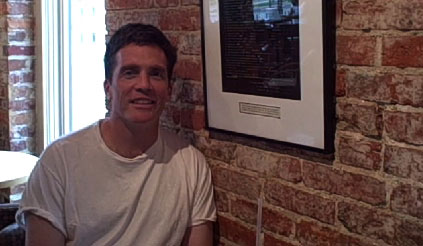
In the last five years, since the publication of Mr. Timothy, Louis Bayard has become one of our leading authors of historical thrillers—but, he told me when we met in Washington, D.C., last month, “It’s not a niche I ever defined for myself. I just walked right into it.” After writing two contemporary gay romantic comedies in the 1990s, he had a literary itch that he simply couldn’t resist scratching: “All I know is that I wanted to write about Tiny Tim, and I wanted to do bad things to him.” After the success of that book, Bayard turned to one of crime fiction’s founding fathers, Edgar Allen Poe, for The Pale Blue Eye, and now, in The Black Tower, he has turned to Eugène François Vidocq, who rose to prominence as one of post-revolutionary France’s first criminal investigators.
“I was toiling through an idea for a novel about Franz Mesmer that wasn’t going where I wanted it to,” Bayard explained, when his editor at William Morrow, Marjorie Braman (who has since become the editor in chief at Henry Holt), suggested Vidocq, a name that Bayard had first encountered during the research for The Pale Blue Eye—he’d been curious that Vidocq was apparently so familiar to 19th-century readers that his name could be dropped without any explanation. “The more I learned about him, the more he intrigued me,” Bayard continued, until he decided Vidocq “should be put in the genre he helped create.”
20 October 2008 | interviews |
 Our Endless and Proper Work is my new book with Belt Publishing about starting (and sticking to) a productive writing practice.




