
Lady Jane’s Salon: Lauren Willig & Jenna Petersen

Last month, I helped launch Lady Jane’s Salon, a new reading series in New York City dedicated to romance novelists that is also a monthly fundraiser for Share the Love, a nonprofit organization that donates “gently used” romance novels to women’s shelters and other institutions that serve women in need. The first reading went really well, as nearly three dozen attendees raised about $100 (and donated about 50 books), and tonight we’re headed back to Madame X (94 W. Houston St.) to hear from Lauren Willig and, with our fingers crossed that the snow will abate with enough lead time to bring her flight into Newark, Jenna Petersen. We’ll start a little bit after 7 p.m., snow or no snow; the admission is $5 or as many books as you care to donate.
(My role is primarily that of host; the bulk of the credit for organizing the series goes to novelists Maya Rodale, Hope Tarr, and Leanna Renee Hieber.)
2 March 2009 | lady jane's salon |
Elizabeth Novickas Welcomes You To Gavelis’s Vilnius
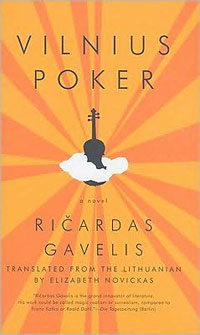 I’m a big fan of Open Letter Books, the University of Rochester-based press that specializes in bringing literature-in-translation to American readers, and as I write this I’m working my way through their edition of the Lithuanian novelist Ricardas Gavelis’s Vilnius Poker. About the time I started reading, I came across an essay written by the novel’s translator, Elizabeth Novickas, for the literary magazine Calque. Novickas and Calque co-editor Steve Dolph were kind enough to allow me to excerpt the essay on this blog—if you obtain the issue in which it appears, you’ll be able to read an additional passage illustrated by photographs of Vilnius (Lithuania’s capital) and an excerpt from the novel (plus new translations of work by Paul Celan, Osip Mandelstam, and many others).
Exploration, whether it be of the human psyche or faraway places, is one of the primary joys of reading fiction. But as a reader, under normal circumstances, we never come as close to the text itself as a translator does. Although reading Ricardas Gavelis’s Vilnius Poker is in itself a startling, sometimes horrifying, sometimes head-spinning experience, I found it a pure joy to explore the depths of Gavelis’s writing, to observe just how carefully he structured his plot and even the cadence of sentences, how phrases and words reappear in different contexts in different meanings, and how, despite the crushing overall impression of grimness, the work contains such outstanding black humor.
And yet humor is only a single layer of the multiplicity of this work, parts of which are still a mystery to me. What, for example, to make of all the preposterous claims the major protagonist, Vytautas Vargalys, makes for his father? Some weird metaphor? A Freudian fantasy? A Lithuanian wet dream? The suspicion that Gavelis is merely yanking our chains comes only at the end of the episode, when Vargalys finds his father drinking while rolled up in a carpet, and out comes an outrageous pun about a snail in his shell (kiliminam name: in a portable/carpet home).
Ultimately it is the author’s integrity, grounded in the reality of location and time, and shining forth from every page, that carries the reader through the mysterious, the preposterous, and the unexplainable. When asked to come up with a summary of what the book is about, or a single section that could characterize it, I find myself groping at so many things that I’m completely at a loss. Yes, I suppose one could summarize something of the plot: there is a murder, a love story, four narrators, a number of characters, a more or less concrete time frame, and most certainly a concrete place, but how to include that time also goes around in circles, and on two occasions actually stops? And what to do with details of the plot that get told over and over, so that in the end you hardly know which version to believe, much less how to describe it?
The best I can come up with, without writing a doctoral thesis on the subject, is also the simplest: this is a piece of fiction about life. The four narrators are all flawed people, but they are all people nevertheless, including the last narrator—the reincarnation of one of the characters as a dog. They make us squirm at their rawness, cringe at the depth of their self-deceptions, laugh at their stories, and in the end, when we see what cards they have been dealt, break our hearts.
1 March 2009 | in translation |
 Our Endless and Proper Work is my new book with Belt Publishing about starting (and sticking to) a productive writing practice.