
Literary Crosstraining With Laura Lippman
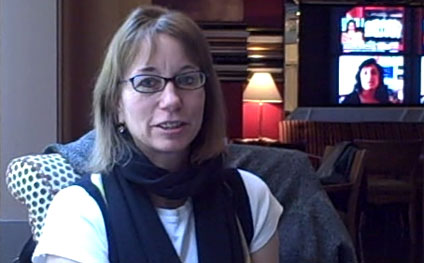
“Last year was insane, and I still feel like I’m trying to catch up,” Laura Lippman tells me as we chat in a café next to the offices of HarperCollins, which has published her novels under the William Morrow imprint for the last 15 years. In addition to writing Life Sentences, a stand-alone novel about a bestselling memoirist whose research into a criminal case involving one of her former classmates digs up all sorts of unsettling information, Lippman also agreed to write a 15-chapter serialized novella starring Tess Monaghan, the reporter-turned-private-eye Lippman introduced in her debut novel, 1997’s Baltimore Blues, and has stayed with for several sequels—interspersed with stand-alone novels, to be sure, but never in such a compressed time frame. (And that’s not even counting the short story collection, Hardly Knew Her, that came out last fall.)
When she was invited by the New York Times Sunday Magazine to write a serial, she sought the advice of two writer friends, Michael Connelly and Ian Rankin, who had previously taken part in the project: “I was hoping to be told it was okay to blow it off,” she laughs, but they assured her she really ought to take the paper up on the offer. So, although she doesn’t usually work from an outline, in order to make the serial fit into her schedule, she worked out the overarching narrative for 11 of the 15 chapters—but, to keep things surprising for herself, she decided each chapter would have its own mini-story…which she’d only discover while she was writing. She does, however, confess to slightly “cheating” on the serial format, in that she wrote the entire novella in advance, rather than on a week-by-week deadline. “I’m just too fond of revision,” she says.
“Life Sentences is one of the toughest books I’ve written,” Lippman added. “There were some really depressing days during the final draft.” She’s worked with the same editor, Carrie Ferron, since Baltimore Blues, and describes Ferron’s guidance as Socratic: “Carrie will tell me something is needed, but she won’t tell me the solution… For this novel, I took all the memoir sections [written in Cassandra’s voice] and put them in one document, and it came to 14,000 words. That was way too much.” She edited the material down by nearly half—6,000 words gone by the time she was through— “It was hard, but it was absolutely the essential thing to do. I’m always trying to acheive that feeling you get when every single word on the page absolutely has to be there, that it had been weighed and tried and earned its keep—and, sure, there’s plenty of times when that didn’t happen, but I still keep trying.”
23 March 2009 | interviews |
Beatrice @ The Merc: Gitty Daneshvari, Daphne Uviller & Jean Hanff Korelitz

Beatrice.com’s reading series spotlighting debut novelists continues at the Mercantile Library Center for Fiction (17 E 47th St.) on Wednesday, March 25, with Gitty Daneshvari (The Makedown) and Daphne Uviller (Super in the City)—and a special appearance by Jean Hanff Korelitz, who’ll be reading from her latest novel, Admission.
The reading begins at 7 p.m., and books will be available for sale during a wine reception afterwards.
Gitty Daneshvari was born in Los Angeles to an Iranian father and an American mother. As a child she talked incessantly, feeling the need to comment on everything around her. While at first charmed by her verbose nature, her family soon tired of the constant commenting. This is how she found writing—it was better than talking since she didn’t even need anyone else to do it with. She currently lives in New York City and yes she still talks too much.
Daphne Uviller co-edited, with Deborah Siegel, the acclaimed anthology Only Child: Writers on the Singular Joys and Solitary Sorrows of Growing Up Solo. She is a former books/poetry editor at Time Out New York, and her reviews, profiles, and articles have been published in The Washington Post, The New York Times, Newsday, The Forward, New York, Oxygen, Allure—and Self, for which she used to write an ethics column. A third-generation West Villager, Daphne lives in New York City with her husband and two children.
Jean Hanff Korelitz grew up in New York City and attended Dartmouth College. She always wanted to be a writer and was first published at age seventeen, when she wrote an article for Seventeen about her cousin Helene Hanff, author of 84, Charing Cross Road. After college, Korelitz spent four years in England and Ireland, first at Cambridge University and later, with her husband, the poet Paul Muldoon. They moved back to the U.S. in 1987 and now live in Princeton, where Muldoon is a professor of creative writing.
18 March 2009 | events |
 Our Endless and Proper Work is my new book with Belt Publishing about starting (and sticking to) a productive writing practice.




