
Lynne Griffin: Literary Mother-Daughter Time
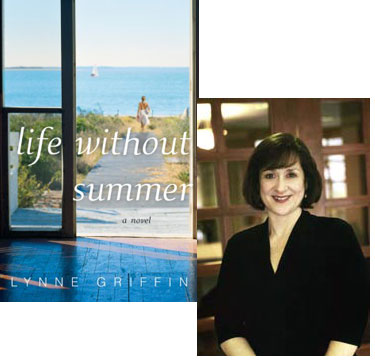
In this special Mother’s Day essay, Lynne Griffin discusses the ways books have helped her bond with her daughter over the years, up to and including the writing of her debut novel, Life Without Summer.
From the time she was able to sit her little body upright, my daughter held tight to a book. I can still picture her in that baby carrier pretending to read her first board book, Teddy’s Garden. As a family educator, I’d been telling parents for years that a love of reading can and should be nurtured. While I still believe this to be true, for my daughter, the passion for books is as innate as the color of her eyes.
In the beginning, I’d capitalize on her interest in books by placing her in a stroller at naptime, thinking whether she slept or didn’t, I’d be able to buy some bookstore or library time. I could poke around collecting titles for my to-be-read list. Invariably she’d resist sleep, instead intent on “reading” her own book—turning the pages delicately, always with the care of a librarian—giving me all the time I needed to make my selections.
In her early childhood, late in the afternoon, I’d act as if my number one priority were good role modeling, when in fact I was merely in need of a break from the rigors of parenting a little one. I’d tell her it was time to collect a stack of books and meet me on the living room couch for some quiet time. In minutes, she’d be as engrossed in her picture or chapter books as I was in the latest hardcover novel I’d purchased.
Until she was a self-sufficient reader, my husband and I would read countless books to her; always before bed, on long car rides, or during dinners that involved foods she didn’t care for. Reading provided an almost magical distraction. We became fans of library visits, books on tape, and book swaps with family and friends.
Like every good parent, I couldn’t wait for the day when she would display her talent for independent reading. Though as she gained skill—always holed up in her room, or parked under a tree, even walking through the house lost in a book—I feared I was losing something. Lovingly crafted, ours was a relationship made closer because hard working authors carefully chose the words placed on those pages. I wasn’t ready to relinquish our special bond made possible through reading together.
10 May 2009 | guest authors |
Christian Moerk and the Trouble with Inspiration
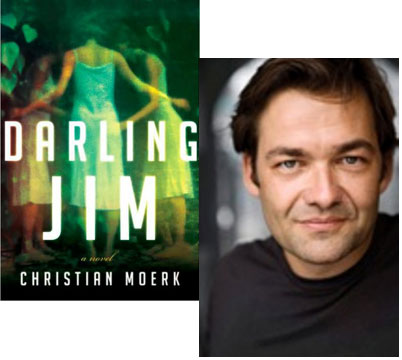
Earlier this week, over at GalleyCat, I had the privilege to post an original Howard Chaykin illustration—a representation of an image described in the final paragraphs of Darling Jim, the debut novel from Christian Moerk. And now, I get to present Moerk’s behind-the-scenes perspective on everything that led up to the words that inspired that drawing. I hope his story will lead you to, well, his story.
I’ve always had a hard time relating to the notion of “inspiration,” in which writers by the very act of going to work are supposedly gifted with something that descends upon them from above and becomes a holy entity of which others should be appropriately respectful. C’mon, you know exactly what I mean: writers looking heavenward while they drone on about where their “inspiration” leads them, or how finishing a book has made them grow as human beings. It’s as if this ethereal propulsion drives their fingers and not the other way around. “Inspiration” is like a handsome dinner guest you can’t start eating without.
That’s bunk, of course. So is the phrase “my process,” unless you develop photos for a living.
The problem for me, I think, lies at the heart of what “inspiration” is supposed to be—for many, the very residence of “creativity” (another close second in the c’mon-shut-up category). So in discussing Darling Jim, I’d like to explain, as honestly as I can, how the work itself sneaks up on you and becomes more important than what the writer has to say about it. To be blunt: it’s the story, not the writer, which is supposed to be interesting.
9 May 2009 | guest authors |
 Our Endless and Proper Work is my new book with Belt Publishing about starting (and sticking to) a productive writing practice.




