
Moving John the Baptist from “Opening Act” to Headliner
Brooks Hansen’s new novel, John the Baptizer, was published just shy of two weeks ago, on John’s feast day. But when we met in a café near the offices of his publisher, W.W. Norton, to discuss the book, he confessed early into the interview that he had not been a big fan of the Baptist attending Mass as a child. “I didn’t really buy this guy,” Hansen recalled. “He seemed angry, he seemed cartoonish… he felt like an opening act. What you’re taught to understand about John doesn’t make sense when you’re a little boy—his willingness to point at Jesus and then withdraw. It was only in returning to the story later in life that I felt compelled by him.”
(For more about what drew Hansen to John’s story, be sure to watch the video interview embedded above or on YouTube.)
There are some distinct challenges to building a story around John, however. “The second you make him the central character,” Hansen explained, “Jesus becomes the bad guy, the guy who comes in and steals the spotlight.” In fact, one of Hansen’s primary sources for his version of events was the sacred writings of the Mandaeans, a religious group that reveres John the Baptist as its greatest prophet and Jesus as a false messiah who betrayed John’s teachings. That doesn’t necessarily mean, however, that Hansen’s novel contradicts Christian doctrine. “Even the most controversial aspects of the story I’m telling are found in the Gospels,” he said. “And John’s story concludes before Jesus’ death and resurrection, so you can explore John’s story entirely without having to address the central Christian issue.”
In addition to the Mandaean scriptures and the Christian gospels, Hansen also drew upon the Roman historian Josephus (particularly when it comes to the Herods). Altogether, he spent seven years writing John the Baptizer, although he admits some of that time was spent working on another project. “But the only way of getting away with this was to tell the story as if I knew it like the back of my hand,” he confided. “You can’t shoot from the hip with this story.” As far as I’m concerned, he’s done a fantastic job—in prose that recalls the majesty of scriptural language but remains modern enough to engage contemporary audiences. But don’t just take my word for it: You can listen to Hansen reading excerpts from the novel on YouTube, starting with the fate of John’s head.
5 July 2009 | interviews |
How “The Scarlet Ibis” Helped Peter Neofotis Find His Voice
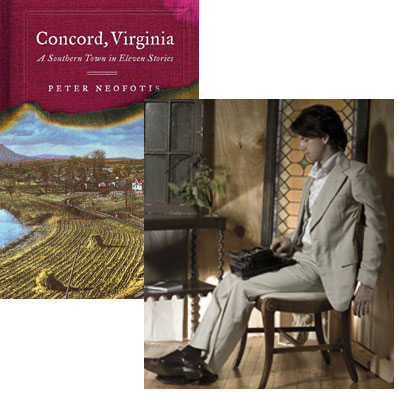
For the last three years, Peter Neofotis has been performing his short stories in various venues around New York City—all of them set in a fictional community which gives his debut collection its title: Concord, Virginia: A Southern Town in Eleven Stories. As I was reading the first stories, given that one of them is about a Korean War veteran fending off an inquisitive reporter’s attempts to get him to say something inspiring for the young men heading out to Vietnam, I made assumptions about Neofotis’s age that proved completely off base; turns out he’s still on the young side of 30. And yet his voice is already clearly identifiable as his own, and it’s unlikely, once you’ve read one or two of his stories, you’d mistake any others you come across for anybody else’s. When I asked if he would discuss his literary inspirations, he picked a story that helped shape both his writing and his performances.
I have just reread James Hurst’s “The Scarlet Ibis,” and once again, it has made me weep—just as it did when I read it in my high school freshman English class ten years ago. I remember the entire class—a very mixed bunch in a public high school—had been moved by the story. Mrs. Lynda Gray, a terrifyingly brilliant teacher, even cracked a tear when she read a few lines from its pages:
“It’s strange that all this is still so clear to me, now that that summer has long since fled and time had had its way…”
The tale behind the “The Scarlet Ibis” is as lonesome and beautiful as the story itself. James Hurst wrote it in his 30s, a few years after taking a job at a bank, to express his grief over his failed career as an opera singer. And though it is his only writing to ever receive national attention, it was a phenomenal success: first published in The Atlantic Monthly in July 1960, it won the magazine’s annual fiction prize then, as Hurst has commented, “took on a life of its own” and has been republished in several anthologies. Often, it is used to teach symbolism. For the death of the stray scarlet ibis foreshadows the death of the narrator’s frail but wondrously lucid brother Doodle.
“the sick-sweet smell of bay flowers hung everywhere like a mournful song…”
1 July 2009 | selling shorts |
 Our Endless and Proper Work is my new book with Belt Publishing about starting (and sticking to) a productive writing practice.