Meg Gardiner: An Amnesia Plot You Won’t Forget
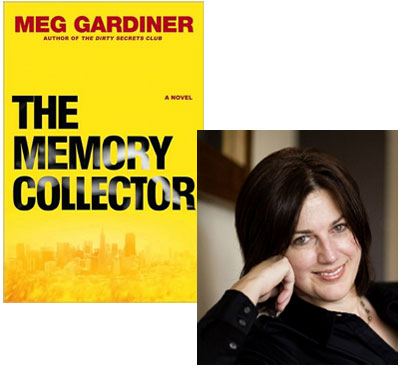
Like many American thriller fans, I was introduced to Meg Gardiner two years ago, when Stephen King praised her to Entertainment Weekly readers after devouring her novels, which were only available in the U.K. at that point. It didn’t take long for her to find a publisher in New York—and, in addition to publishing the backlist that got King so excited, Dutton has also launched a new series from Gardiner, the second installment of which, The Memory Collector, has just come out. You may recognize one of its initial premises, which she explains below, from the movie Memento, but you’ll soon find that she’s taking the concept in a different direction…
Jo Beckett analyzes the minds of the dead. She’s a forensic psychiatrist who performs psychological autopsies in cases of equivocal death. When the police and medical examiner can’t determine why someone has died, Jo digs through the victim’s past to ascertain whether the death was natural, accidental, suicide, or homicide. She calls herself a deadshrinker.
But in The Memory Collector Jo has a live patient. She handles the case as she would a psychological autopsy because Ian Kanan has short-term memory loss and can’t tell her what’s happened to him.
Anterograde amnesia—short-term memory loss—leaves old memories intact but destroys the ability to form new ones. Ian Kanan remembers everything about his life, right up until he suffers a brain injury. Thereafter, nothing sticks in his mind. Every few minutes, all the information he’s just gathered, all memory of his current experiences, simply fades. He can’t learn anything new. He can’t remember where he is or what he’s doing.
The idea for Kanan, the security contractor whose short-term memory has been destroyed, grew out of my brother’s true life experience working with brain-injured people. One man had short-term memory loss caused by a motorcycle crash. Every few minutes the man’s memory would evaporate. No matter how many times my brother saw him, the man always shook hands and introduced himself. At a rock concert, he continually shouted in surprise, “It’s the Grateful Dead!” The man was intelligent and personable. But he couldn’t remember from hour to hour what was going on. He didn’t even realize that he was forgetful.
So I thought: What if Jo were faced with a patient who can’t form new memories—and he’s a dangerous man? All Ian Kanan’s skills and military training, all his lethal abilities, are intact. If he disappears, planning to hunt down his enemies, could Jo track him down? If she found him, how could she stop him? Even if she convinced him to call off his vendetta, within minutes he’d forget, and pick up his gun again.
Then I thought: What if his memory loss is being caused by a contagious agent? What if he can infect others?
That was the genesis of The Memory Collector.
10 July 2009 | guest authors |
Glen David Gold: Fame, Fame, Fame, Fame
Before we get started, Glen David Gold has embraced Futility, and he wants you to know all about it:
“My great-aunt Ingrid was Charlie Chaplin’s neighbor,” Glen David Gold explained to me as we met for iced tea last month before a bookstore appearance for Sunnyside, his first novel since the bestselling Carter Beats the Devil. (Yep, it’s been eight years!) “Family legend has it she wrote his autobiography—well, he did read his drafts to his neighbors and then take their suggestions.”
Sunnyside is, among other things, the story of how Charlie Chaplin weathered the blows to his public image during the First World War, and taking on Chaplin is a natural follow-up to writing about a character inspired by Harry Houdini, as Carter was. “Houdini was the first ‘most famous person in the world’ in the modern sense of the term,” Gold said. “He was famous because of his act, and Chaplin was his successor—but I knew there was a difference in the quality of their fame. I just wasn’t sure what it was at first…. A lot of his biographies are well-written, but they get to a certain point and they just throw their hands up.” He eventually realized why; it was a point in Chaplin’s life at which his fame had simply spiraled beyond his ability to shape it. “I grew up in Los Angeles,” Gold continued, “so I’ve seen fame happen to people. I’ve seen how gravity realigns around them when they enter the room. So what would it be like to be the first person that had happened to?”
Gold’s exploration of the relationship between the audience and the artist—between the spectacle and the spectator—led some early reviewers of Sunnyside to complain that the novel was too complicated, or required readers to connect too many dots themselves. Gold has taken the complaints in stride. “Some people complained Carter was too fun,” he observed. Citing Dos Passos as an example, he described a storytelling strategy that makes room for historical digressions: “You move off to the side and have faith that the forward momentum comes with the reader’s engagement in the world you’ve created.”
Another source of inspiration comes from John D. MacDonald, whose Travis McGee novels helped Gold realize the importance of giving readers a solid footing in early scenes so they’ll trust you when you begin to knock them off center as the story progresses. And when I mentioned that what I’d read of the novel so far reminded me of Ishmael Reed’s Mumbo Jumbo in its playful treatment of history, Gold’s eyes lit up; he studied under Reed in his graduate creative writing program. “Ishmael was very playful,” he recalled. “but I also admire his ability to both critique and empathize simultaneously. He did not speak with contempt, even of the most contemptible characters… Writing was obviously to him one of the resaons to get out of bed.”
It doesn’t take much to see how fully Gold has inherited the attitude. I love Sunnyside, and I can’t wait to get back into the rest of it.
8 July 2009 | interviews |
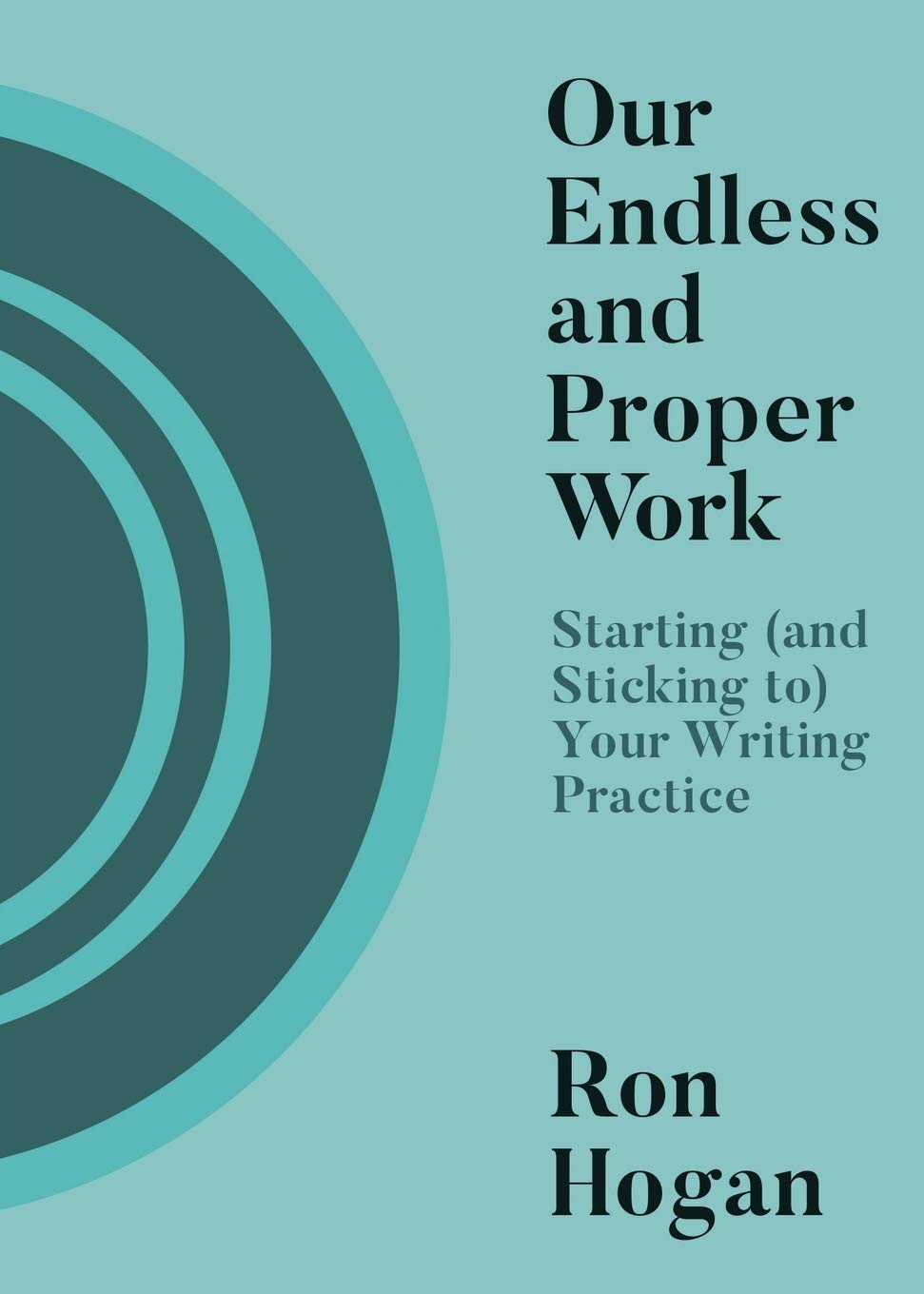 Our Endless and Proper Work is my new book with Belt Publishing about starting (and sticking to) a productive writing practice.