New Yorker Taps a New Generation of Faves
 The New Yorker announced the roster of its new list of “20 Under 40” fiction writers of particular esteem, and The New York Times got the scoop:
“They are Chimamanda Ngozi Adichie, 32; Chris Adrian, 39; Daniel Alarcón, 33; David Bezmozgis, 37; Sarah Shun-lien Bynum, 38; Joshua Ferris, 35; Jonathan Safran Foer, 33; Nell Freudenberger, 35; Rivka Galchen, 34; Nicole Krauss, 35; Yiyun Li, 37; Dinaw Mengestu, 31; Philipp Meyer, 36; C. E. Morgan, 33; Téa Obreht, 24; Z Z Packer, 37; Karen Russell, 28; Salvatore Scibona, 35; Gary Shteyngart, 37; and Wells Tower, 37.”
There are some great writers on this list—I’m already a fan of at least five of them—and of course we all have our ideas about who ought to be on this list and isn’t: I would’ve been delighted to see Cory Doctorow, or Megan Abbott, or Lauren Van den Burg, or Ron Currie, Jr., but that’s the sort of debate that makes these lists an entertaining parlor game, no more meaningful (or meaningless) than trying to put together your fantasy baseball team. Rather than the last word, this should be a conversational jumping-off point, an opportunity for all of us who love great writing to share our favorites with each other and make new discoveries.
I will say, however, that I found the Times‘ choice of headline—”20 Young Writers Earn the Envy of Many Others”—profoundly disappointing; it may well be the case in the days to come, but I think it’s a rather shabby sentiment to launch the list with, although it may tell us much about the ways in which the Times views the contemporary literary scene.
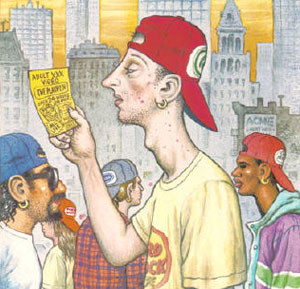
Robert Crumb’s parody of New Yorker icon Eustace Tilley from a 1994 cover
2 June 2010 | uncategorized |
Kimiko Hahn, “Pinguinus Impennis”

Large, flightless, and defenseless,
the great auk was captured
for feathers for featherbeds—
hunters loosening the plumage in cauldrons
fueled with the oil
from the freshly killed auks before them.
After the 1830 volcanic eruptions in Iceland, after
museums and collectors vied for the near
extinct “penguin of the North,”
in 1844, the last pair was beaten to their deaths
and their solitary egg dashed on the rocks of Eldey Island.
Could we not sleep on straw or goose-down?
What dreams are worth such extinction?
And are they dreams I’d wish to own?
Toxic Flora is the eighth collection of poems from Kimiko Hahn; other poems from the collection include “Cope’s Rule” (from W.W. Norton’s Poets Out Loud site), “The Fever” (The New Yorker), “Xenicus Longipes” (Poetry Daily), “The Sweetwater Caverns” (Academy of American Poets), and “Bumblebees” (OnEarth).
In an interview with Bomb, Hahn talks about using stories from the science section of the New York Times as inspiration: “All my material issues from deep and very personal concerns whether it’s for girls to be able to express anger or the melting of glaciers. I am both a poet who writes about what moves me—but I am also a citizen who has opinions.” Further explanation comes from an interview with the Wall Street Journal: “I grew up in a family of artists not scientists, so for me the language of science is very exotic, the way Japanese words might be exotic for someone else. So that exotic interesting language is what immediately triggers excitement in me. And then understanding what these concepts are and trying to be clear about the concepts but at the same time figuring out what that has to do with my life both literally and figuratively, that is to say in terms of metaphor. So science articles and issues have been percolating and I’m very proud of how chiseled the poems are and I hope they honor the original essays that I’ve drawn from.” Finally, in an essay for Poets Out Loud, Hahn offers insight into the sequencing of poems in the collection.
1 June 2010 | poetry |
 Our Endless and Proper Work is my new book with Belt Publishing about starting (and sticking to) a productive writing practice.