
Ellen Bryson’s Dream of Bearded Ladies
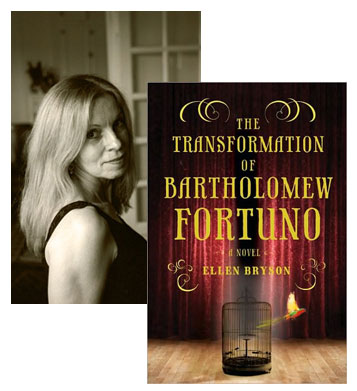
The Transformation of Bartholomew Fortunato is narrated by “the World’s Thinnest Man,” one of many “Curiosities” living and working in P.T. Barnum’s downtown Manhattan museum in the spring of 1865. Bartholomew has a very elevated sense of his calling, but his self-image has quite a few blind spots, which come into play when his own curiosity is aroused by the arrival of a bearded lady to the museum; his fascination with her coincides with Barnum’s own desire to keep tabs on his latest star attraction. Ellen Bryson says the idea for her debut novel came to her in a dream—followed by a bout of research that led her to photos of Barnum’s cast. But, she explains, the character that spoke to her in a dream was not the one whose voice would give the novel its shape…
The Transformation of Bartholomew Fortuno started with an image of six bearded sisters in a circus tent. I’d just finished Angela Carter’s amazing novel Nights at the Circus—there’s nothing better than a book about bawdy burlesque women—and drifted off to sleep. I woke up at 3:00 that morning to a vision of six fabulous sisters lined up in the shape of a half moon, their bearded faces lifted to the tent’s canvas ceiling. One after the other, they shouted out their names, a spotlight glimmering off their cheekbones and their luscious beards.
Today, I remember only two names: the first, Esmeralda, a spry young thing who still whispers to me for space on the page. The second was Iell. I can still see her calling out “Iell,” her beard a stunning, burnished red, her face the face of an angel. I couldn’t take my eyes off her. How could a woman with a beard be so beautiful? And so feminine? As the rest of the sisters dissolved into a sepia background, I couldn’t help but wonder if others would see her beauty or only see the beard? What would it have been like to be her? What was her story?
Iell will tell me, I thought. But, for the life of me, no matter how clearly I could see her, Iell would not speak.
28 June 2010 | guest authors |
Maxine Kumin, “Virgil”

He came, a dog ausipiciously named Virgil,
homeless, of unknown breed but clearly hound
barking at scents, aroused by hot ones to bugle.
His first week here he brought three squirrels to ground
and lined their mangled corpses up on the grass
to be—why not?—admired before burial.
He gobbled the snottiest tissues from the trash.
Also, he swiped our lunches off the table.
He knew not sit or stay, has still to take in
that chasing sheep and horses is forbidden.
When reprimanded, he grovels, penitent.
He longs for love with all his poet’s soul.
His eyebrows make him look intelligent.
We save our choicest food scraps for his bowl.
Where I Live: New & Selected Poems 1990-2010 also includes “Looking Back in My Eighty-First Year” (from the Norton Poetry Out Loud website), “The Word” (orginally published in The Atlantic, republished online with other poems from her early career), ” and “The Nuns of Childhood: Two Views” (The Atlantic). It doesn’t have “How It Is” (Poetry Foundation website), but that’s still a good poem.
Two years ago, in an interview with The Christian Science Monitor, Kumin (while advising her interlocutor to ignore Virgil’s antics) describes her arrival at “a point in life where it would be easy to let down my guard and write simple imagistic poems,” adding: “But I don’t want to write poems that aren’t necessary. I want to write poems that matter, that have an interesting point of view… Twenty years ago, I thought Denise Levertov was wrong to write political poems, that she would lose her lyrical impulse. But I’ve changed my mind; I didn’t write my poems because I wanted to, they were wrung from me. I had to write them.”
25 June 2010 | poetry |
 Our Endless and Proper Work is my new book with Belt Publishing about starting (and sticking to) a productive writing practice.