
Author2Author: Samantha Bruce-Benjamin & Brando Skyhorse
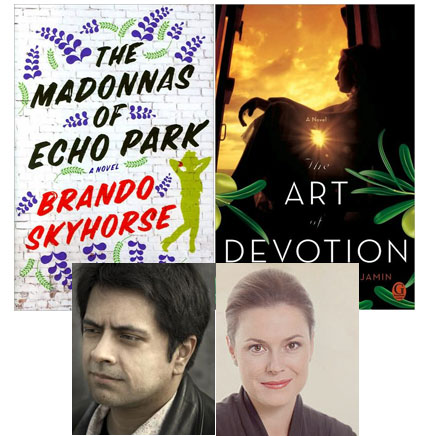
It’s not true that every editor in the publishing industry has a book in them, but it does happen, and this summer we happen to have two fine examples at hand, Brando Skyhorse‘s The Madonnas of Echo Park and Samantha Bruce-Benjamin‘s The Art of Devotion. I invited the two to ask each other about their experiences as they became published authors—they had plenty to say on the subject, so let’s get right to it…
Brando Skyhorse: Being an editor was an invaluable education in making me a better writer. Do you remember a specific instance where a particular edit offered key ideas in how to approach your own writing?
Samantha Bruce-Benjamin: There was an occasion where I found myself having to do what all editors must at one point in their careers: rewrite someone’s novel for them. Initially, I was thrilled to be asked. Then I read it.
If this particular author used the word “cried” once, then it was used 20,000,000 times—every single page of a 560-page manuscript. Also, everyone “turned,” sometimes “crying” and “turning” all at the same time:
“Give me the techno-diffuser zapper,” the bad guy cried, turning.
“No,” Agent X – the good guy – cried, turning back.
“I mean it. Give it to me now,” he cried louder.
“Will not,” Agent X turned, crying louder than him….…You get the picture. I also imagine that you may suspect I am joking. I am not.
5 July 2010 | author2author |
Read This: Africa United
 If you’ve been following me on Twitter for the last two weeks, you know that I’m a huge fan of the Ghana Black Stars, and that I was rooting hard for them to defeat Uruguay this afternoon and advance to the World Cup semifinals. (Dominic Adiyiah was robbed, and that’s all I’m going to say about that, except that I’m cheering for the Netherlands next week.) I watched the game at Papaye, a Ghanaian restaurant in the Bronx, and during the subway ride up and back, I finally had an opportunity to finish reading Africa United, a book about thirteen of Africa’s national soccer teams (but not, unfortunately, the Black Stars) and how their fates are intertwined with the various political situations.
Steve Bloomfield watches a lot of African soccer, but he also spends a lot of time talking to the local league officials, or recounting how regimes would use a team’s rising fortunes for their own propagandistic ends. (That cuts both ways, though; one of my favorite anecdotes is of a Zimbabwean protest speech that went: “Today Robert Mugabe we are showing you the red card! Get off the field Robert Mugabe!”) When you hear about something like the Ivory Coast’s football success helping to resolve tensions between the country’s warring northern and southern regions, it’s hard not to be moved. But for all its optimistic moments, I wouldn’t call this a feel-good book—Bloomfield is forthright about the politics, and about the problems that African footballers face in competing at a global level, and he’s certainly not saying that football is going to make Africa a democratic utopia. Analysis isn’t really the point, though. What matters here, what will stick with you, is the ground-level perspective on a part of the world that’s undergoing massive upheavals—political, economic, cultural—because it’s that perspective, that intimate glimpse into the lives that are being changed, that helps us understand this much better why Africa matters.
2 July 2010 | read this |
 Our Endless and Proper Work is my new book with Belt Publishing about starting (and sticking to) a productive writing practice.