
Maggie Pouncey’s Perfect Reader at Greenlight Bookstore
 I’ll be at Greenlight Bookstore tonight for another installment of our monthly “Author/Blogger” series. This time around, it’s a hyperlocal affair, as Robin Lester of Clinton Hill Blog interviews Brooklyn-based Maggie Pouncey, who will be reading from her debut novel, Perfect Reader. As always, we’ll also be fielding questions from the audience—and since it looks like it actually might not rain this month, I hope those of you reading this in New York City might be able to make it. (The reading starts at 7:30 p.m.; Greenlight is right at the Lafayette St. stop on the C line, and very close to the Atlantic Avenue nexus for several other subways.)
I’m catching up with the back half of Perfect Reader this afternoon; it’s a great story about a twentysomething woman who’s struggling to deal with her father’s death, the situation exacerbated by his designation of her as his literary executor—including a collection of unpublished poems he wrote about his love for a girlfriend she never knew existed—who’s very eager to see those poems published.
12 July 2010 | events |
Watch This: World Cup Soccer in Africa: Who Really Wins?
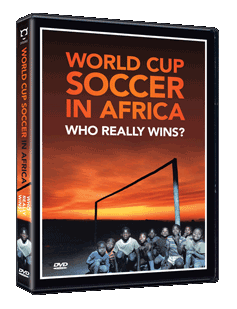 An hour or so after the World Cup ended—and congratulations to Spain; that was a fantastic goal—I popped a documentary that I’d received last month, World Cup Soccer in Africa: Who Really Wins?, into the DVD player and started watching. One of the themes that I’d been noticing in the Cup coverage was the idea that South Africa was “proving” that it was capable of hosting an international sporting event of this magnitude; American media were particularly falling over themselves in these last few days to enthuse about what a wonderful time they’d had and how beautifully everything had gone. This documentary casts the issue in a slightly different light: It doesn’t question whether South Africa could handle the Cup, and it doesn’t deny that doing so will bring lots of international prestige. What it does ask is: Is it worth the cost?
The film’s most significant line of attack is on the $1.7 billion-dollar project to build multiple stadia across a nation still in need of more components of a basic civic infrastructure, like hospitals and schools—in one case, a local school was actually displaced by a new stadium. Several of the commentators and activists interviewed point out that these arenas, built to FIFA specifications as to what constitutes a world-class football venue, are grossly oversized for South Africa’s regional sporting needs; the term “white elephant” is introduced reluctantly at first, but is used with greter regularity once the theme is introduced. From there, the big question is: What happens to South Africa after FIFA collects its television revenues and sponsorship fees and leaves the country? What, if any, long-term economic benefit will South Africa see from hosting the Cup? (The argument is not one-sided; the filmmakers do allow those who believe South African tourism will last beyond the tournament their say, and though Archbishop Desmond Tutu acknowledges that the situation is not perfect, he pitches this as a major step forward for the country.)
Here’s the trailer…
11 July 2010 | watch this |
 Our Endless and Proper Work is my new book with Belt Publishing about starting (and sticking to) a productive writing practice.