
Damon Galgut & The Fiction of Memory

Damon Galgut’s In a Strange Room is marketed as fiction; heck, it was on the short list for this year’s Man Booker Prize, which is awarded to the year’s best fiction (at least among those written by citizens of the Commonwealth of Nations or the Republic of Ireland). But its three sections are about the travels of a South African man named Damon. I didn’t want to fall into the trap of assuming an autobiographical aspect to a work of fiction, I explained to Galgut as we met at Housing Works Bookstore last week, but… “it’s about a man named Damon, who’s South African,” he filled in, smiling slightly.
“My project in this book was to tell the truth,” he explained. “There’s no invention, strictly speaking. It’s me remembered as honestly as possible… how the journeys unfolded and how my relationships with my traveling companions changed.” When The Paris Review began to publish the sections, an editor there asked Galgut how they should be labeled: Were these travelogues? Were they memoir? Were they stories? “I couldn’t really answer that question… The Paris Review made the decision to run it as fiction, and I’ve become more happy with that choice over time.”
As he sees it, consciousness relies upon memory and memory is, at heart, an act of fiction: “In narrating to ourselves the story of our lives… we tend to join the dots. Stories are about giving meaningful structure to a set of events.” The emphasis on recounting his memories as accurately as he could also led Galgut to the unusual narrative voice of In a Strange Room, which frequently shifts perspectives within a single paragraph. “Sometimes you’re back there in the moment,” he explains, “and sometimes you’re a stranger to yourself, watching yourself in the past.”
The three stories also explore what Galgut describes as “the full complex of human relationships,” from power dynamics to love and guardianship. (And though each section is named with one of those elements in mind, all come into play in each section in varying degrees.) It can take a while to get used to the voice, but once you adjust to the unstable ground and accept Galgut’s best recollections in good faith, it is a… well, happy isn’t the right word; let’s say it’s a highly rewarding experience.
23 November 2010 | interviews |
Read This: Lord of Misrule
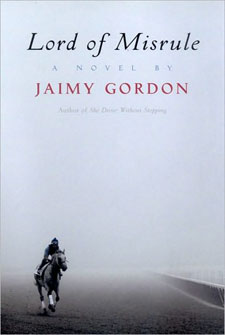
When Jaimy Gordon’s Lord of Misrule was announced as the winning fiction at last week’s National Book Awards, the first reaction in the ballroom was stunned silence (well, except at the tables of Gordon’s publishers). I assume that’s because very few people in that audience had had the opportunity to read the novel—officially, it hadn’t actually come out until two days before the awards ceremony, and even most reviewers hadn’t gotten their hands on advance copies until after the nominees had been named in mid-October. I’d gotten hold of a PDF, so I’d started reading the novel, and I knew it was good, but for technical reasons, it was not a convenient way to read the book all the way through, so it wasn’t until this weekend, with a finished copy in hand, that I finished, and I can assure you: Lord of Misrule is a damn good book and anybody who tells you it doesn’t deserve the National Book Award is somebody whose future literary recommendations you can safely ignore.
(Oh, sure, there’s the popularity contest aspect of analyzing these sorts of literary competitions to consider; heck, either of the other two nominees I’ve read so far also deserved the award, and so did several other books that weren’t even in the running. But saying any of those books could have won doesn’t, at least the way I see it, mean this book shouldn’t have won.)
The flap copy for Lord of Misrule invokes authors like Nathanael West, Eudora Welty, and Damon Runyon—my own take would probably be closer to a mix of Damon Runyon and David Goodis. The story is set at a racetrack and stables in West Virginia, (just this side of the Ohio border), the sort of track where owners bring their run-down horses, the has-beens and the also-rans, aiming to make their money at the claiming races. Gordon quotes Ainslie’s Complete Guide to Thoroughbred Racing to explain the principle of the claiming race:
“When he enters his animal in a race for $5,000 claiming horses, the owner literally puts it up for sale at that price. Any other owner can file a claim before the race and lead the beast away after the running. The original owner collects the horse’s share of the purse, if it earned any, but he loses the horse at a fair price… if it is a $5,000 horse.”
There’s also some opportunity to win some good purses with horses with long odds that run better than anybody else knows to give them credit for, and that’s part of what brings Tommy Hansel and his girlfriend, Maggie Koderer, to Indian Mound Downs. Their continued presence stirs up some long running tensions around the track; Two-Tie, a loan shark who’s been banned from the track but still keeps a hand in the game, has his reasons for keeping an eye on Maggie, while the local big cheese, a trainer named Joe Dale Bigg, develops his own interest in her (and one of her horses). You’ll also want to keep your eye on Medicine Ed, the groom who’s been around for ages, seen everything, and is just about ready to get out (except, of course, there’s no way he’ll ever be able to afford to leave). Gordon shifts nimbly from one perspective to the next, and creates just enough suspense around the four races that form the narrative’s backbone to keep you guessing. (Although there are exciting climaxes on—and off—the track, this novel is arguably more about buildups and letdowns than it is about payoffs.)
Maybe it’s not your standard noir, but if Lord of Misrule hadn’t been published by McPherson & Co., an independent press out of upstate New York, I could easily see it as a paperback original from Hard Case Crime… with a much more “pulp” cover, natch. (It’s sort of a shame Hard Case isn’t doing the paperback, although of course it’s wonderful for Gordon that she’ll have the resources of Vintage behind her, and a deal with Pantheon for the next book, too.) I’m thinking mainly of the atmosphere: not just the fluid boundary between legal and illegal activity, but the pervasive sense of fatalism even when things seem like they’re looking up.
I hear tell that David Milch and Michael Mann are working on a new series for HBO set at a race track; that’s as good an approximation as I can think of for what Jaimy Gordon has achieved here. As I say, there may be novels you’ve read this year you like better, but you can’t deny this is great stuff.
22 November 2010 | read this |
 Our Endless and Proper Work is my new book with Belt Publishing about starting (and sticking to) a productive writing practice.




