
Amelie Nothomb: From Tokyo to Manhattan
“Japan is perhaps the most important country of my life,” Amélie Nothomb said, sitting in a sidewalk café shortly before the opening ceremonies of the PEN World Voices Festival last week. She was born in Japan (her parents were Belgian diplomats) and lived there until she was five, but those early experiences stayed with her as the family moved to China, the United States, and on to several other nations: “I kept saying that I was Japanese, that one day I would go back to my country.” In 1989, at the age of twenty-one, she got her chance. “Two years later, I escaped after a professional catastrophe and a love disaster,” she continued; she wrote about her work experience in an autobiographical novel called Fear and Trembling published in 1999, but it wasn’t until 2007 that she published the book which was eventually translated into English as Tokyo Fiancée.
“I think it’s much more difficult to write about happiness than to write about any other subject,” Nothomb explained, “so I needed almost twenty years to be able to talk about it.” It took her far less time to digest the humiliation she endured at her job, where she’d eventually been assigned a position as a washroom attendant, than the good times she had with Rinri, a young man who originally hired her as a private French tutor. The scenes from their relationship in Tokyo Fiancée don’t always seem happy—his parents can be insufferably condescending; he invites all his friends to meet her, then vanishes into the kitchen and makes her fend for herself conversationally—and finally she realizes that he’s serious about wanting to marry her and she’s just as serious about not wanting to marry him. Still, she puts off telling him no because, as she writes, “to refuse would have meant breaking up, something I did not want.” She does enjoy his company, after all, and it’s only when the pressure to marry becomes too stifling that she flees to her sister’s house in Belgium.
4 May 2011 | interviews |
Ellen Elias-Bursac & Albahari’s Amusing Leeches
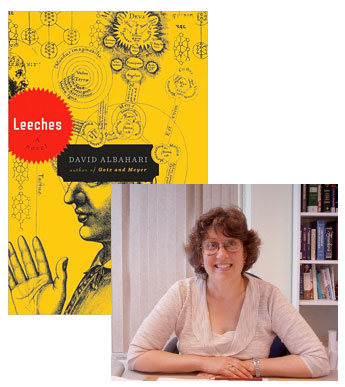
Ellen Elias-Bursaċ has plenty of experience translating the Serbian author David Albahari—her English-language version of his novel Götz and Meyer won the ALTA Translation Award and was tapped for the Barnes & Noble Discover promotion, which is no mean feat for a translated novel, let me assure you. So when a former colleague sent me a copy of Albahari’s latest, Leeches, I thought it would be interesting to hear from Elias-Bursaċ about what attracts her to Albahari’s stories.
Leeches is a thriller, narrated from an undisclosed location outside of Serbia, reprising events that transpired in the spring of 1998 in wartime Belgrade and building to the months just before the NATO bombing campaign. The narrator’s position of exile links it to much of Albahari’s writing during the 1990s, when he was situating his protagonists in Canada (Bait, Snow Man, Globetrotter) and dealing with the war at a continental remove, but, in contrast, the story the narrator tells us in Leeches is situated directly in Belgrade, smack in the middle of the war.
The suspense generated by the thriller format works well to convey the atmosphere of suspended animation in the year before the NATO bombing. Suspended animation is, perhaps, the best way to describe the bated-breath atmosphere the novel creates. In fact the protagonist (never named) and his best friend, Marko, get stoned at frequent intervals throughout the novel. It’s not only their spacy highs and disjointed conversations, but the actual holding of breath in the process of getting high, that typifies for me the feel of the novel. This sense is further enhanced by the format of a single paragraph for the whole novel.
Spacy highs notwithstanding, the novel does not sidestep the reality it addresses. Unlike Götz and Meyer, which refracts questions of wartime responsibility through World War II, Leeches takes on the Miloševiċ regime and the culture it spawned front and center. His protagonist is a Serbian writer who finds himself embroiled in a mysterious, sometimes mystical, chase after an elusive beautiful woman, Margareta, and a mysterious, regenerating manuscript tied in various ways to the Jewish communities of Belgrade and Zemun (a city just across the Danube from Belgrade), and, perhaps, to the protagonist himself. Not so elusive are the neo-Nazi repercussions to his involvement with Jewish themes: attacks on his person, his apartment, the newspaper he works for, that ensue after he begins writing in his regular newspaper column about the plight of Serbian Jews.
The context of the tense, grim story line makes the fact of the humor of Albahari’s writing all the more striking. It’s the humor that motivates me, as a translator, to translate David Albahari’s writing. His protagonists are often rather solemn, first-person characters, usually urban intellectuals, seldom named. While never bumblers, Albahari’s protagonists are often bewildered by what happens to them and their innocence of the obvious brings a dark laughter to the bleakest of situations.
29 April 2011 | in translation |
 Our Endless and Proper Work is my new book with Belt Publishing about starting (and sticking to) a productive writing practice.