
Adriana Hunter: Discovering Fresh Climates
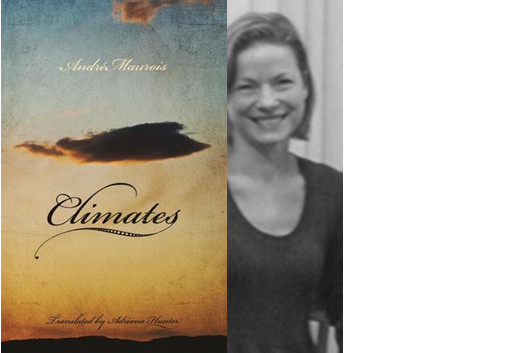
photo: Peirene Press
Over the last decade or so, Adriana Hunter has become one of the leading English-language translators of contemporary French literature, but with Climates, she’s taken on something new, or rather something not so new—André Maurois wrote Climats in the late 1920s, and it was a bestselling sensation not just in France but throughout Europe when it was first published. (At the time, it was brought to the United States as Atmosphere of Love; in the 1980s, a new translation appeared under the title The Climates of Love.) In this guest essay, Hunter talks about the challenges she faced in making a novel that’s nearly 85 years old “fresher” while staying true to the language conventions of the era.
My “way in†to translating any book is its narrative voice. I hear a voice and get a feel for its tone, rhythms and word patterns. André Maurois’s Climates of Love was a little more complicated because there are two narrators, Philippe and Isabelle, as well as less formal extracts from Philippe’s private notebooks and from letters. On top of this, there is the question of period: Climates was written in the 1920s, and my publisher had asked me to update the prose, making it feel fresher but without anachronisms (infatuation and jealousy probably feel the same now as they did a century ago, but other sensibilities and constraints in the book are very specific to the characters’ era, and I was keen to respect these).
Having previously translated only contemporary writers, I found the question of period and anachronism an enjoyable new challenge. In Maurois’s original, even the dialogue can sound like writerly prose whereas in a lot of contemporary fiction even the prose sounds like colloquial dialogue. I wanted to strike a balance, making the prose accessible but still with the poise and restraint of another era. I hope this sentence from the first page illustrates this:
“That is the charm of new acquaintances: the hope that, in their eyes and by denying the truth, we can transform a past that we wish had been happier.â€
Which might have sounded more natural as:
“That’s what’s nice about meeting new people, you can always hope that—if you deny the truth yourself—you can make them believe your past was happier than it was.â€
This is a perfectly valid translation, but look at those modern contractions (that’s what’s), those muscular dashes around a clause and that gangling repetition of “wasâ€. It just doesn’t sound like someone from Philippe’s background in the 1920s.
10 December 2012 | in translation |
C.P. Boyko on “Rock and a Hard Place”
 C.P. Boyko’s Psychology and Other Stories is full of deep character studies, like the sexually confused boarding school student of “Reaction-Formation” or the sociopathic escaped mental patient of “Eat the Rich and Shit the Poor.” Boyko settles into his stories, then slowly explores their edges—at novella length, he can afford to take his time. Earlier this year, he read a short story by another Canadian writer he found equally immersive, which he tells us about here.
I have become disenchanted with first-person narration, but “Rock and a Hard Place” by Trevor Clark (in his collection Escape and Other Stories) makes me believe in it again. The story is desultory without being maundering, the narrator candid without sounding pompous or declamatory, and the voice gritty and realistic without resort to a prose that is sloppy or illiterate. The story is packed with event—it is written as a sort of unabashed confession by a 29-year-old single mother trying to quit smoking crack—and at the end of thirty dense, harrowing pages, one feels as if one has heard her entire life story. That’s quite a feat. Here are two typical paragraphs:
I remember this lease-breaking party I had so I could move out of my apartment. The neighbours were used to me cranking up my stereo, but I think they were all afraid to complain because they’d heard me yelling and ranting so often. I really outdid myself that night. A little while ago I ran into this guy I know who told me he’d never forget it. I asked, “Were you there?”
“Was I there? I was in the middle of doing a hash toke on the stove with hot knives when all the power got cut off.” The superintendent wanted to close down the stereo so he blacked out the apartment. People were throwing beer bottles, glasses, and just about everything off the balcony. They still wouldn’t break my lease, though.
There are some other great stories in this collection, too.
9 December 2012 | selling shorts |
 Our Endless and Proper Work is my new book with Belt Publishing about starting (and sticking to) a productive writing practice.