Kyle Minor Studies “A Field Guide…”
Kyle Minor won honorable mention for both fiction and poetry in the 2005 Atlantic Monthly competition, and second place for nonfiction in the 2004 contest. He’s currently working on a memoir, a novel, and a book-length poem, excerpts from all of which have turned up in journals such as Quarterly West, Mid-American Review, River Teeth, and the McSweeney’s website. All this before he’s even completed the M.F.A. program at Ohio State… In this contribution to our ongoing series of essays by short story writers, Kyle takes a close look at one of his favorites: Wallace Stegner’s “”A Field Guide to the Western Birds,” which can be found in Stegner’s Collected Stories.
I love bombast. Fireworks. Language that walks the tightrope while cannon fire fills the air all around. Barry Hannah, Jonathan Lethem, Cormac McCarthy. That sort of thing. Dazzle. Energy. Power.
But there are other kinds of power. I’ve lately been reading again through Andre Dubus, Marilynne Robinson, Alice Munro, Wallace Stegner. Our contemplatives. I could throw out some words, capital-A Abstractions like Dignity, Gravity, Transcendence. Words we use when we try to approximate the readerly sensation that begins faintly at the tips of our toes or in the burnings of the soft cartilage of our ears, and moves slowly toward the center of our bodies, building in intensity, building to the crescendo of the newly aching heart, the loosened tear ducts, the head bowed under the weight of the terrible knowledge that what is complicated is also true.
I’m most taken with Wallace Stegner’s long story “A Field Guide to the Western Birds,” the story that introduces us to retired literary agent Joe Allston, narrator of many of Stegner’s finer novels, including The Spectator Bird.
6 February 2006 | selling shorts |
Patrick O’Keeffe Gets “Carried Away”
I’m launching a new essay feature on Beatrice this week, in which short story writers will be invited to comment upon their favorite short stories or short story writers. It’s called “Selling Shorts,” which is an admittedly egregious pun, and probably a bit mercenary for a bookblog, but I hope it’ll come to grow on you—and the authors will be swell, at any rate.
First off, I’ve invited Patrick O’Keeffe, whose The Hill Road is [UPDATED: the winner] of the second annual Story Prize. He graciously agreed to contribute an essay about Alice Munro’s “Carried Away,” which can be found in the collection Open Secrets.
“Take what you have gathered from coincidence”—Bob Dylan

Alice Munro, in Open Secrets, resembles Tolstoy, in that she convincingly gives you the entire social structure of a place, in her case the town of Carstairs, from top to bottom, each character from the inside out. “Carried Away,” Louisa’s story, is constructed around a set of bizarre, though plausible, coincidences. Louisa is initially a commercial traveler; she later becomes the public librarian, and receives letters from Jack Agnew, a soldier in the First World War. She sends him a photograph, falls deliriously in love with him, but when he returns from the war, he marries the dull, conventional Grace. Louisa, unlike Grace, possesses “some consciousness of herself as a heroine of love’s tragedy.” Jack, however, was engaged to Grace before he went off to the war. He sneaks books out of the library, but never approaches Louisa, whose love for a man she has never seen persists. There is an indication of mythology, of legend, to all this.
Once an outsider and a stranger in the town, Louisa, as time passes, ends up doing well for herself, because she marries Arthur Doud. The Doud family owns the piano factory, which is the town’s chief employer. One afternoon, Arthur visits the library to return Jack Agnew’s books, given to him by Jack’s wife, Grace, after Jack is beheaded in an accident with a mechanical saw in Arthur’s factory. Louisa doesn’t tell Arthur about Jack, and a new episode in both of their lives begins.
24 January 2006 | selling shorts |
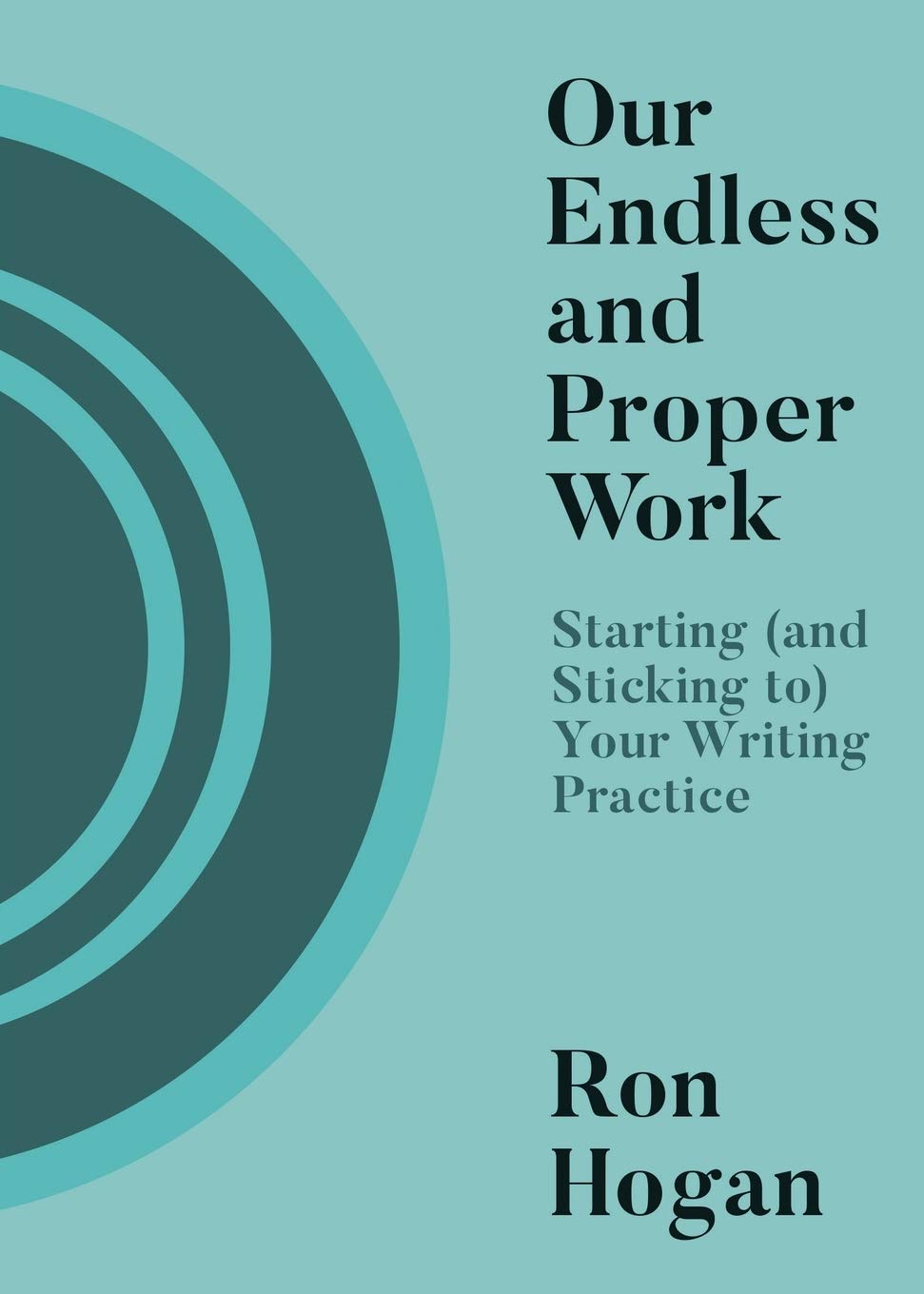 Our Endless and Proper Work is my new book with Belt Publishing about starting (and sticking to) a productive writing practice.