
Nalini Jones’s Short Story Mix Tape
Although most “Selling Shorts” guest writers zero in on a single story that has moved or inspired them over the years, sometimes it’s hard to narrow the field down to just one. Nalini Jones, the author of What You Call Winter, has her own dream anthology, and today she’s given us a peek into her selection process. I have a feeling that some short story writer about twenty or thirty years into the future might be adding some of Nalini’s stories from this debut collection to his or her own wish list…
In college, in a fit of archival spirit, I tried to gather my favorite songs on a single mix tape. One became two, two became three, and a week later I’d created a series of over a dozen, which I eventually gave to my uncle. I imagine they might still be in my grandmother’s house, the cases scratched and dusty, the tapes themselves relics of a particular moment in my history.
My mix of stories changes all the time—with a few anchors, of course. I cannot do without Eudora Welty’s “June Recital.” Loch’s plight, shut up in a room to nap while a whole glorious world awaits exploration, is so nuanced, so minutely imagined, that we are immediately rooted both in a southern town and in a small boy’s sensibility. By the time we look through his telescope, our eyes have adjusted to Morgana; every line is saturated with a sense of place. And I love Miss Eckhart, whose passion for music is so great that even trifles—the sashes for recital day—are swept up in its tide.
Chekhov’s section has grown to include “Gusev,” for the sense, as it ends, that nothing is quite final. The quiet matter of Gusev’s death, the way we slip with his sailcothed body into the water, the sudden encounters with pilot fish and the shark, and the final view of the ocean, indifferent and lovely, all take us beyond what seem to be the original parameters of the story—the life of Gusev. There is a sense of our opening into a new world even as his life closes. In the dark pitiless waters, we’re shown life swimming in and around his death, and then, as we leave Gusev and return to the surface, Chekhov gives us a glimpse of the beautiful light that transforms the ocean into something “tender” but nameless “in the language of men.” That gesture toward mercy, toward hope, never fails to move me. It strikes me as intensely generous.
3 November 2007 | selling shorts |
Roy Kesey Lingers in “The New Automaton Theater”
Roy Kesey‘s All Over is technically the second book from new independent publisher Dzanc Books; the first was a reprint of Kesey’s novella Nothing in the World just a few months ago. Tonight he’s in New York, reading at the Happy Ending series with Ben Percy and Min Jin Lee, but before that, he wants to share with you his enthusiasm for Steven Millhauser…
Impossible thing, this thing about a favorite! Can other people do this? Who are these people, these favorite-havers, and with which sort of knife do they cut the list down to one?
But, okay. So. Speaking of knives: Steven Millhauser, The Knife Thrower, “The New Automaton Theater.” Because, how does he do that?
By which I mean: the story is a house of cards, but not the usual kind: it is a reverse pyramid balanced on a single card.
By which I also mean: this story walks blindfolded to the end of the gangplank, and we hold our breaths. The swords unsheathed just in case, the eye-patches and parrots and peg-legs, et cetera: the story wipes the sweat from its inky brow, and steps forward for the last time on earth. Except it doesn’t fall. Instead, it takes another step. And still doesn’t fall. Another step. Another. Still not falling, and now it starts to jog.
By which I really mean: this story, this new automaton theater, it expands and expands beyond its already ingenious premise until we almost (but never quite) want it to stop expanding so that we can get our heads around what just happened in that paragraph right back there. The narrator starts off talking about real historical objects that exist at the far edge of our capacity for understanding and wonderment–the mechanical songbirds of Hero (or Heron) of Alexandria, the mechanical duck (four hundred separate pieces per wing! Fully functional intestines!) of Jacques de Vaucanson—and then says that in his (the narrator’s) town, such things are small beer. Now, that is not a hard thing to think or write. But Millhauser actually imagines and describes these farther machines, and then farther, and then farther.
24 October 2007 | selling shorts |
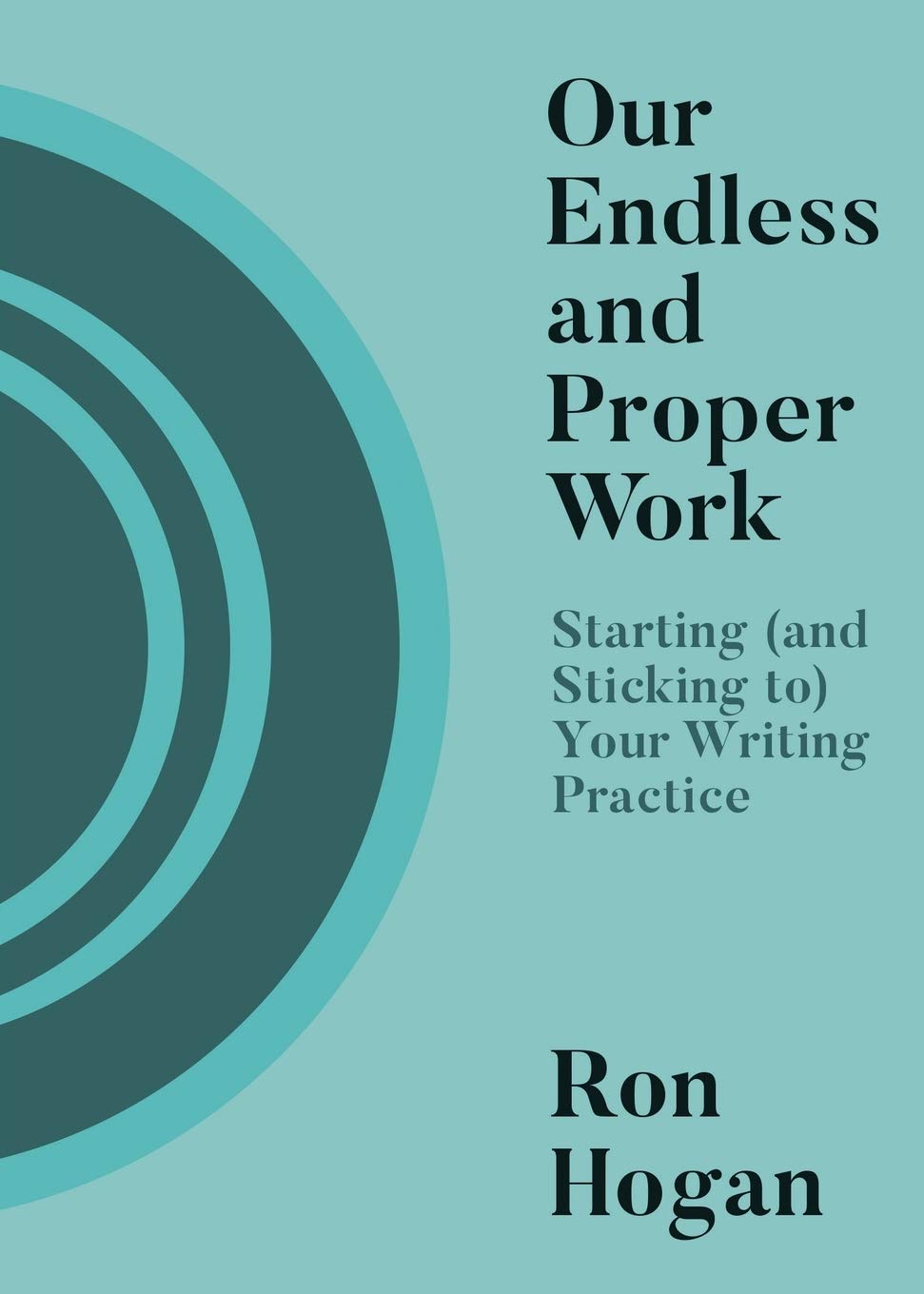 Our Endless and Proper Work is my new book with Belt Publishing about starting (and sticking to) a productive writing practice.